SYNOPSIS
Mrs. Teasdale is a wealthy widow who will donate $20 million to the cash -
strapped country of Freedonia, but only if the nation's elected leaders will
agree to make Rufus T. Firefly the nation's dictator. Firefly is
duly appointed, but instead of managing Freedonia's affairs, he attempts to woo
the wealthy Mrs. Teasdale into an affair of their own. Meanwhile, a rival
suitor and the ambassador from neighboring Sylvania, Ambassador Trentino, hires the sultry Vera Marcal to seduce Firefly so that
he himself will have a shot at wooing and marrying Mrs. Teasdale, thereby
annexing Freedonia for Sylvania. To aid his romantic espionage, Trentino hires
Chicolini, a peanut salesman, and his mute friend Pinky as spies, a move that precipitates a war breaking out between Freedonia
and Sylvania.
Producer: Herman J. Mankiewicz
Director: Leo McCarey
Screenplay: Bert Kalmar, Nat Perrin, Harry Ruby, Arthur Sheekman
Cinematography: Henry Sharp
Film Editing: LeRoy Stone
Original Music: Harry Ruby, Bert Kalmar
Cast: Groucho Marx (Rufus T. Firefly), Chico Marx (Chicolini), Harpo Marx (Pinky), Zeppo Marx (Bob Rolland), Raquel Torres (Vera Marcal), Margaret Dumont (Mrs. Teasdale), Louis Calhern (Trentino), Leonid Kinskey (Agitator), Edgar Kennedy (Street Vendor).
BW-69m. Closed Captioning.
Why DUCK SOUP is Essential
Let's get something straight: If a school that taught you how to be funny in the
movies existed, Duck Soup would be one of the textbooks. With that said,
what makes this Marx Brothers picture so different from all the others, such as
A Night at the Opera (1935)? Why is Duck Soup the essential Marx
Brothers comedy?
When making Duck Soup, the Marx Brothers had no other intention than
making their usual anarchic comedy picture. Groucho Marx attributes the
film's strong satire on war to director Leo McCarey. And with the rise of
fascism in Europe, the release of Duck Soup did seem well-timed,
given that Hitler had just come to power about two months before the film's
general release. But to say that Duck Soup is essential because of
its satire on war would be shortchanging other aspects of the film.
Duck Soup is a crucial chapter in the Marx Brothers' oeuvre because it
marked the best and last opportunity for them to be at their most outrageous.
But more than them running amok in front of the camera (and they had plenty
of experience being let loose in front of an audience in vaudeville and
Broadway), the Marx Brothers made a comedy that was cinematic. Their comedy
avoided the stagey aspects of their early pictures like Animal
Crackers (1930). The Duck Soup plot was absurd, but it was not so
ridiculous that you didn't care what was going to happen to the characters.
This was one aspect of that Irving Thalberg did not abandon when he produced
their next picture, A Night at the Opera (1935), at MGM.
Even more important to the production was the presence of a grade A director by
the name of Leo McCarey, whom Groucho described as the Marxes only first-class
director. More than a "supervisor," McCarey actually directed the picture, in
the sense that he helped to shape it creatively. He came up with Harpo's slyly
snipping scissors, as well as the lemonade seller sequence, a nearly wordless
exchange, for which McCarey drew upon his experience directing silent comedians
like Laurel and Hardy. McCarey was confidant enough in his abilities to allow
the lemonade sequence to take shape through improvisation, a process that took
four days to shoot. It was also McCarey's idea to film the mirror sequence,
based on an old vaudeville routine. It reportedly took only two hours to film.
Finally, Duck Soup is an example of the professionalism that the Marxes
brought to their work, both on the stage and in front of the camera. Look at
the mirror sequence: instead of breaking the sequence up with one of Groucho's
humorous asides, the Brothers shoot the wordless sequence in nearly one take.
Groucho could have easily gotten away with just one joke, but it would have
disrupted what makes the gag so great, and that is the perfect timing. Their
professionalism is also found in the way the Brothers approach music in the
picture. While it may seem a trivial tidbit at first glance, the fact that
Duck Soup is the only film in which the four perform musically together
is not unimportant. Having been trained in the musical arts by their mother,
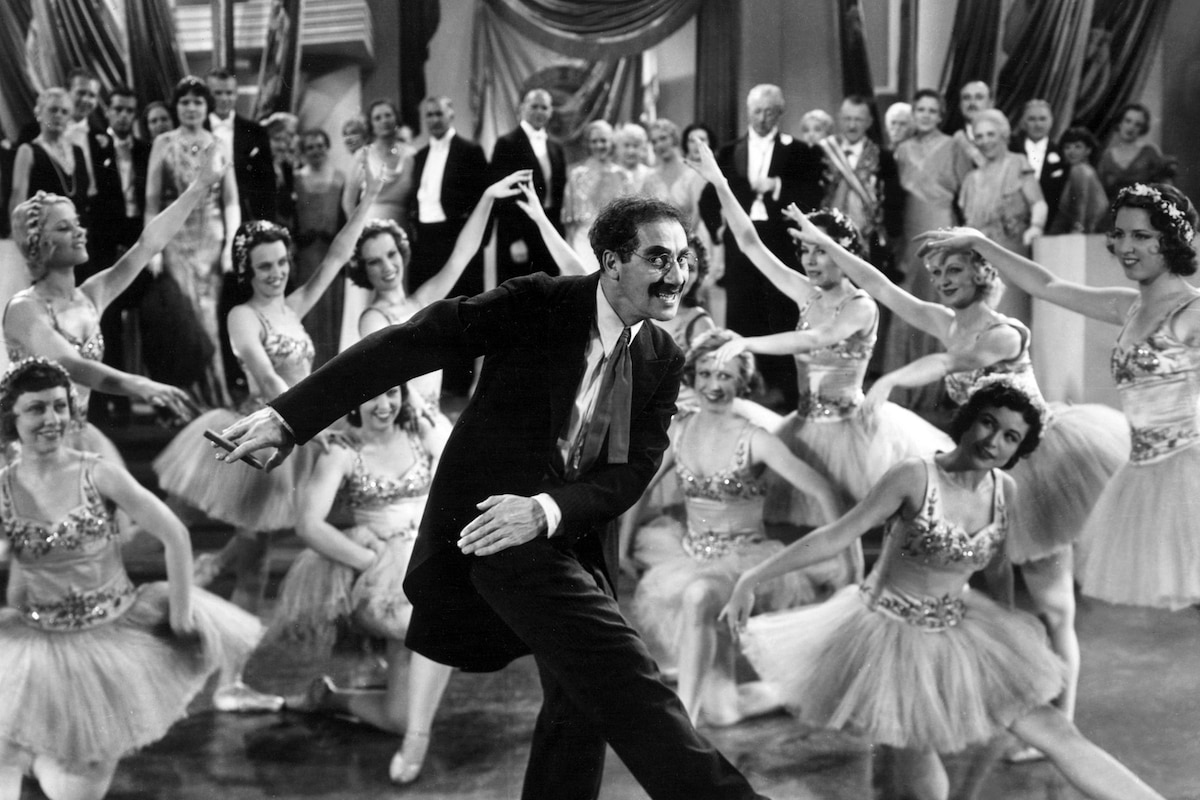
the four took their music very seriously. The final musical number is
carefully choreographed with them front and center, instead of the number
being staged with just an army of scantily-clad women, a l‡ a Busby Berkeley
dance sequence. Overall, the number was not placed in the picture for any
romantic leads to come together, as is usually the case, but rather as a part
of the comedy and satire. While some musical comedies, like the Marxes'
earlier Paramount films, would use the music as an interlude from the comedy,
in Duck Soup the music, the dancing, and everything but the kitchen
sink are tossed into the comic stew.
Duck Soup: The Essentials
March 21, 2006
SIGN UP FOR OUR NEWSLETTERS

CONNECT WITH TCM