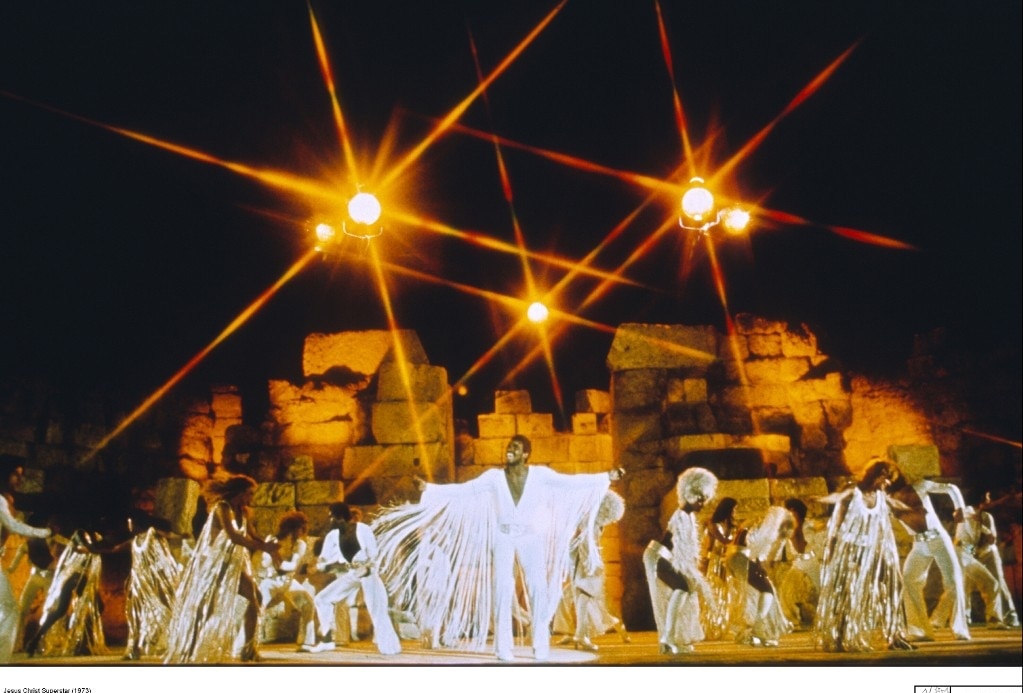
Produced and directed by Norman Jewison, with a screenplay by Jewison and Melvyn Bragg from the book by Tim Rice, Jesus Christ Superstar (1973) was based on the 1970 concept album about the events leading up to the death of Jesus, by Rice and Andrew Lloyd Webber. The album featured Deep Purple lead singer, Ian Gillian, as Jesus, Yvonne Elliman as Mary Magdalene, Barry Dennen as Pilate, Murray Head as Judas, and members of Joe Cocker's backup group, The Grease Band . The next year, the album became a Broadway musical, debuting at the Mark Hellinger Theater in New York, on October 12, 1971. Jeff Fenholt played Jesus, Ben Vereen was Judas (later replaced by Carl Anderson when Vereen fell ill), and Yvonne Elliman and Barry Denner reprised their original roles from the album. Despite protests by religious groups, it ran for 711 performances. One of the minor players who was also an understudy for the role of Jesus was Texas-born rock drummer, Ted Neeley.
Norman Jewison told filmmaker Hal McClure that he had wanted to make the film after hearing the original album while filming Fiddler on the Roof (1971) in Zagreb, but when Jewison cast the film, Ian Gillian was unavailable to play Jesus, due to a prior commitment with Deep Purple. Ted Neeley won the role after a screen test for Jewison with Carl Anderson (who had become a close personal friend) at Pinewood Studios in London. During shooting, Jewison told Neeley and Anderson that he had cast them because he had wanted to see that close friendship on the screen. Jewison cast Yvonne Elliman as Mary Magdalene and Barry Dennen as Pontius Pilate, with Josh Mostel as King Herod.
Made by Universal Pictures, Jesus Christ Superstar was shot on location in Israel at the Bell Caves, Beit Guvrin, the Dead Sea, Pratzim, and Bet Shean, with the soundtrack recorded at Olympic Studios in London. Although the locations gave an air of authenticity, the production was not without its problems. There were several unusual falls: choreographer Rob Iscove fell from the top of an amphitheater in Bet Shean, which resulted in many smashed bones, including his jaw, and many weeks spent hospitalized in Tel Aviv before he could be flown home safely. Alex Thomson, the director of photography, suffered serious injuries when he fell from the camera rostrum, and was replaced with Douglas Slocombe. Production designer Richard MacDonald had a bad fall in the Avdat ruins and was in the hospital for an extended stay.
The desert heat was an issue. According to Jewison, the temperatures soared to nearly 120 degrees during the day, with the cast and crew needing to rehydrate themselves every twenty minutes from giant blocks of ice imported from Tel Aviv. The heat also made it impossible to shoot strenuous dance numbers at any time other than the early morning and just before sunset, because the dancers could only do two or three minutes at a time. The war was another issue. Half the crew would be absent if there was an attack on the Golan Heights because many of them were in the army. It's not surprising that Jewison wrote, "Filming was helped along by a healthy quantity of pot, which was relatively easy to obtain in the Middle East." During their downtime on the weekends, the cast and crew hung out in the Gulf of Aqaba to scuba dive, fish, and drink beer. Despite all the problems, Jewison would come to consider Jesus Christ Superstar to be "the most inventive and visually interesting" of any of his films. "I used all my old live-TV musical shtick. Tremendous zoom shots, great swooping crane movement, and much of the camera work choreographed to the music."
Universal left Jewison alone to make the film, although executive Ned Tannen was sent to check up on production. He was surprised to see no one working when he arrived, having forgotten that it was Yom Kippur, and the crew had three days off to respect the high holy days. According to Jewison, Tannen never saw any of the footage he was promised; he just hung out with Jewison and smoked pot. When he returned to Hollywood a few days later, Tannen told Universal that the production was on schedule and the footage he'd seen was terrific. Jewison later remarked, "That Jordanian weed must have been great."
Norman Jewison offered to work on the film without salary in exchange for a percentage of the gross profits, and to keep the budget below $3.5 million. His feeling was that as producer, director and co-screenwriter, he would deserve a percentage if the film was a success. He got the percentage, calling it "was one of the best deals I ever made in my life."
When Jesus Christ Superstar premiered on August 7, 1973 in New York, it attracted attacks by many Jewish organizations in the United States. Benjamin R. Epstein, the national director of the Anti-Defamation League was worried that young, impressionable people would be influenced. "[T]he movie's sharp and vivid emphasis on a Jewish mob's demand to kill Jesus can feed into the kind of disparagement of Jews and Judaism which has always nurtured anti-Jewish prejudice and bigotry." The casting came under fire as well. "Here the actor portraying Jesus is blond; Judas is black; the priests and rabbis are dark-haired, foreboding, and garbed in black." Universal responded in a prepared statement that Jesus Christ, Superstar was "a rock opera, a musical entertainment, not a religious tract. [...] With every respect for the sincerity and concern expressed, we do not believe their views to be supported by the content of the film or shared by the many millions who have listened to the music or viewed the concert and stage presentations throughout the world since 1970."
According to Ted Neeley, there was some doubt about how the film was going to be released globally. No one had ever filmed a rock opera before and they were unsure of what the demand would be. Jewison was able to show the film to Pope Paul VI, "who openly loved what he saw. He said, 'Mr. Jewison, not only do I appreciate your beautiful rock opera film, I believe it will bring more people around the world to Christianity, than anything ever has before.'"
The backlash, including criticism of then Prime Minister Golda Meir and the Israeli government for allowing the film to be made in Israel with their cooperation, left Jewison feeling "betrayed" by many of his friends. Still, Jesus Christ Superstar made a whopping $23 million at the U.S. box office, and the criticism did not extend to other countries, where it had a good reception.
Roger Ebert gave the film three stars, calling it "a bright and sometimes breathtaking retelling of the rock opera of the same name. It is, indeed, a triumph over that work; using most of the same words and music, it succeeds in being light instead of turgid, outward-looking instead of narcissistic. Jewison, a director of large talent, has taken a piece of commercial shlock and turned it into a Biblical movie with dignity."
Most actors have found playing Jesus to be a curse because audiences can't accept them as anything else. However, Ted Neeley has embraced the role, making a second career out of playing Jesus in Jesus Christ Superstar on stage for the last forty years. Those performances often allowed him to reunite with his close friend, the late Carl Anderson, Yvonne Elliman and Barry Denner. He will be touring with the show in Europe in 2016 and 2017.
By Lorraine LoBianco
SOURCES:
Ebert, Roger "Jesus Christ, Superstar" The Chicago Sun-Times 12 Aug 73
Greenhouse, Linda "Superstar Film Renews Dispute" The New York Times 8 Aug 73
Heaton, Michael "'Jesus Christ Superstar': Ted Neeley talks about the role that changed his career, life" The Plain Dealer 26 Mar 15
The Internet Movie Database
Jewison, Norman This Terrible Business Has Been Goo to Me: An Autobiography
McClure, Hal Hays Adventuring: My Life as a Pilot, Foreign Correspondent and Travel Adventure Filmmaker
Ortega, Shawna "Jesus Christ Superstar: Ted Neeley Tells the Inside Story" Songfacts.com
Sella, Marshall "Is God Ted?" New York Magazine 23 Jan 95
TedNeeley.com
Willis, John Theatre World 1993-1994
Jesus Christ Superstar
by Lorraine Lo | May 19, 2016
SIGN UP FOR OUR NEWSLETTERS

CONNECT WITH TCM