Several of Oscar Wilde's plays and stories - notably Salome, The Canterville Ghost, and The Picture of Dorian Gray - have been adapted to both TV and feature film many times. The Importance of Being Earnest is certainly among the most produced, if not the record holder: four times on the big screen, including a 1937 German-language version, a little-known all-black 1992 version featuring Brock Peters, and the big-budget 2002 remake starring Colin Firth, Rupert Everett, Reese Witherspoon, and Judi Dench; and countless TV versions in Spain, Germany, Sweden, and two credited to the BBC in 1937 and 1938.
The 1952 version of The Importance of Being Earnest, however, is considered the most faithful and the definitive take on the comic classic. Much of that can be attributed to the fact that director Anthony Asquith decided not to follow the usual approach to stage hits. Instead of opening it up for the screen, he stayed close to the theater version and came up with little more than a filmed play (which Oliver Parker may have been reacting to in his 2002 version, which adds dream sequences, flashbacks and character back stories in an attempt at a more cinematic approach). Asquith, however, emphasizes the stage-bound nature of the production by having it begin with people taking their seats in a Victorian-era theater and opening up their programs (revealing the film's credits). As one audience member peers through glasses at the stage, we are drawn into the story, shot both in locations and on sets.
What follows is the familiar comedy of social mores and mistaken identities as two single London men go about their clandestine activities under the pseudonym "Ernest," wooing two eligible young country ladies and uncovering a labyrinth of secrets about the past. The play on which it is based was the last of Wilde's works for the stage, premiering on Valentine's Day 1895, before his swift and scandalous fall from grace on morals charges. Asquith's faithfulness to the original may have been motivated in part by a curious circumstance concerning the play's aborted run. The man who brought the immorality charges against the homosexual playwright was then British Home Secretary (and later Prime Minister) Herbert Asquith, father of director Anthony. Ironically, the younger Asquith, who died in 1968, was himself gay.
One of Great Britain's most successful directors after World War II (along with Carol Reed and David Lean), Asquith had a penchant for bringing theater works to the big screen, including a long association with playwright Terence Rattigan. Two of Asquith's most famous pictures, The Winslow Boy (1948) and The Browning Version (1951), were adapted from Rattigan's work. He also achieved international success (and several Academy Award nominations) with his film version of George Bernard Shaw's Pygmalion (1938), starring Leslie Howard and Wendy Hiller. Asquith's devotion to the theatrical, however, brought him increasing criticism for what was seen as his failure to achieve truly cinematic art. Nevertheless, he was famed for getting top performances out of his actors, and the ensemble work here is indicative of that skill.
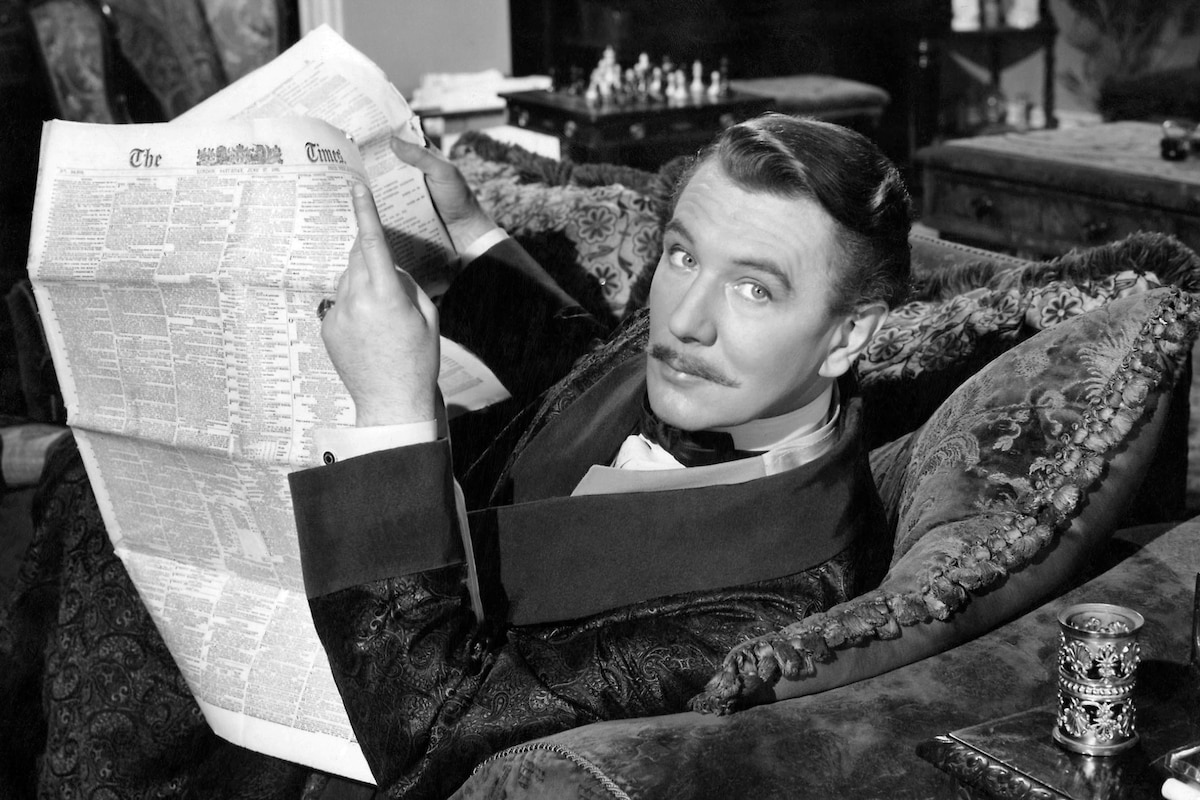
Despite being too old for the role of the 28-year old Jack Worthing, 44-year-old Michael Redgrave gives one of his most memorable performances as the "Bunburying" gentlemen with a secret. Father of actors Vanessa, Lynn and Corin and grandfather of Joely and Natasha Richardson, Redgrave had his most notable roles in Mourning Becomes Electra (1947), Asquith's The Browning Version, Joseph L. Mankiewicz's The Quiet American (1958, in the role taken by Michael Caine in the 2002 remake), and countless classic stage roles.
The Importance of Being Earnest also features the British comic great Margaret Rutherford, best known for her work as Madame Arcati in Noel Coward's Blithe Spirit (1945), a role she originated on stage in 1941, and as Agatha Christie's sleuth Miss Jane Marple in such films as Murder She Said (1961) and Murder at the Gallop (1963).
The performances in The Importance of Being Earnest -- particularly Dame Edith Evans's Lady Bracknell - have come to be considered so definitive that it's hard to find one of the many community theater productions done every year across the globe that stray very far from this approach.
Director: Anthony Asquith
Producers: Earl St. John, Teddy Baird
Screenplay: Anthony Asquith, based on the play by Oscar Wilde
Cinematography: Desmond Dickinson
Editing: John D. Guthridge
Art Direction: Carmen Dillon
Original Music: Benjamin Frankel
Cast: Michael Redgrave (Jack Worthing), Michael Denison (Algernon Moncrieff), Edith Evans (Lady Bracknell), Margaret Rutherford (Miss Prism), Joan Greenwood (Gwendolyn), Dorothy Tutin (Cecily).
C-95m.
by Rob Nixon
The Importance of Being Earnest
by Rob Nixon | March 28, 2006
SIGN UP FOR OUR NEWSLETTERS

CONNECT WITH TCM