When you consider that the most famous scene he's ever filmed
involves Ned Beatty being brutally violated by a toothless
mountain man, it's a bit surprising that John Boorman is the
writer-director behind Hope and Glory (1987), an utterly
charming examination of civilian life during wartime. Boorman
based the film's screenplay on his own experiences in and around
London during the blitz. Just a boy at the time, Boorman found
himself regularly bedazzled by the action unfolding around him,
whether it involved nighttime buzz-bomb attacks, captured German
pilots, or his sisters' escapades with assorted Allied soldiers.
Although Hope and Glory was nominated for a handful of
Oscars® and made a bit of money when it was originally
released, it remains one of the more unjustly under-appreciated
films of the 1980s. It's inviting from beginning to end - the
polar opposite of the psychic pounding you get from
Deliverance (1972).
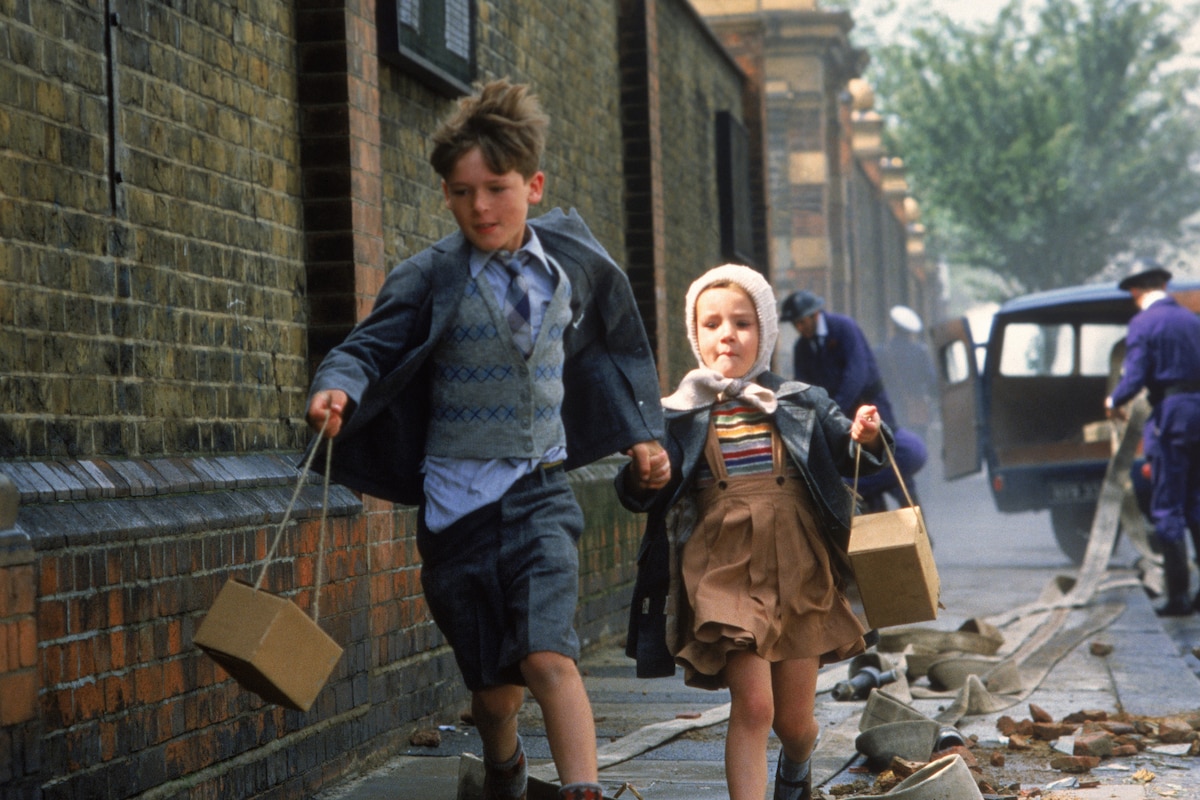
Boorman's charming protagonist is 9-year-old Bill Rohan (Sebastian
Rice-Edwards), a content little kid whose family is suddenly
forced to deal with the fact that Britain is under nightly attack
by the Nazis. The war has turned his life into a chaotic series
of incidents that range from the humorous to the horrifying. His
father (David Hayman), volunteers for service, even though he
isn't legally required to do so, leaving Bill and his blossoming
teenage sister, Dawn (Sammi Davis), in the sole care of their
emotional mother (Sarah Miles).
This leads to a series of winning episodes that eventually
coalesce into an emotionally charged narrative. Bill grows up
considerably during the adventure, but the same could be said of
every member of his family. His sister finds love, and his mother
re-visits an old flame. Even his ornery grandfather (Ian Bannen)
comes out of it a changed man.
It takes a while to get used to the idea that Hope and
Glory isn't going to be a straight-forward tragedy. The story
contains moments of sadness and death, just as one would expect of
a war-based movie. But Boorman is far more interested in
recreating the sense of adventure that he felt while cavorting
through the bombed-out ruins of his neighborhood.
A great deal of time and energy went into re-creating the street
that Boorman grew up on as a child. For lack of a fitting
stand-in, Rosehill Avenue was
constructed virtually from scratch, but in a rather unique manner.
Anthony Pratt, Boorman's head of production design, created an
ingenious set that relied a great deal on optical illusions. The
houses that stand closest to the camera when Billy is out in the
street, are facades built on scaffoldings. The houses that fade
into the distance down the way are actually painted in perspective
to
suggest a long road; some of the "houses" were only a few feet
high.
There was also a cut-out of the London skyline in the distance, as
well as a moveable St. Paul's Cathedral. Nowadays, vaguely
unconvincing digital effects would surely trump the possibility of
such brilliant handiwork. Here, the effect is seamless.
Boorman, as you might suspect while watching Hope and
Glory, based many of the characters on his real-life
relatives. He wasn't too sure how his aged mother would react
when she saw herself portrayed in a motion picture, and, as
Boorman wrote in his autobiography, it didn't go quite as well as
he had hoped: "As the crowd poured out from the premiere, press
and television surrounded my mother, demanding to know how she
felt about seeing her life on the screen. ‘It was quite good in
its way,' was her faint praise, ‘but personally I prefer a good
thriller.'" Boorman suspected that the film had stirred up long
dormant, conflicted feelings in his mother. "She enjoyed the
attention," he wrote, "but...felt I had stolen something from her.
She never said as much, but I knew it was so."
Producer: John Boorman, Michael Dryhurst
Directed by: John Boorman
Screenplay: John Boorman
Cinematography: Philippe Rousselot, John Harris
Editor: Ian Crafford
Music: Peter Martin
Production Design: Anthony Pratt
Art Design: Don Dossett
Special Effects: Rodney Fuller, Michael Collins, Phil Stokes
Set Design: Joan Woollard
Costume Design: Shirley Russell
Makeup: Anna Dryhurst
Cast: Sebastian Rice-Edwards (Bill Rohan), Geraldine
Muir (Sue Rohan), Sarah Miles (Grace Rohan), David Hayman (Clive
Rohan), Sammi Davis (Dawn Rohan), Derrick O'Connor (Mac), Susan
Wooldridge (Molly), Jean-Marc Barr (Cpl. Bruce Carey), Ian Bannen
(George), Annie Leon (Bill's Grandmother), Jill Baker (Faith),
Amelda Brown (Hope), Katrine Boorman (Charity), Gerald James
(Headmaster), Barbara Pierson (Teacher), Charley Boorman
(Luftwaffe Pilot).
C-113m. Letterboxed.
by Paul Tatara
Hope and Glory
by Paul Tatara | March 28, 2006
SIGN UP FOR OUR NEWSLETTERS

CONNECT WITH TCM