When comedians do Charles Boyer imitations, it is invariably with
a bad French accent and a line from Algiers (1938): "Come
wiz me to ze Casbah". But here's the catch: like Humphrey Bogart's
oft-quote "Play it Again, Sam" - Boyer never said, "Come with me
to the Casbah." He also hated it. As Larry Swindell wrote in his
biography of Boyer, "He believed that the parody demeaned his
integrity as an actor, even creating the supposition that he was
not a serious actor. He believed the whole thing had been carried
altogether too far when one of the best-known Boyer imitators
proved to be that American original, Mr. Bugs Bunny. To the bogus
impersonation he also attributed the myth, as he called it, of the
great lover - or "lovair". 'Mostly I've played other parts, but
even when I've played other parts people see me differently. In
America, when you have an accent, in the mind of the people they
associate you with kissing hands and being gallant. I think this
has harmed me, just as it has harmed me to be followed and plagued
by a line I never said.'"
He also did not enjoy filming Algiers. The film was a
remake of Julien Duvivier's acclaimed French film Pepe le
Moko, starring France's biggest star, Jean Gabin. Boyer
justifiably complained, "An actor never likes to copy another's
style, and here I was copying Jean Gabin, one of the best."
Director John Cromwell used sequences of the Casbah from the
original picture and much of the French musical score. This, too,
bothered Boyer, "[Cromwell] would run a scene from the
original and insist we do it exactly that way - Terrible, a
perfectly terrible way to work." Cromwell felt differently, "Boyer
was the unhappiest man in Southern California. He felt doomed to
imitate a Jean Gabin performance, and never appreciated how
different his own Pepe was from Gabin's. Boyer showed something
like genius to make it different. It was a triumph of nuance. The
shots are the same, the dialogue has the same meaning, but Boyer's
Pepe and Gabin's Pepe are two different fellows but in the same
predicament."
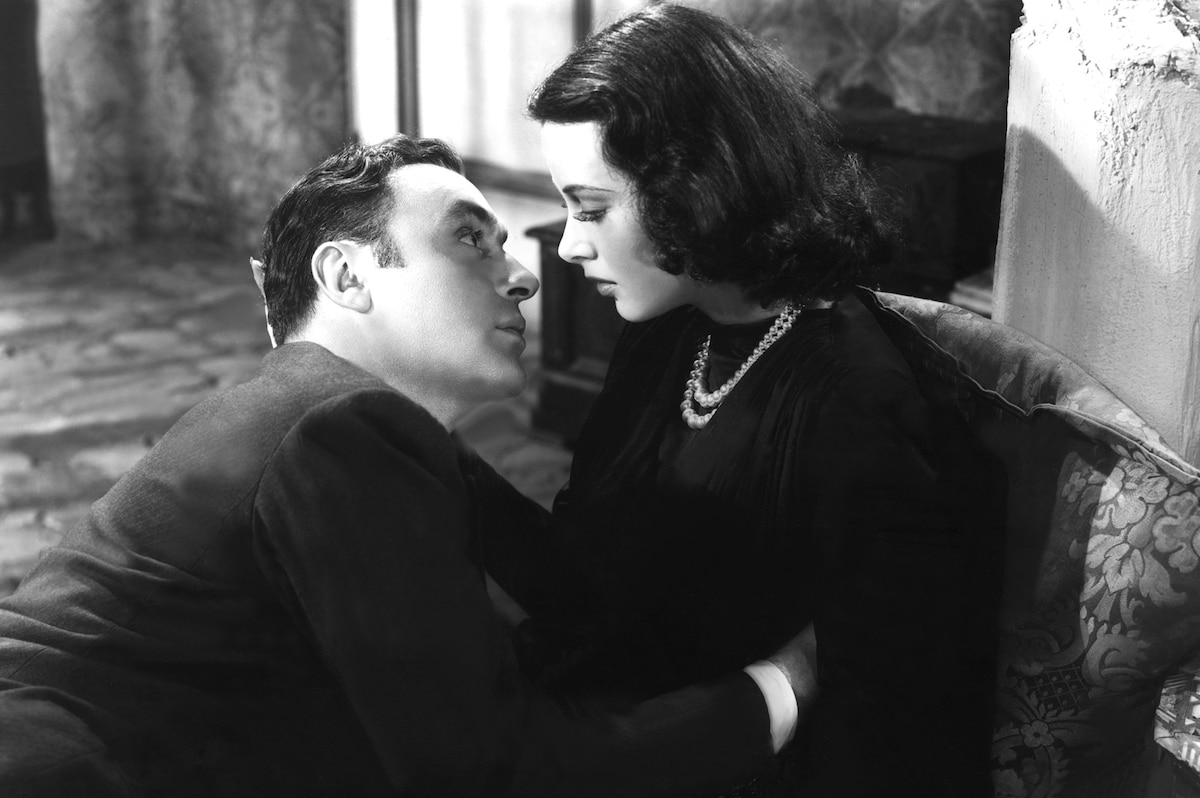
For Boyer's love interest, Ingrid Bergman, Dolores Del Rio, and
Sylvia Sidney had been considered before the role went to the
woman who would be proclaimed as the most beautiful ever to appear
before a camera - Hedy Lamarr. As Hedwig Kiesler, she had appeared
fully nude in the 1933 Czech film Extase, then married a
millionaire who unsuccessfully tried to buy up and destroy every
print of the film. She was questioned about this by MGM publicity
head Howard Dietz "Did you appear in the nude?" "Yes." "Did you
look good?" "Of course!" "Then it's all right, no damage has been
done."
In her controversial autobiography, Ecstasy and Me, Lamarr
remembered meeting Boyer for the first time. "It was a rainy
evening and I was painting greys and blacks - yes, I paint as well
as collect - feeling very good. Reggie [actor Reginald
Gardiner, who she was dating at the time] dropped in to ask me
to go to a party with him. It was the last thing I wanted to do.
Furthermore a change from paint clothes to a formal gown was no
casual zip-up....So reluctantly I went. I wasn't at the party more
than ten minutes when a deep voice said from in back of me, 'I
have not seen your face but from the back your hair and your
figure assure me you are a beautiful woman.' I detected a warm
French accent in the words. I turned to find the gentleman was
Charles Boyer. I thanked him for the compliment. 'Ah,' he said
smiling, 'I was right. It is so heartening to have snap guesses
confirmed. You are truly beautiful. Now, 'he went on, 'give me a
list of your credits, I will give you my list of credits and we
will get that out of the way.' I told him, 'It will not take me
long. Though I am under contract to MGM I have not made a picture
here yet. I made a few minor films in Vienna.' 'Ah,' he said,
'Hedy Lamarr.' He rolled the name beautifully in his throat. 'They
told me you'd be here.' He took me by the arm, and looked into my
eyes, 'Would you consider making a film with me?' When I nodded,
he led me across the room to a distinguished looking gentleman
whom he introduced as Walter Wanger. 'Well, what do you think?'
asked Boyer. I, of course, had not the slightest suspicion of what
they were talking about. Wanger stared at me. 'Say a few
sentences.' 'I was happy painting at home in the rain,' I
improvised, 'and now I am wondering whether it was wise to leave.
I am very bad at small talk and my English is still difficult to
handle.' Wanger nodded. 'Yes, it could be. Could be.' Boyer
clarified it all. 'Walter just purchased the American screen
rights to Pepe le Moko from MGM. I have promised him I
would star in his version.'"
MGM was still looking for an appropriate vehicle for Lamarr's
first film and Algiers seemed to be it. Production began on
April 1, 1938. The date was significant: things did not go
smoothly, according to Cromwell. "[Hedy] was a nice girl,
or she was then. Hedy didn't make trouble, didn't have an ego
problem. The problem was, she couldn't act, and we knew it before
we started shooting or even rehearsing. After you've been in the
business for a time, you can tell easily enough right when you
meet them. I could sense her inadequacy, Wanger could sense it,
and I could see Boyer getting worried even before we started
talking behind Hedy's back...Sometimes the word personality is
interchangeable with presence although they aren't the same thing.
But the principle applies, and Hedy also had no personality. How
could they think she could become a second Garbo?...Hedy Lamarr
had a more discernible presence from picture to picture, call it a
persona if you will, and she also learned to act. Sort of...Hedy
always got star billing, but she wasn't a star. She was a beauty.
Well, we got the picture going, and we did all right. The critics
saw she couldn't act, but she got by, and they sold the picture by
gushing how beautiful she was. I'll take some credit for making
her acting passable but can only share credit with Boyer
fifty-fifty. I rate my accomplishment with Lamarr in
Algiers above what I did with [Bette] Davis in
Of Human Bondage [1934] because Bette could have
done it on her own without me. Hell, all I did was cast her and
say roll 'em. So I'll say Boyer's was a finer accomplishment than
mine. I didn't have to act with her; he did. He proved himself a
gentleman of grace and courage and excellent poise. If you were in
a group of people and saw an atomic bomb falling down on you,
Charles Boyer would be the one not to panic. He pulled Hedy
through so delicately. He sensed a lack of confidence but was more
concerned about the little confidence she did have, which was
sometimes revealed in the slightest arrogance. He didn't want to
destroy that, but he never lied to her. He didn't tell her she was
bad, and he didn't say she was good. He acted with sincerity and
with integrity and she responded to it. Any actor, good or bad,
responds to another actor's level...In Algiers Hedy plays
off Boyer and he's incredible. The love scenes are so strong that
you don't see it's all him."
While Boyer himself may have disliked being thought of only as a
"great lovair", Algiers certainly cemented his reputation.
And it would serve as the inspiration for another romantic star:
animator Chuck Jones based the character of the love-sick French
skunk Pepe Le Pew on Boyer's character. Charles Boyer must have
been thrilled.
Producer: Walter Wanger
Director: John Cromwell
Screenplay: Henri La Barthe, John Howard Lawson, James M. Cain
Cinematography: James Wong Howe
Film Editing: Otho Lovering, William Reynolds
Art Direction: Alexander Toluboff
Music: Vincent Scotto, Mohammed Igarbouchen
Cast: Charles Boyer (Pepe le Moko), Sigrid Gurie (Ines), Hedy
Lamarr (Gaby), Joseph Calleia (Inspector Slimane), Alan Hale
(Grandpere), Gene Lockhart (Regis).
BW-95m.
by Lorraine LoBianco
Sources:
Ecstasy and Me by Hedy Lamarr
The Reluctant Lover, Charles Boyer by Larry
Swindell
Walter Wanger: Hollywood Independent by Matthew Bernstein
Algiers
by Lorraine LoBianco | March 24, 2006
SIGN UP FOR OUR NEWSLETTERS

CONNECT WITH TCM