Before John Frankenheimer became the director of such 1960s movie classics as The Manchurian Candidate (1962), The Birdman of Alcatraz (1962), Seven Days in May (1964), and Seconds (1964), he was one of the most celebrated small screen directors of the 1950s, creating edgy, vital live television drama for Playhouse 90 and other programs. Then his big screen career stalled after a string of box office stiffs in the 80s and early 90s: "I just hadn't been offered the really great scripts, so I found myself accepting some stuff that had a lot of fingerprints on them. It was just not the kind of material that I was being offered in the 60s and 70s," he reflected in a later interview. "I was getting older and I was very acutely aware that there was not much of a demand for me."
So the man who helped elevate the art of TV drama in the 1950s returned to the small screen when HBO offered him the drama Against The Wall (1994). It became the first in a remarkable run of four acclaimed made-for-cable movies, for which he took home four consecutive Emmys Awards for directing. "It was a kind of rebirth. I got all my confidence back and I found that I was really sharp and focused."
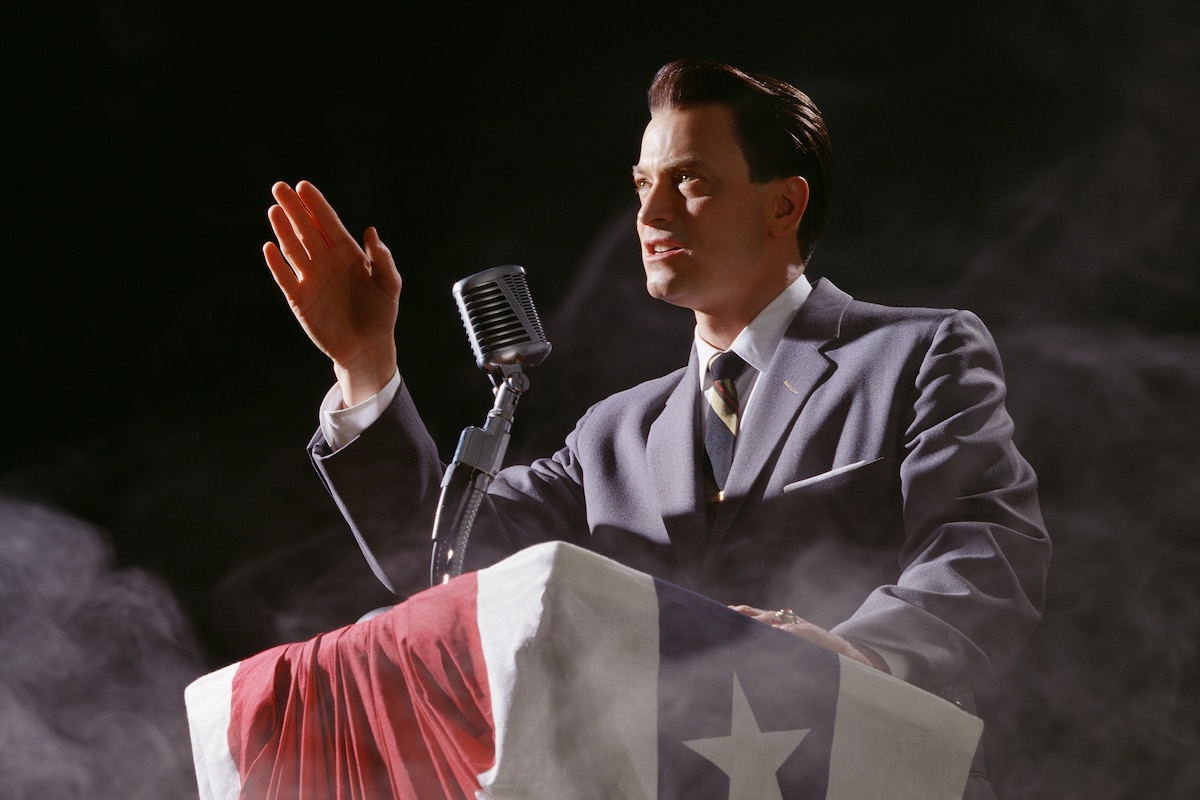
George Wallace (1997), the fourth of these films, was made for the commercial cable station TNT. It dramatizes the polarizing political career of George Wallace, the Alabama politician who leveraged the prejudices of Southern white voters to serve two terms as Governor of Alabama and run in the Democratic primaries for the 1972 Presidential election, a campaign cut short by an assassination attempt that left him paralyzed. He was a firebrand populist who promised "Segregation today, segregation tomorrow and segregation forever" in his inaugural gubernatorial address in 1963. He notoriously blocked the entry of black students to the University of Alabama after the Supreme Court ruled segregation unconstitutional and his vocal opposition to the Civil Rights Act became into a rallying cry for angry, racist, white Americans in the Deep South. The two-part mini-series was written for the screen by Paul Monash, a veteran who began writing for TV in the 1950s (including an episode of Playhouse 90 that directed by Frankenheimer 40 years before) and Marshall Brady, based on Brady's 1968 biography of Wallace.
For the role of Wallace, Frankenheimer courted veteran film, television, and stage actor Gary Sinise, co-founder of Chicago's esteemed Steppenwolf Theatre Company and an Oscar nominee for Forrest Gump. Sinise had already played one American political figure for TV--Harry Truman in the 1995 telefilm Truman--but he was wary of stepping into the skin of the man who fanned the flames of racism and intolerance in the 1960s. Frankenheimer, however, pressed him to look deeper into the script, which follows Wallace from idealist to political opportunist to the face of Southern racial intolerance and then coming back around to his public renunciation of his segregationist views. Frankenheimer likened it to a Faust tale, a man who sold his soul for political power. "Here's a person who spent a lot of his life on a quest, fighting for the wrong things, and then he realizes it and tries to redeem himself in some way," Sinise explained in a 1997 interview. "That's where the hope of it is."
Angelina Jolie, whose career was just beginning, won the role of Wallace's vibrant young second wife Cornelia, the daughter of Wallace's political mentor Big Jim Folsom. "They showed me the "Life" magazine cover of her over the body when he was shot and the look on her face. That told me everything I needed to know to like her," she remembered in an interview years later. "She could have been shot at that moment but she was on him and she was holding him." Jolie earned the best reviews of her budding career to date for her passionate performance.
Mare Winningham, a respected film and TV veteran herself with an Emmy Award and two nominations to her name, plays Wallace's first wife Lurleen, and Clarence Williams III is Archie, the African-American prisoner who serves as a trustee working at the Governor's mansion, a fictional character created for the film.
Frankenheimer had hoped to shoot the film on location in Alabama but then-Governor Fob James refused the production access to key locations in the state. The film was shot in California with Sacramento's capitol building standing in for Alabama's state house.
Recalling his roots in live television, Frankenheimer creates a visually dynamic drama on a limited budget with elegant camerawork, bold compositions (even quoting from his own The Manchurian Candidate) and a judicious use of handheld shots. To enhance the authenticity and immediacy of the drama, archival film and TV news footage of protests and riots and other key historical events is edited into black-and-white recreations and dramatic footage. As New York Times critic Caryn James observed, "What sounds like a gimmick actually creates a sense that those scenes are, indelibly, part of history."
George Wallace earned an impressive eight Emmy nominations. Along with his directing statuette, Frankenheimer directed Gary Sinise and supporting actress Mare Winningham to Emmy Awards and Jolie to a Golden Globe for her performance. "I've had complete creative freedom, complete artistic control," Frankenheimer said of his cable films. "There's been no interference. Those things are very important to a director." The acclaim brought Frankenheimer back to the big screen--he followed the telefilm with the hit action thriller Ronin (1998)--but it wasn't the end of his TV work. He tackled American politics once more with the made-for-HBO drama Path to War (2002), for which Sinise reprised the role of George Wallace in a brief, uncredited appearance. It was Frankenheimer's final film. He died in 2002 at the age of 72.
By Sean Axmaker
Sources:
The Directors: Take One, Robert J. Emery. TV Books, 1999.
Angelina, Andrew Morton. St. Martin's Press, 2010.
Vision and Conflict: Collaborating on the Wallace Saga, DVD featurette. Warner Home Video, 2008.
"Going Beyond Just Facts to Show a Hollow Soul," Caryn James. The New York Times, August 23, 1997.
George Wallace
by Sean Axmaker | May 03, 2016
SIGN UP FOR OUR NEWSLETTERS

CONNECT WITH TCM