With The Lady Vanishes (1938), Alfred Hitchcock scored his biggest triumph in
Great Britain shortly before leaving to pursue a career in the U.S, where
he would eventually become the world's most recognizable film director. In
fact, the success of The Lady Vanishes helped him negotiate the best
possible deal in Hollywood. It also gave film scholars a healthy helping
of those traits that would distinguish his films: deceptive appearances,
sly humor, a tangled international plot and what he called "The McGuffin,"
a nonsensical device used to motivate the action and suspense.
Ironically, although it was one of his biggest hits, The Lady
Vanishes was the only major Hitchcock film that he didn't initiate
himself. Two soon-to-be-successful British writers, Sidney Gilliat and Frank Launder, had
pitched a novel by Ethel Lina White (who also wrote the book on which
The Spiral Staircase, 1946 would be based) to producer Edward Black in
1937. The story, about a young girl on vacation in Europe who befriends an
elderly woman then has to prove the lady's existence after she disappears,
seemed a natural for the screen. Black gave them the go-ahead, assigned
the film to American director Roy William Neill, then sent a crew to
Yugoslavia for background shots. One of the crewmembers had a minor
accident there, and during the investigation the local police came across
the script. One look at the opening pages, which juxtaposed shots of the
Yugoslavian army with waddling geese, and the authorities deported the
entire crew, which led Black to cancel the production.
A year later, Hitchcock was trying to find a film to end his contract with
Black so he could sign a deal with Charles Laughton's production company
and pursue offers from America following the success of The 39 Steps (1935). For once, he couldn't come up with a property. Knowing
Hitchcock was desperate to get on with his career, Black dusted off the
script to The Lady Vanishes and the director immediately agreed to the
production. He suggested some changes to Launder and Gilliat that
tightened the film's opening and made the finale more exciting,
but basically shot the film as written, although he insisted on a
screenplay credit for his wife, Alma Reville.
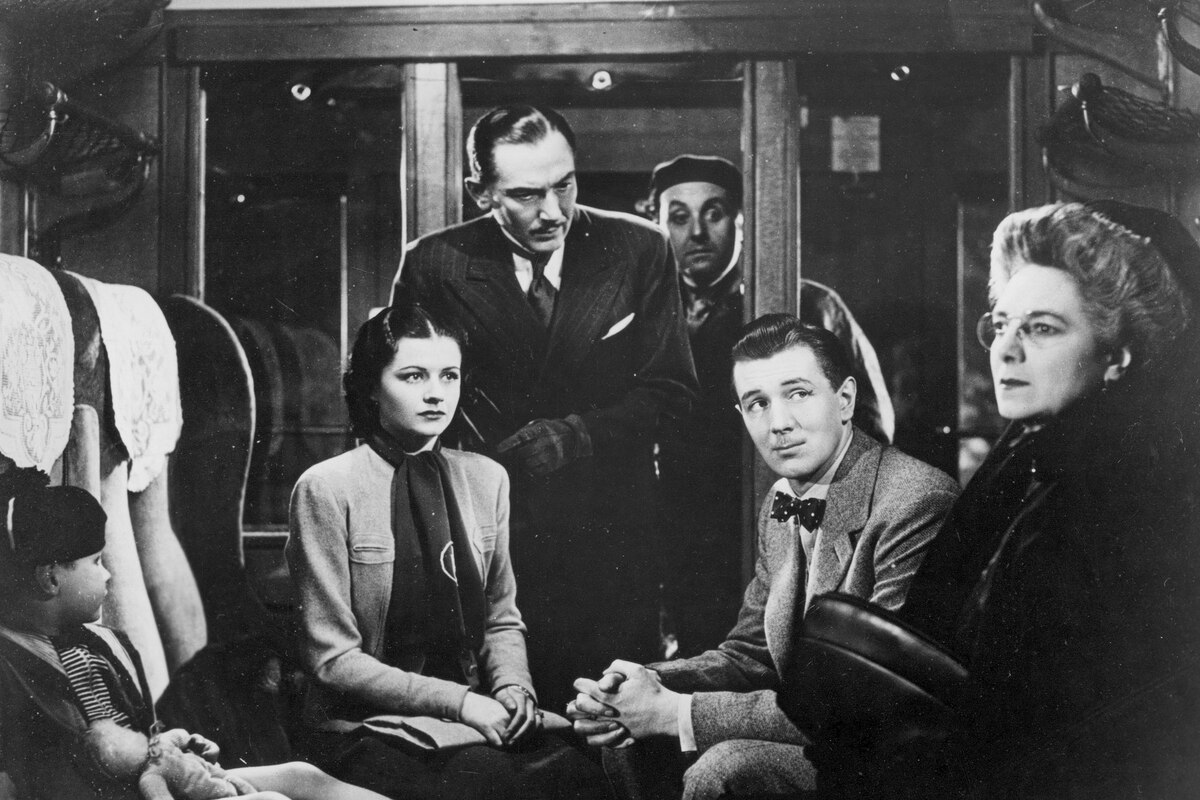
Hitchcock was particularly lucky in his casting, awarding the leads to two
actors who would soon become major stars in England. After considering
Lili Palmer for the female lead, he settled on a young actress, Margaret
Lockwood, who had long dreamed of playing one of White's heroines. The
male lead went to Michael Redgrave, a popular young stage actor who had played a bit part in Hitch's earlier thriller, Secret Agent (1936). The stage star was
reluctant to commit, however. He had just completed three plays in
repertory with John Gielgud and wanted to continue concentrating on his
stage work. It was Gielgud who convinced him that he'd learn a lot about
filmmaking from Hitchcock but the main lesson he learned was how to
handle himself on the set. Hitchcock put most of his work into preparing shots
and sequences, editing the film in the camera by shooting just what would
end up on the screen. All he wanted from the actors was cooperation.
Sensing that Redgrave had a swelled head about his stage work, on the first
day of shooting Hitchcock told him, "You know, don't you, that Robert Donat;the star of The 39 Steps; wanted to play this role in the worst
way." When he realized that Redgrave didn't care, Hitch took a liking to
him, using his casual attitude as a part of the character. As a result,
the film made Redgrave, in his first leading film role, an international
star.
For the title role, Hitchcock cast Dame May Whitty, a stage veteran who had
recently scored a hit in Hollywood as the old lady murdered by Robert
Montgomery in Night Must Fall (1937). Although a wonderful actress in
certain roles, Whitty was somewhat set in her ways after almost three
decades of stardom. To unsettle her, Hitch interrupted her first scene,
shouting, "Stop! That's terrible. Aren't you ashamed of yourself?" From
then on, she did exactly as he wanted and turned in a surprisingly
hard-edged performance as the title character who turns out to
be a spy.
As with Whitty, Hitchcock made several of the other actors play against
type. Hollywood leading man Paul Lukas was cast as the villain, a
seemingly compassionate doctor who turns out to be a cold-blooded espionage agent.
Glamorous character actress Catherine Lacy played a nun with a twist --
after a surprising shot of her wearing high heels under her habit, she
turns out to be one of the enemy spies. But his biggest success, at least
with English audiences, was casting dramatic actors Basil Radford and
Naunton Wayne as two comical cricket fans -- typical English tourists more
interested in catching the latest scores than helping the leading lady find
her missing friend. The two were such a hit in their roles that they would
repeat them in other films, including the classic horror tale Dead of
Night (1945).
The Lady Vanishes was one of those rare films that hit pay dirt on
its initial release and has never lost its luster as a classic. When it
opened in England in October 1938 it quickly became the most successful
British film to that time. Two months later, it was the hottest ticket in
New York, where it was named Best Picture of 1938 by The New York
Times and brought Hitchcock the New York Film Critics Award for Best
Director. It also helped him win a lucrative contract with independent
producer David O. Selznick, for whom he would work through most of the
'40s.
Producer: Edward Black
Director: Alfred Hitchcock
Screenplay: Alma Reville, Sidney Gilliat & Frank Launder
Based on the novel The Wheel Spins by Ethel Lina White
Cinematography: Jack Cox
Art Direction: Alex Vetchinsky, Maurice Carter, Albert Jullion
Music: Louis Levy
Principal Cast: Margaret Lockwood (Iris Henderson), Michael Redgrave
(Gilbert Redman), Paul Lukas (Dr. Hartz), Dame May Whitty (Miss Froy),
Cecil Parker (Eric Todhunter), Naunton Wayne (Caldicott), Basil Radford
(Charters), Catherine Lacy (The Nun), Googie Withers (Blanche).
BW-96m.
by Frank Miller
The Lady Vanishes
by Frank Miller | September 25, 2003
SIGN UP FOR OUR NEWSLETTERS

CONNECT WITH TCM