"You can walk for a year in any direction with just your rifle, live good and easy, never have to 'sir' to nobody. Yeah, I call that free." - Bill Tyler in The Mountain Men
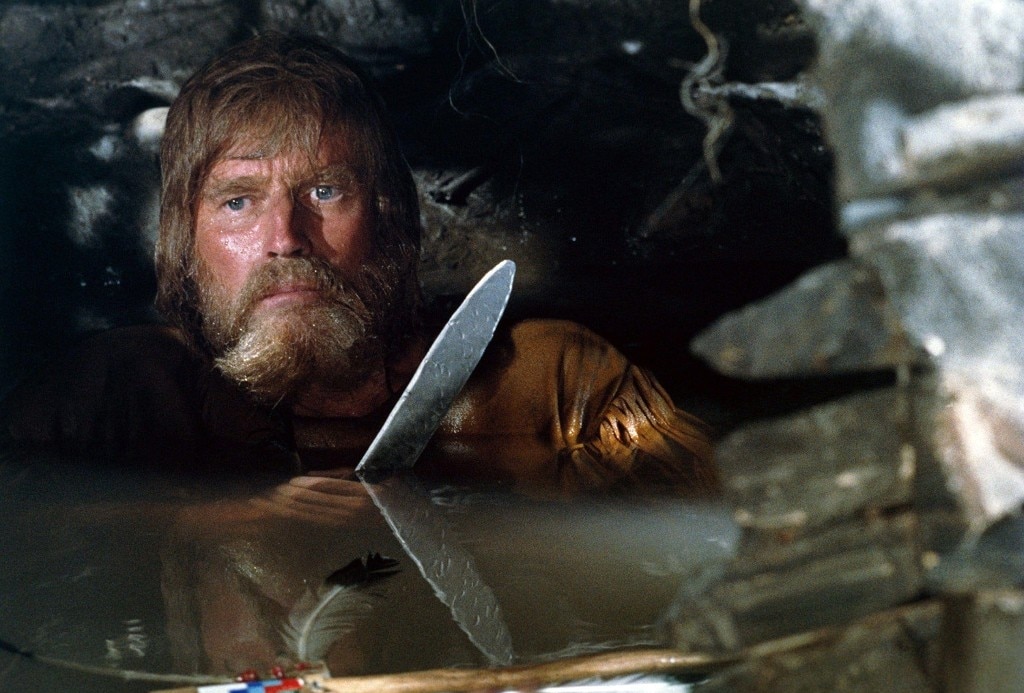
The Mountain Men (1980) is, as the title suggests, a story of the early American frontiersmen who chose live apart from society. Bill Tyler and his buddy Henry Frapp are trappers and hunters in the American frontier of the 1830s. They aren't settlers. They are men who prefer to live alone in isolation in the wilderness. "It's an early version of America's drive West, before the country was settled, before there were gunslingers and ranchers and farmers and towns with sidewalks," screenwriter Fraser Heston said in an interview years later.
Fraser was an avid outdoorsman and he came up with the original story after he spent time living among Alaskan Eskimos and Native Americans. The script took shape, further research into the history of trappers, traders, and mountain men in Wyoming, under the name Wind River, with his characters modeled after real-life historical figures. Bill Tyler is in part drawn from John Colter, a hunter and scout on Lewis and Clark expedition who chose to remain in the wilderness when the expedition returned east. He was a hunter and a trapper and in the early 1800s he became the first white man to explore and report in detail the region that would become Wyoming, including the areas that became Yellowstone and Grand Teton National Parks.
Where the real life Colter died in 1812 or 1813, however, Tyler is a veteran hunter and trapper in 1838 Wyoming, emerging from two years of self-imposed exile in the wilderness to find the once-lucrative fur trade dying out as silk became the new fashion in hats, replacing the market for pelts. The story follows his adventures as he survives the elements, befriends a Crow brave named Medicine Wolf, and rescues a Blackfoot squaw named Running Moon from her abusive, obsessive warrior husband Heavy Eagle, who spends the rest of the film in an obsessive quest of revenge against Tyler.
Producer Martin Ransohoff brought the script to Columbia Pictures and they offered the lead to Charlton Heston, the screenwriter's father. "I thought it was a wonderful part, in a rich script," he wrote in his autobiography. Bill Tyler "spoke very clearly to me: one of the several men I'd played in both stage and screen who recognize that their own time was coming to an end." The part of the grizzled, garrulous Henry Frapp went to Brian Keith, an old hand at such colorful character roles. It was the first time the elder Heston had worked with Keith since Arrowhead 25 years earlier. He "gave on the very best of his gritty, charismatic performances as Frapp," Heston wrote in his autobiography. "A wonderfully quirky actor, he's a joy to play with." It shows in their onscreen camaraderie. At times they are like a bickering old married couple, at others they are like old war buddies who have one another's back in battle.
The film was shot on location in Wyoming at Grand Teton National Park, Bridger-Teton National Forest, Shoshone National Forest, and Yellowstone National Park, in both winter and spring. "The elegiac quality I perceived in much of the writing leached through to the film itself in many scenes," Charlton Heston wrote years later. "Shooting in the big skies of the American Rockies, as beautiful as any country on earth, makes it easier to get some of it on film." High school and college students from Wyoming and Montana reservations were hired as extras to represent the Blackfoot, Crow, and Nez Perce tribes.
By the time the film was released it had undergone numerous changes. Wind River became Last of the Mountain Men, The Mountain Man, and finally The Mountain Men, giving Frapp top billing along with Tyler, so to speak. Heston was proud of their work but disappointed with the way the studio edited the film and appalled by the advertising campaign that the studio slapped together, which he described as "Cartoon drawings of Brian and me running away from some pretty ridiculous Indians. The ads were an appalling surprise." It did, however, mark the first time that father and son worked together as creative partners on a film and they continued the creative collaboration with the 1982 adventure Mother Lode, written and produced by Fraser and directed by and starring Charlton Heston, and the TV movies Treasure Island (1990) and The Crucifer of Blood (1991), with Fraser stepping behind the camera to direct his father.
By Sean Axmaker
Sources:
In the Arena, Charlton Heston. Simon & Schuster, 1995.
"The Highest Peak: Best of the mountain man movies," Henry C. Parke. True West, November 26, 2015.
"John Colter, the Phantom Explorer--1807-1808". Colter's Hell and Jackson Hole, National Park Service.
AFI Catalog of Feature Films
The Mountain Men
by Sean Axmaker | April 27, 2016
SIGN UP FOR OUR NEWSLETTERS

CONNECT WITH TCM