When it opened in 1963, this fascinating and disturbing Roger Corman science-fiction film was promoted by American International Pictures like an average drive-in programmer with skeletons and nubile women on the poster art. However, it became clear to anyone who laid eyes on it that this was no ordinary sci-fi programmer. Corman was at the peak of his powers that year with other films like The Haunted Palace, The Raven, The Terror, and The Young Racers, and he was firmly ensconced with AIP after they pulled a runaround tactic when he tried to go independent in 1962 with The Premature Burial.
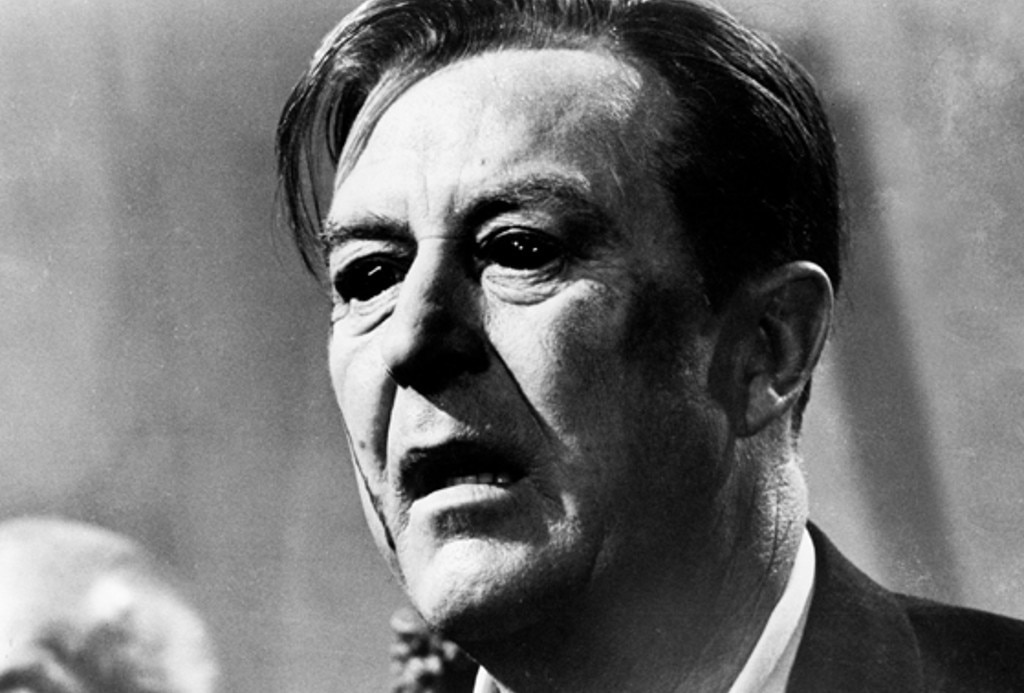
That film would be significant as the only Corman adaptation of an Edgar Allan Poe story to not star Vincent Price; instead he cast Ray Milland as the tortured hero whose fear of being buried alive leads to disastrous consequences. Milland would be a logical choice for X: The Man with the X-Ray Eyes as Charles Xavier, another tormented protagonist - in this case a scientist whose groundbreaking work in ocular research creates a new drug capable of inducing x-ray vision. His experiments on his own eyes allow him to see further and further through objects and people, leading to a bizarre and highly unsettling ending no viewer ever forgets.
Shot in lurid Pathécolor, this production featured many of Corman's usual collaborators behind the camera including cinematographer Floyd Crosby and composer Les Baxter, whose easy listening talents get more of a workout here than usual. AIP played the film on various double and triple bills, most frequently alongside Francis Ford Coppola's Dementia 13, a pairing capable of rattling more than a few impressionable teenagers.
An Oscar winner for 1945's The Lost Weekend, Milland was gradually moving more into television when he made his three-film detour into AIP (which also included directing and starring duties on 1962's Panic in Year Zero). His big screen output would be limited for the remainder of the decade, but he made a resurgence in 1970 with Love Story. He would remain steadily in demand for the remainder of his career and even returned to AIP in 1972 for Frogs and The Thing with Two Heads after the departure of co-founder James H. Nicholson.
Not to be overlooked in the film next to Milland's powerhouse performance are some of the supporting actors, including Don Rickles breaking away from his usual comedic mode for a sleazy and unnerving turn as Crane. Also on hand is veteran character actor John Hoyt, who also appeared in none other than Joseph L. Mankiewicz's Cleopatra the same year. Busy TV actor Harold J. Stone would go on to reunite with Corman for The St. Valentine's Day Massacre in 1967, and he would also appear in such epics as Spartacus (1960) and The Greatest Story Ever Told (1965).
Interestingly, both of the screenwriters of this film had been better known for working with William Castle outside the gates of AIP. Ray Russell made his screenwriting debut adapting his novella for Castle's Mr. Sardonicus in 1962, which would be followed by Zotz! and Corman's The Premature Burial. He developed the original story for this film and penned the screenplay itself with Robert Dillon, who worked on two Castle films the same year, 13 Frightened Girls and The Old Dark House.
Rumors have abounded for decades about the ending of this film, with author Stephen King starting a rumor that a horrific additional line ("I can still see!") was shot but proved to be too shocking for audiences. Others have insisted they heard that line at some point, though Corman himself claims it wasn't filmed. Complicating things was the release of Gold Key comic book with an extended and more extreme version of the ending that presumably extended AIP's budgetary constraints at the time, so what was originally planned and shot may continue to remain a mystery.
By Nathaniel Thompson
X: The Man with the X-Ray Eyes
by Nathaniel Thompson | April 21, 2016
SIGN UP FOR OUR NEWSLETTERS

CONNECT WITH TCM