Cursed with witnessing his mother's adultery and his father's legacy
of hatred for all women, Don Juan (Philippe De Lacy) grows up the
playboy of Rome. Advised by his bitter father never to give his love
to a woman, the grown Don Juan (John Barrymore) keeps a banquet of
women at the ready, filling his calendar with amorous meetings. In a
humorous scene early in Don Juan (1926), Alan Crosland's enormously entertaining
film of the perennially popular drama, Don Juan's faithful assistant
Pedrillo (Willard Louis) works to keep three different women, all in
Don Juan's house at the same time, unaware of each other's
presence.
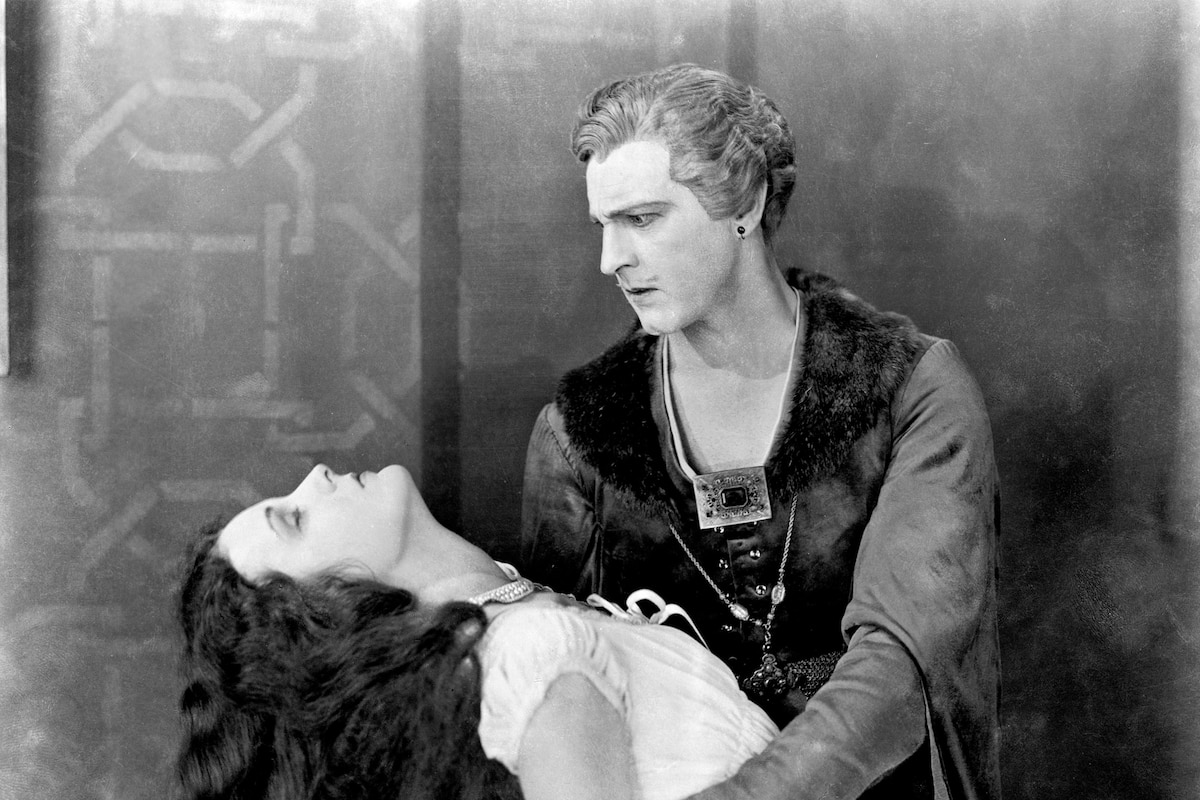
Intrigued by Don Juan's reputation, a member of the infamous,
villainous Spanish Borgia dynasty, Lucretia (Estelle Taylor) invites
the handsome rogue to a party. It is at that fateful ball that Don
Juan meets the woman who will forever alter his romantic ways,
Adriana Della Varnese (Mary Astor), a woman whose innocence and
piousness change his perception of female duplicity and malevolence.
But Adriana's father Duke Della Varnese is an enemy of the Borgias.
Jealous of Don Juan's obvious affection for Adriana, Lucretia hatches
a plan to have Adriana marry the repugnant Count Donati (Montagu
Love) in exchange for sparing Duke Della Varnese's life.
Don Juan (1926) features a host of Hollywood talent, both established
and emerging including Astor, who would one day become one of film
noir's most famous femme fatales for her role in The Maltese
Falcon (1941). Myrna Loy also appears as Lucretia's plotting,
beautiful lady-in-waiting. The part of Lucretia's maid, Maria, was
Loy's 11th film role in some 80 film appearances before she made her
most famous mark in 1934 as the sophisticated detective Nora Charles
in the popular Thin Man series.
Don Juan was the first Vitaphone feature film in which music
and sound effects were integrated into the film action. The
experiment heralded the end of silent film and proved so wildly
successful it led to the second Vitaphone film at Warner Brothers,
The Jazz Singer (1927), also directed by Crosland, which has
often been considered the first talkie.
Don Juan's New York City premiere was also meant to introduce
the new Vitaphone technology -- sound on discs synchronized to run
with the picture -- and was accompanied by a welcoming speech from
Will H. Hays, the notorious censor behind the Production Code, as well as
a host of other demonstrations of Vitaphone's aural virtuosity,
including performances of the New York Philharmonic and violinist
Jascha Heifitz.
The charismatic Barrymore did all of his own stunts in this lavish,
captivating swashbuckler, including the climactic duel between Don
Juan and Donati over Adriana's hand. But the thrills of Don
Juan were not strictly swashbuckling ones. Don Juan also
excels as a love story, and a Warner Brothers press agent helpfully
noted that there were a total of 191 kisses exchanged between
Barrymore and his many female companions in the film. Barrymore,
however, was reportedly unhappy with playing this romantic role,
tired of "pansy parts" as he called them, and anxious for meatier
roles of the Dr. Jekyll and Mr. Hyde (1920) variety. The set
was filled with the stress of Barrymore's increasingly uneven
temperament and the stress generated by the presence of Barrymore's
romantic lead in Don Juan, Mary Astor, had once been his real
life romantic companion as well. Barrymore was 42 and Astor 17, when
the pair starred together in Beau Brummel (1924) and enjoyed
a secret romance. Astor was enthralled by what she called
Barrymore's "magic and magnetism," though she was unable to break
away from her controlling parents to marry him. By the time Don
Juan began production, however, the couple were no longer
together, with Barrymore now engaged to Dolores Costello who would go
on to appear with Barrymore in The Sea Beast (1926) and marry
the actor in 1928. So, tension on the set ran high, with Barrymore
ignoring the heartbroken Astor, or openly taunting her by flirting
with other actresses on the set when he wasn't huddling with
Costello.
Don Juan's production design was a meticulous undertaking
involving extensive research to create the film's extraordinary
vision captured in Ben Carre's sets. From the film's prologue, where
the gorgeously attired young Don Juan and his father Don Jose (played
by Barrymore in aging make-up) survey an opulent room filled with
women, Don Juan has a rich, and often decadent atmosphere
befitting its mix of comedy and extremes in violence and
eroticism.
Director: Alan Crosland
Producer: Jack Warner
Screenplay: Bess Meredyth; based on the poem of the same name by Lord
George Gordon Byron
Cinematography: Byron Haskins
Production Design: Ben Carre
Music: William Axt
Cast: John Barrymore (Don Juan), Mary Astor (Adriana Della Varnese),
Willard Louis (Pedrillo), Estelle Taylor (Lucretia Borgia), Helene
Costello (Rena), Count Donati (Montagu Love), Warner Oland (Caesar
Borgia), Myrna Loy (Maria, Lady in Waiting), Josef Swickard (Duke
Della Varnese).
BW-113m.
by Felicia Feaster
Don Juan (1926)
by Felicia Feaster | October 22, 2002
SIGN UP FOR OUR NEWSLETTERS

CONNECT WITH TCM