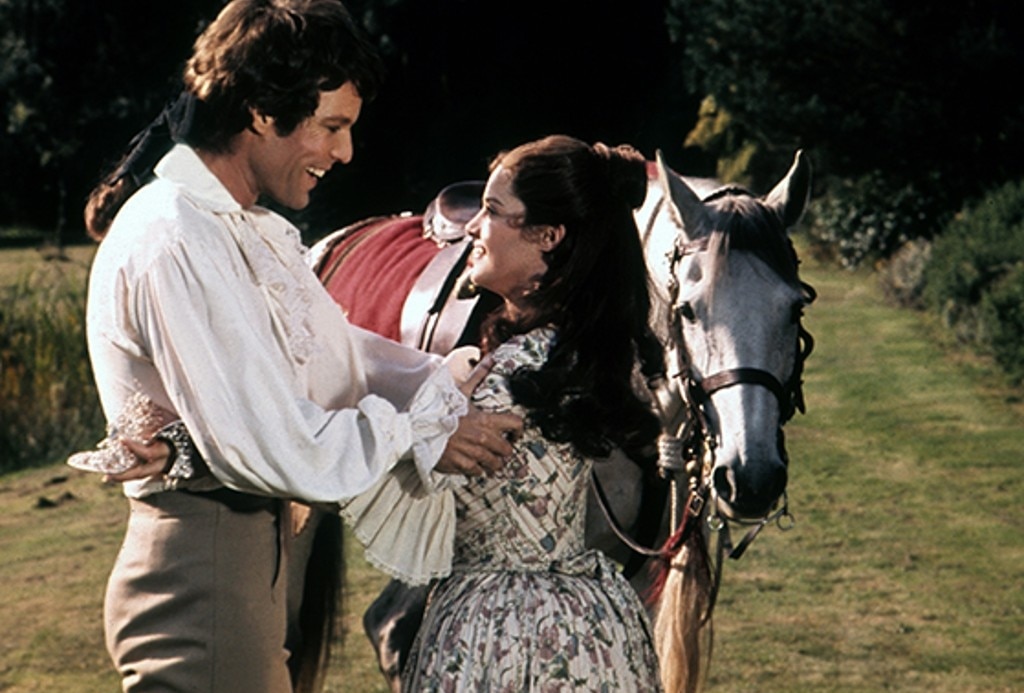
There have been many movie versions of the Cinderella story, some of them memorable, others less so; but in spite of the sure-fire material, not all of them enjoyed box office success. One of the most sumptuous was the extravagant, no-expense-spared original musical, 1976's The Slipper and the Rose, a British production with a terrific, mostly-English cast, plus American star Richard Chamberlain as a dashing, singing Prince Charming. In spite of the high production values and music and lyrics by the legendary Sherman Brothers (who wrote songs for Mary Poppins and other Disney hits), the film was a flop in the United States, although it was a hit in Great Britain.
Produced by talk show host David Frost The Slipper and the Rose is based on the French version by of the tale written by Charles Perrault in 1697, and the film is set in that era, with the elaborate costumes, powdered wigs, and furnishings reflecting the elegant excess of the time. Frost brought the project to Richard and Robert Sherman and asked them to write the screenplay as well as the score. At first they demurred, since they felt that Rodgers & Hammerstein had already written the definitive musical version, a television special which starred Julie Andrews, in 1957. Looking for a new approach, the Shermans decided to tell the story from the Prince's point of view. The Slipper and the Rose begins with the Prince talk-singing "Why Can't I Be Two People," an amusing ditty bemoaning his royal duty to marry for dynastic and political reasons instead of for love.
Blond and handsome Richard Chamberlain had become a star in the 1960s, playing the title role in the television series Doctor Kildare. During the run of the series he also became something of a teen idol when he had a pop hit with the song "Three Stars Will Shine Tonight," based on the theme music from the show. When Doctor Kildare ended, Chamberlain was determined to prove his versatility and did stage work in musicals and dramas, moving to England in the late 1960s. He even played Hamlet in repertory. By the time he appeared in The Slipper and the Rose he was a familiar performer in British films and television, and his American stardom was expected to be an asset for the film.
According to publicity for The Slipper and the Rose, Irish-born singer and actress Gemma Craven was cast as Cinderella after a year-long search, during which producers considered eighty-five actresses for the role. It was her film debut. Though she went on to have an impressive career in Britain on the stage and in television, The Slipper and the Rose proved to be her most substantial film role. Her portrayal of Cinderella is sweet, but not saccharine, and she displays a more complex personality than the one-note heroines in other versions of the tale.
Supporting the attractive romantic leads were some of Britain's legendary acting greats, singing and dancing in comic gem performances: Edith Evans then 87, in her penultimate role was the dotty dowager Queen Mother; Kenneth More played the officious Lord High Chamberlain, aptly described by the prince as "the ever unctuous"; Margaret Lockwood was an icy-chic wicked stepmother; and Annette Crosbie sparkled as the overworked fairy godmother. As the King, veteran actor Michael Hordern, all bumbling dignity, leads a Rockettes-kicking chorus line of 3elderly ministers singing the comic song "Protocoligorically Correct."
< br>
Visually, The Slipper and the Rose is fairytale-gorgeous. The company spent several weeks filming on location at two castles near Salzburg, Austria, where The Sound of Music had been filmed, as well as in Salzburg itself. Even before principal production began, director Bryan Forbes and crew had filmed some exteriors of winter scenes in the nearby Bavarian mountains. The interiors were shot at Pinewood Studios outside London, re-creating the elaborate interiors of Austrian and German castles of the appropriate era. One of the loveliest re-creations had nothing to do with royal grandeur. A scene near the end of the film of a sad Cinderella on a flower-bedecked garden swing is an homage to the famous 18th century Fragonard painting, "The Swing," with Cinderella in a pink dress and hat copied from that artwork.
Director: Bryan Forbes
Producer: David Frost, Stewart Lyons
Screenplay: Bryan Forbes, Richard M. Sherman and Robert B. Sherman
Cinematography: Tony Imi
Editor: Timothy Gee
Costume Design: Julie Harris
Production Design: Raymond Simm
Music: Richard M. Sherman and Robert B. Sherman, Angela Morley
Principal Cast: Richard Chamberlain (Prince Edward), Gemma Craven (Cinderella), Edith Evans (Dowager Queen), Annette Crosbie (Fairy Godmother), Christopher Gable (John), Michael Hordern (King), Margaret Lockwood (Stepmother), Kenneth More (Chamberlain), Lally Bowers (Queen).
C-143m.
by Margarita Landazuri
The Slipper and the Rose
by Margarita Landazuri | April 13, 2016
SIGN UP FOR OUR NEWSLETTERS

CONNECT WITH TCM