For her first film after the 1976 remake of A Star is Born, which moved the old Hollywood melodrama into the world of rock and roll stardom and became a massive hit (despite scathing, and often mean-spirited, reviews), Barbra Streisand reunited with Ryan O'Neal, her co-star in the modern screwball farce What's Up, Doc? (1972), for another knockabout romantic comedy.
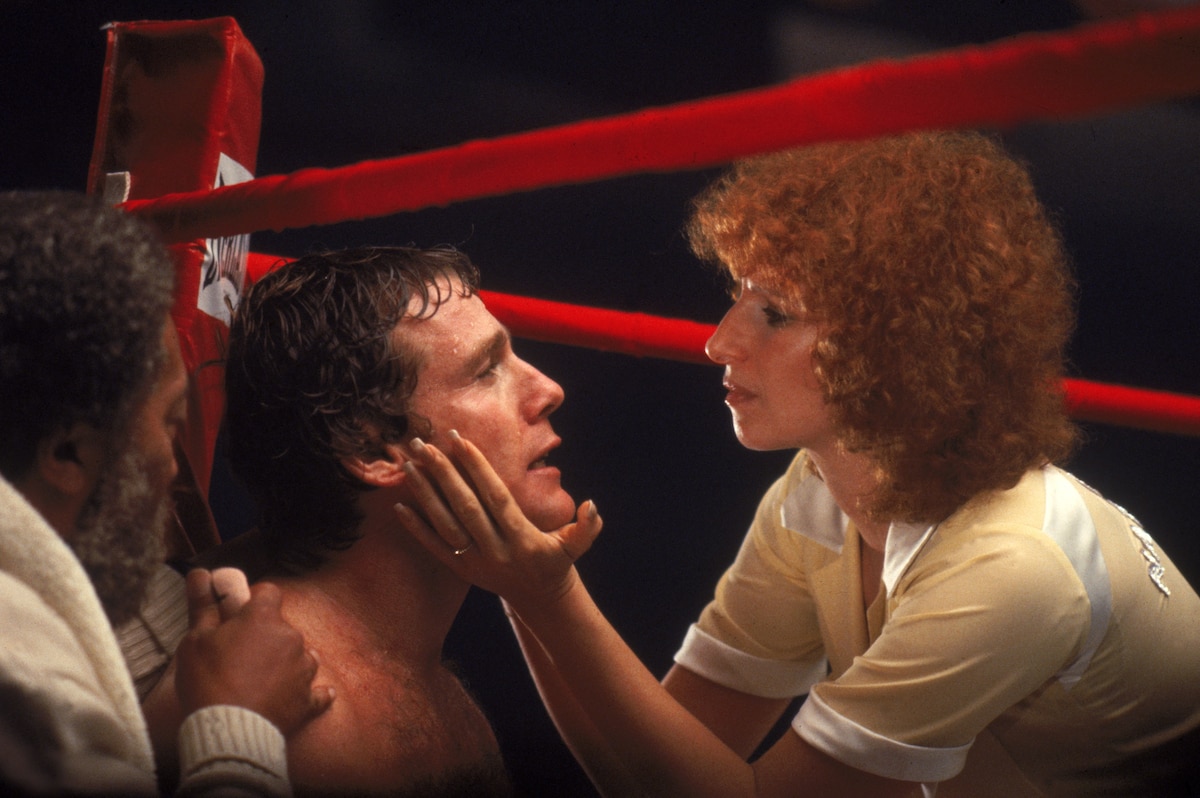
The Main Event (1979) stars Streisand as perfume magnate Hillary Kramer, a high-strung businesswoman whose company--in fact, her entire fortune--is stolen by her business manager / husband, who has absconded to South America. All she has left, besides debts, is a boxer named Eddie 'Kid Natural' Scanlon (O'Neal), a contract that was purchased as a tax write-off for the business. It's a modern battle-of-the-sexes movie with a Hepburn-and-Tracy vibe and a reversal of sexual the roles--the savvy woman is the manager and promotion mastermind and the male fighter is the under-appreciated artist she manipulates for publicity. They clash, sparks fly, and as they spat and spar in public (a show that makes his stock as a boxer far more valuable than his actual pugilistic talents), they fall in love in that volcanic love / hate manner that Hollywood loves so much.
The script, written by TV veterans Gail Parent and Andrew Smith for producing partners Renee Missel and Howard Rosenman, made its way to Jon Peters, Streisand's personal and professional partner, and he thought it would make a great vehicle for Streisand. She trusted his instincts and signed on as producer as well as star of the production and, just as on A Star Is Born, insisted on creative control. Howard Zieff, who had proven himself a deft filmmaker of light comedy with the witty Hollywood satire Hearts of the West (1975) with Jeff Bridges and the snappy, grown-up House Calls (1978) with Walter Matthau and Glenda Jackson, signed on to direct with Streisand as a hands-on collaborator who had right of final cut. According to biographer James Spada, Streisand even put a condition in the contract that forbade Zieff from speaking or writing negatively about Streisand or Peters. Ever.
Streisand worked with the screenwriters, had final say on the casting, and encouraged improvisations on the set. A scene with Hillary and Eddie on a talk show with his next opponent (played by Richard Lawson) and TV sportscaster Brent Mussbuger was reworked to get a snappy spontaneity. "The scene took on a life of its own," recalled co-star Lawson. "It was written was a straight interview but the whole aspect of her falling asleep and Ryan waking her up, and of her calling Musberger 'Brett' and 'Burt'--all of that was total improvisation." Another scene, with Hillary and Eddie the morning after they first make love, was written and shot after principal photography was completed at Streisand's insistence. It was another bit of comedy that upended and played on traditional expectations of sexual roles. In Streisand's own words, she wanted to "say something about men and women and the roles they're supposed to play and yet be funny." According to O'Neal, "In What's Up, Doc?, we did what we were told, Peter Bogdanovich ran the show. This time we tried all kinds of things. [Barbra] played the Bogdanovich role."
For the theme song, Streisand's record producer suggested Paul Jabara, the composer of Donna Summer hit (and Oscar winner) "Last Dance" and a Streisand fan. The single "The Main Event" became Streisand's first foray into disco. It went to number three on the pop charts in the summer of 1979 and the album went gold. Like the song, the film was a hit and it ended the year in the top twenty moneymakers.
By Sean Axmaker
Sources:
Streisand: A Biography, Anne Edwards. Little, Brown, and Company, 1977.
The Importance of Being Barbra, Tom Santopietro. St. Martin's Press, 2006.
Streisand: Her Life, James Spada. Crown, 1995.
AFI Catalog of Feature Films
IMDb
The Main Event
by Sean Axmaker | April 13, 2016
SIGN UP FOR OUR NEWSLETTERS

CONNECT WITH TCM