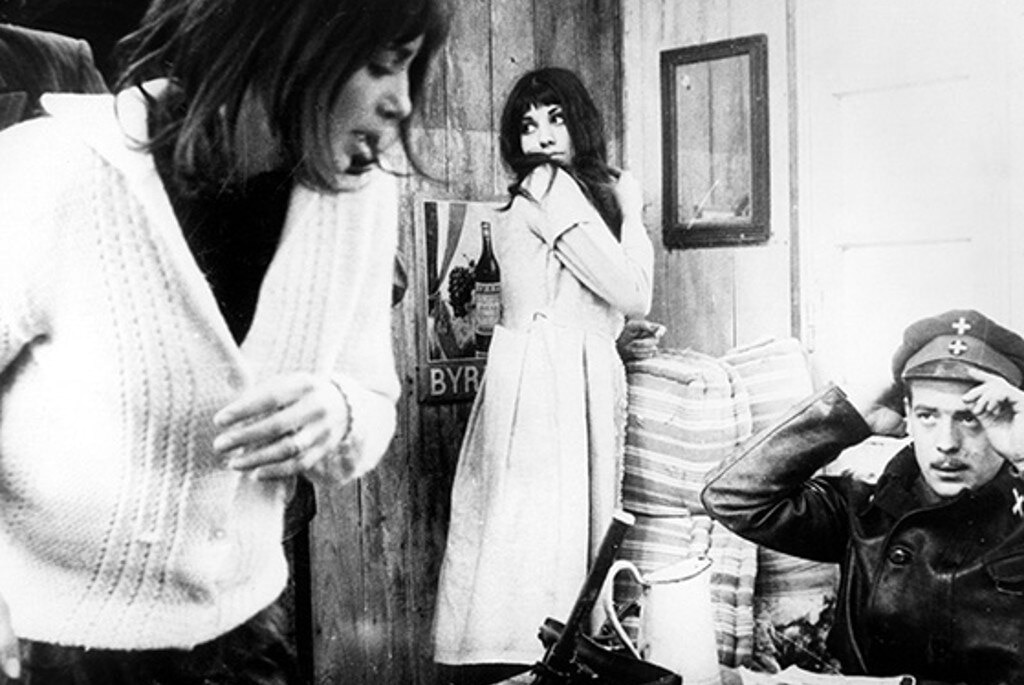
Two naive peasants, Ulysses and Michel-Ange, are promised great riches if they will serve their country at war. Abandoning their wives, the duo become soldiers of the king, raping, murdering, and plundering in his name. They eventually return home as victors but discover a revolution has taken place in their absence and they are now branded as traitors.
Les Carabiniers is easily one of Godard's most challenging films, juxtaposing black farce with real newsreel footage of battlefield atrocities to comment on the absurdity of war. The unique visual style of the film, which is both a tribute to the silent films of Louis Lumiere and the grainy texture of early photographs, also emphasizes the director's strangely detached presentation of events. Certainly one of the more memorable scenes in the film is a montage in the style of Sergei Eisenstein that catalogues the many conquests of the two moronic riflemen, rendered as postcard images. Equally notable is the sequence where Michel-Ange, experiencing his first movie, tries to enter the screen.
Needless to say, Godard's film was savagely attacked by French critics and stirred up considerable controversy. One critic wrote, "As for the horrors of war, you will find them evoked here not only clumsily but with offensive crudity. Jean-Luc Godard has not hestitated to provide his film with an authentic counterpoint by including newsreels shot by war correspondents at the risk of their lives. Caricature does not become satire as he had hoped: our laughter freezes." Godard took all this criticism as high praise, however, and responded, "In dealing with war, I followed a very simple rule. I assumed I had to explain to children not only what war is, but what all wars have been from the barbarian invasions to Korea and Algeria."
Director: Jean-Luc Godard
Producer: Georges de Beauregard, Carlo Ponti
Screenplay: Jean-Luc Godard, Jean Gruault, Roberto Rossellini (based on the play "I Carabinieri" by Benjamino Joppolo)
Cinematography: Raoul Coutard
Editing: Agnes Guillemot, Lila Lakshmanan
Music: Philippe Arthuys
Principal Cast: Marino Mase (Ulysses), Albert Juross (Michel-Angel), Genevieve Galea (Venus), Catherine Ribero (Cleopatre).
In French with English subtitles
BW-77m.
by Jeff Stafford
Les Carabiniers
by Jeff Stafford | October 22, 2002
SIGN UP FOR OUR NEWSLETTERS

CONNECT WITH TCM