For most audiences today, the comedy team of Bud Abbott and Lou Costello are best remembered for only a handful of works--their legendary "Who's On First?" routine, and the 1951 horror spoof Abbott and Costello Meet Frankenstein. There was a time when these two vaudeville comedians were the toast of Hollywood, and dominant box office champions. Those glory days did not last, and they spent the latter part of their film career trying to chase the success of Abbott and Costello Meet Frankenstein. It is easy for 21st century armchair quarterbacks to look back on the furious rise and sudden decline of Abbott and Costello and chalk it all up to too many "Abbott and Costello Meet a Monster" formula pictures. But there's a secret history buried under all those monster films. The thing that really burst the Abbott and Costello bubble was not when they met monsters--it was when they met themselves.
Our story starts with a promising young boxer named Louis Cristillo, whose short stature belied a multifaceted athleticism. His outstanding win-loss record for his first dozen bouts probably gave the local gambling community conniption fits, which were resolved when his father demanded he change careers. So, young Cristillo set off for Hollywood, where he found work as a stunt man. During production on The Trail of '98 in 1928, however, he suffered an injury that forced yet another career rethink. This propelled him to St. Joseph, Missouri, where he renamed himself "Lou Costello" and started doing vaudeville comedy with a straight man named Joe Lyons. One fateful day in 1936, Lyons failed to show up for a gig, leaving Costello to hire a substitute partner for the night--one William Alexander "Bud" Abbott.
On stage, Abbott's smarmy persona and bullying self-confidence played well opposite Costello's childlike buffoonery. Audiences loved them together, and poor Joe Lyons found himself out of a job. Off stage, however, Abbott was a difficult partner, and a career-long albatross for Costello to bear. Abbott was a fourth-grade dropout, an epileptic, and an alcoholic. He could not remember his lines, nor could he do anything resembling "acting" with those lines anyway. He had no aptitude for physical comedy. Basically, he could do one thing--he did it well, he may even done it superlatively, but nonetheless it was just one thing, and that placed permanent boundaries on what their comedy team was capable of. Playing to vaudeville houses, where a 20 or 30 minute routine was all that was required and the same show could be recycled endlessly night after night, he brought a structure to Costello's comedy and made them stars. But on the movie screens, trying to support a 90 minute feature, and do so again and again with enough variety to keep audiences satisfied, he was as much a liability as an asset.
To add to the tension, Lou Costello and Bud Abbott had personal conflict that was often insanely petty. For example, Lou fired a maid--Bud then hired the same maid. This triviality resulted in enduring enmity and angry shouting matches. In another age, the off-screen feuding between the two comedians could have been mined for reality television gold. In the 1940s and 50s, it was merely a source of dysfunction.
But these issues were almost entirely invisible to the audience, for whom Abbott and Costello burst onto the scene as a fresh, fast-paced, comedy powerhouse. They quickly became one of the nation's top box office attractions.
Abbott and Costello now had enough clout to do just about anything they wanted. Or, at least Lou Costello did--as the nominal creative force behind the team and the only one who seemed interested in trying to steer the ship, he could have tried to exercise that leverage in any number of ways. In the end, he used that leverage sparingly, arguing for the chance to make a couple of experimental comedies that kept him and Bud Abbott separate, so as to buy him some breathing room from his exasperating partner. Other than that, Abbott and Costello used their stardom to goof off--showing up late to the set, and focusing their attention on cards and other distractions.
The lackadaisical attitude took its toll. Their marquee value dwindled; they left the nation's top studio (MGM) for a struggling also-ran (Universal); their longtime producer Alex Gottlieb departed; and their radio show ended. And then, just as it seemed everyone was ready to switch off the lights for good, they made a film called Abbott and Costello Meet Frankenstein. It was a massive success that earned back huge profits to Universal, revived interest in both their moribund gothic horror cycle and the flagging Abbott and Costello comedies, and remains an enduringly beloved comedy classic to this day.
Unsurprisingly, the studio sought to replicate the success--and thus Abbott and Costello Meet the Killer, Boris Karloff; Abbott and Costello Meet the Invisible Man; Abbott and Costello Meet Dr. Jekyll and Mr. Hyde; and Abbott and Costello Meet the Mummy. Problematically, distribution company Realart decided the best way to exploit their license to reissue old Abbott and Costello features was to more or less dump all of them onto theaters at once. The marketplace was glutted with Abbott and Costello product--which only served to dilute the audience and emphasize how formulaic the films had become.
Meanwhile, upstarts like Dean Martin and Jerry Lewis started to peel away Abbott and Costello's audience--they were fresh, young, and silly, and quickly usurped the role of top comedy duo in the nation's hearts and cinemas. By 1951, Martin and Lewis were the highest paid act in show business. By 1953, they had appeared in a dozen films.
In 1953, by contrast, Abbott and Costello were falling out of their own films. They were supposed to star in Fireman Save My Child, but production was disrupted when Lou Costello fell ill. Buddy Hackett and Hugh O'Brien subbed in to take over their roles and finish the film. When Costello felt well enough to return to work, producer Howard Christie decided it was time for the boys to "meet" Jekyll and Hyde.
Intriguingly, screenwriters Grant Garrett and Sid Fields' early drafts were titled "Abbott and Costello Meet Dr. Jekyll and Mrs. Hyde"! The early scenes of the finished film still retain some residual dialogue hinting at that alternate gender-bending scenario, but subsequent drafts by Lee Loeb and John Grant steered the project back into more familiar, and largely generic, territory.
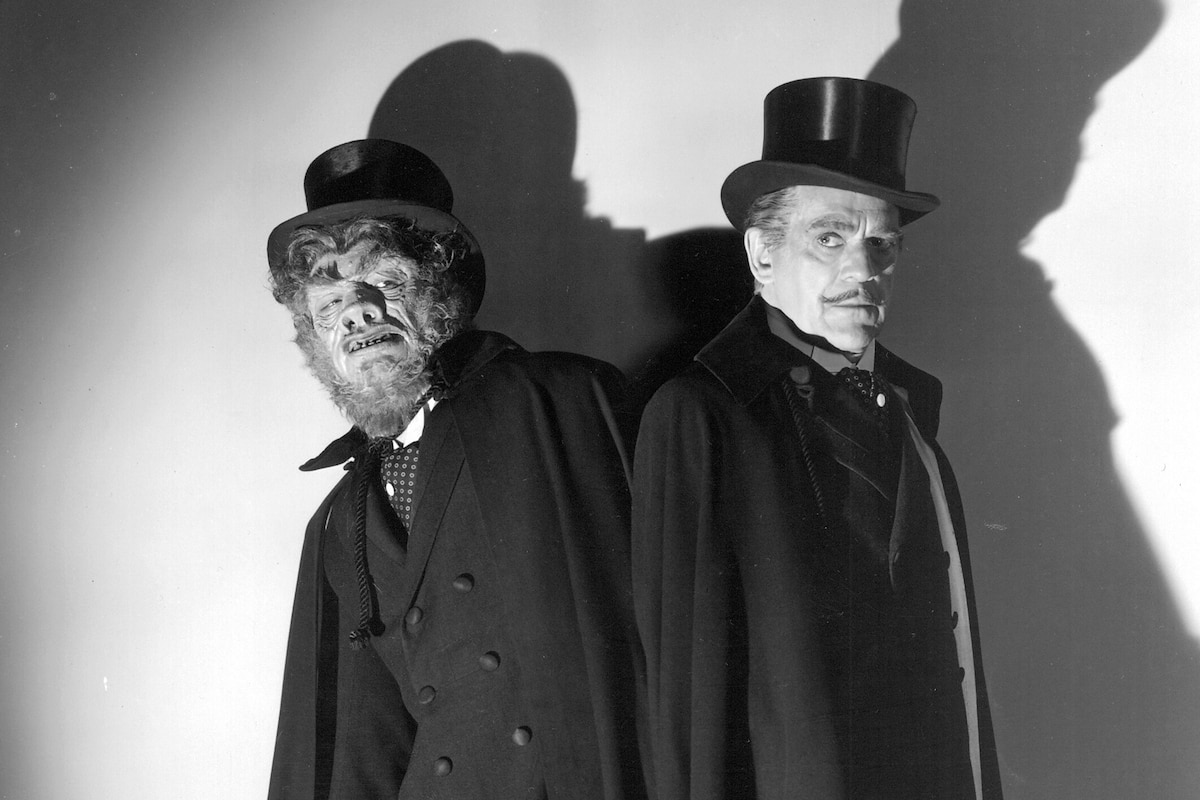
Universal otherwise had not had any skin in the Dr. Jekyll and Mr. Hyde game--the 1920 film with John Barrymore had been a Paramount production, and both the 1932 Rouben Mamoulian version and the 1941 Victor Fleming remake were MGM pictures. Thanks to Abbott and Costello, though, Universal now had a handy gimmick to try out their own Jekyll and Hyde variant, with genre superstar Boris Karloff in the title role, more or less. ("More or less" because Karloff only plays Dr. Jekyll, ceding the part of Mr. Hyde to his stunt double Eddie Parker in a mask).
Director Charles Lamont was (reluctantly) responsible for nearly all of Abbott and Costello's screen comedies. He was a fourth-generation actor who had long ago shifted his focus towards working behind the scenes. In 1922 Lamont started directing silent comedies for the likes of Mack Sennett and Al Christie. In the 1930s he directed Buster Keaton's run of talkie comedy shorts, and briefly worked at Columbia's comedy shorts division directing Charley Chase and The Three Stooges. When he passed away in 1993, Lamont had over 100 movies to his name. By the mid-1940s, Lamont was a well-respected and seasoned comedy veteran, and he knew what he wanted to do: sophisticated situation comedies, not knockabout slapstick. But Abbott and Costello's then-producer Alex Gottlieb was in a tight situation--production on Hit the Ice was interrupted by the firing of director Erle C. Kenton, and Gottlieb wanted somebody with Lamont's experience and level head to right the ship. He completed the assignment, protesting all the way how little he cared for this style of comedy, only to find the film was a popular and profitable hit. With every successful Abbot and Costello film he made, he only convinced his employers that was where to deploy his talents. He would almost never be given the opportunity to do any other kind of film ever again.
By David Kalat
Sources:
Leonard Maltin, The Great Movie Comedians
Jeffrey S. Miller, The Horror Spoofs of Abbott & Costello: A Critical Assessment of the Comedy's Monster Films
James Robert Parish and William T. Leonard, The Funsters
Bill Warren, Keep Watching the Skies!
Abbott and Costello Meet Dr. Jekyll and Mr. Hyde
by David Kalat | March 30, 2016
SIGN UP FOR OUR NEWSLETTERS

CONNECT WITH TCM