Walt Disney enjoyed great success with live action documentaries ever since, in 1948, he began the True Life Adventure Series, live-action documentary shorts that would give viewers a glimpse at the wilds of nature unavailable at the local zoo. Starting with Seal Island, which won an Oscar, Disney ventured deeper and deeper into live action nature films, moving towards blending documentary film with narrative film in ways that hadn't been done since the early days of film. The movies would have a story, and actors and a script, but much of the footage would be real life action caught in the wild, or at least real life action thrust upon unaware animals in the wild. Nikki, Wild Dog of the North was one of the studios best efforts, and quite successful too, but one that has become virtually forgotten over the years.
Nikki, the dog of the title, is a malamute, one eighth wolf, the rest Mackenzie Huskie, so the narration informs us. He's owned by a fur trader, Andre Dupas (Jean Coutu), and the two venture down river in the Canadian Northwest in 1899, just before the turn of the century and an eventual end to their lifestyle. It's a different world, one full of traditions and rituals that Nikki, faithful dog, must learn from his master. Upon coming ashore in their canoe before hitting the rapids the following day, Nikki immediately runs off to play and before long, smells a bear. Andre knows all too well what Nikki smells and informs Nikki of what he has learned about bears: if you don't bother them, they don't bother you. To make sure of this, he ties Nikki to the heavy supply bag and settles down to take a nap.
The bear, identified by the narrator as Noozak, a very old she-bear, is just coming out of hibernation with her cub, Neewa. Noozak, we are informed, is too old to have any more children and Neewa, it is implied, is too much for her to handle. Indeed, Neewa immediately begins not only playing with every animal he can find, from goose to groundhog, but arousing the unwanted interested of a grizzly bear he mistakes for his mom. The grizzly attempts to kill Neewa until Noozak intervenes and, while Neewa hides up a tree, is killed by the grizzly. Back at the canoe, Nikki hears the moans of Neewa and takes off, dragging the supply bag behind him. Andre tries to stop him but can't and instead follows Nikki to his destination, the tree sheltering Neewa. Andre frees the cub, spots the dead mother, and decides to take the cub along for the ride on one condition: Nikki must take care of her. How? Andre ties the two together, a rope connecting them at the neck.
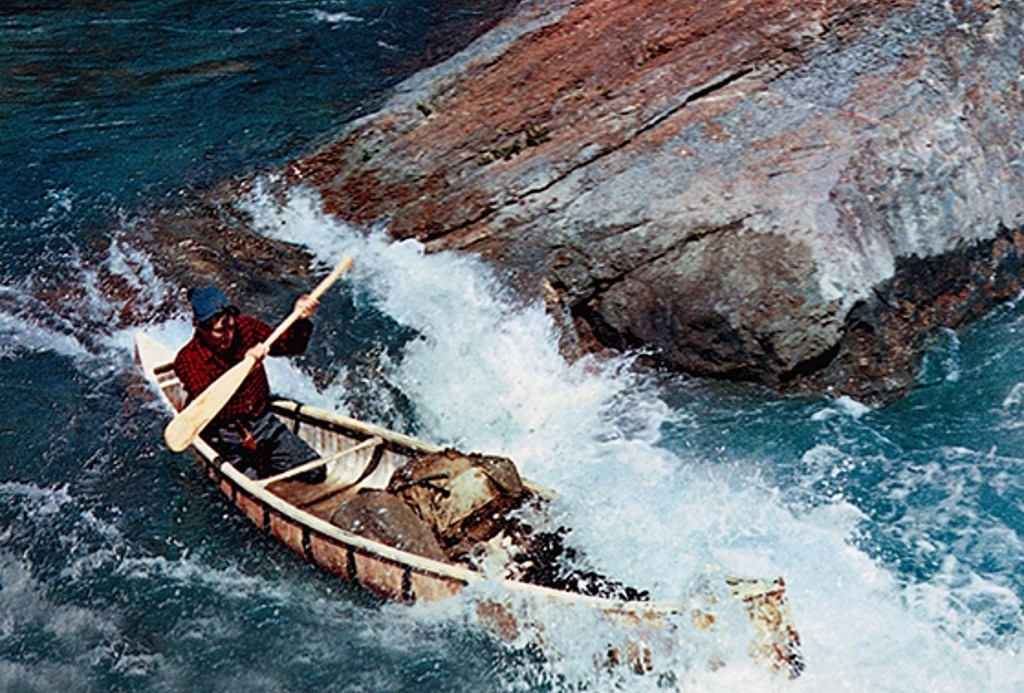
The next day, as they set off to face the rapids, both Nikki and Neewa begin fighting and Andre tries to calm them down while simultaneously navigating the canoe down the rapids. The canoe capsizes and Nikki and Neewa are sent rushing down river, straining to stay alive as they tug and pull on each other's neck. When they finally make it ashore, they find that life is harder than they expected. Neewa is fine with berries and grass while Nikki has a taste for meat. Any time Nikki attempts to chase down some game, however, he is met with the insurmountable task of chasing anything down while dragging a bear by his neck. It's not long before the two must learn to live and work together, and become friends in the process.
Eventually, the two break free from their mutual bondage and make their way separately. Nikki encounters man outside of her beloved owner Andre and must learn that not all men are friendly. Eventually, he is caught and an evil fur trader, La Beau (Emile Genest) trains him to be a fighting dog and doesn't know if he will ever see Neewa or Andre again.
Nikki, Wild Dog of the North is notable for several reasons. For starters, it's a brutal film, especially coming from the Walt Disney studio. So brutal, in fact, that even now, decades later, it's probably best, despite its "G" rating, to keep small children away as the scenes of animals fighting in the wild, from bears to wolverines and dogs against dogs, can be both very real and even disturbing at times. Some of the fights seem real enough to question the safety of the animals involved and, indeed, in today's atmosphere, many of the scenes in this movie might not sit well with a modern audience. It also portrays its lone Indian character, Makoki (Uriel Luft), in the same way as many Hollywood productions of the day, i.e. speaking in broken English and played by a white actor. On the other hand, that same character is portrayed in an entirely positive light while the white fur trader he works for, La Beau, is portrayed as bigoted, brutish, and distrustful. And despite the very real scenes of animal fighting, the movie carries a strong message that dog fighting is a cruel and inhumane sport.
Nikki, Wild Dog of the North was the precursor to The Incredible Journey, released just two years later and far better remembered today. That's probably for a few reasons. One, it had cats and dogs, not bears and dogs. Two, it wasn't nearly as violent. Three, it was adapted from a very successful novel and had Nikki, Wild Dog of the North before it to learn from its mistakes. Still, Nikki, Wild Dog of the North is deserving of more attention than it's received. It set a template for this kind of cinematic storytelling and is filled with gorgeous on-location photography of the Canadian wilderness. Nikki, Wild Dog of the North is a conflicted movie to say the least. It probably wouldn't contain nearly as many, or as intense, scenes of violence if made today but in many ways that makes it a unique document of its time. It's more of a harsh journey than an incredible one, but a worthy journey all the same.
By Greg Ferrara
Nikki, Wild Dog of the North
by Greg Ferrara | March 11, 2016
SIGN UP FOR OUR NEWSLETTERS

CONNECT WITH TCM