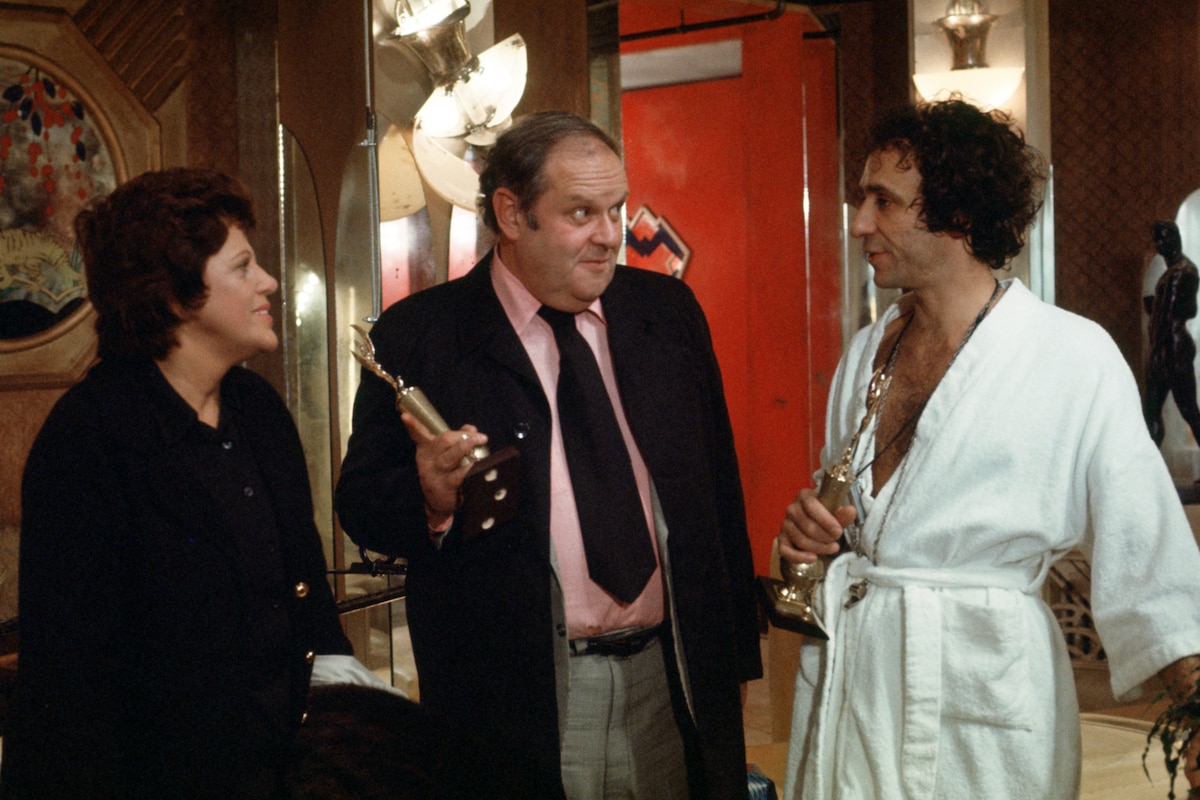
Before American playwright Terrence McNally won his four Tony Awards, he had his first major success with The Ritz, a rapid-fire farce set in a gay bathhouse in Manhattan. It's where a naïve Cleveland businessman, completely unaware that it's a haven for homosexual men, hides out when his Italian brother-in-law decides that he has to die. Mistaken identities and misunderstandings ensue, including a third-rate chanteuse who performs at the bathhouse nightclub and mistakes the businessman for a Broadway producer. Jack Weston played the hapless businessman on the run, Jerry Stiller the brother-in-law determined to kill him, and Rita Moreno the singer, a heavily-accented entertainer by the name of Googie Gomez.
McNally had written a play set at a gay bathhouse called Tubs but Moreno inspired McNally to rework it. "I'd developed my Googie character in a hundred "idle" hours in dressing rooms and at laid-back parties with showbiz friends," she wrote in her memoir. "She was the worst Hispanic cabaret singer of all time," with operatic gestures, excessive make-up, tasteless costumes, and a thick Miami-Cuban accent, and she performed as Googie at a party thrown by actor James Coco, where McNally was a guest. "Terrence wrote Googie into his play big-time after seeing me at Jimmy's party," she wrote, and though she was unavailable when the play was workshopped in New Haven, she took over the role when it went to New York.
The play opened on Broadway in 1975 and played for almost a year, closing after nearly 400 performances, and earned Rita Moreno a Tony Award for her performance and McNally a Drama Desk nomination for Outstanding New American Play. A month after it closed, production began on a film adaptation at Twickenham Studios in London, England under the direction of Richard Lester with a screenplay penned by McNally. Seven members of the original Broadway cast were brought along to the film, including stars Moreno, Weston, and Stiller, and supporting player F. Murray Abraham, a stage veteran who was still years away from making his name on the screen in his Oscar-winning performance as Antonio Salieri in Amadeus (1984). New to the ensemble were Kaye Ballard as Weston's frantic wife (who jumps to all sorts of conclusions when she discovers him in the bathhouse), Treat Williams as a rookie detective with voice on helium, silent film legend Bessie Love in a small role, and future Cheers star and favorite Pixar voice actor John Ratzenberger, who made his film debut as a bathhouse patron.
An American who made his home in England, Lester made his reputation as a fresh, innovative filmmaker with Beatles rock and roll romp A Hard Day's Night (1964) and the swinging London spoof The Knack and How to Get It (1965) and proved his versatility with the acidic drama Petulia (1968), the comic swashbucklers The Three Musketeers (1973) and The Four Musketeers (1974), and the melancholy Robin and Marian (1976). The Ritz, which puts a contemporary spin on the classic door-slamming bedroom farce, gave Lester an opportunity to stage a madcap slapstick comedy in a modern setting. And though it may not seem particularly revolutionary today, it put numerous gay characters on the screen at a time when they were rarely acknowledged, let alone respected, in American movies. While the portrayal of gay characters leans on familiar stereotypes, from swishy, effeminate portrayals (Abraham offers a particularly flamboyant performance) to sex-obsessed promiscuity, Lester includes them in a raucous party where everyone and everything is fair game, from the machismo of the Italian code to the parody of Hispanic caricatures created by Moreno. "I so liked Rita Moreno and Jack Weston," he recalled to Steven Soderbergh. "It was such fun."
By Sean Axmaker
Sources:
Rita Moreno: A Memoir, Rita Moreno. Celebra, 2013.
Rita Moreno, Susan Suntree. Chelsea House Publishers, 1993.
Getting Away With It, Steven Soderbergh. Faber & Faber, 2011,
AFI Catalog of Feature Films
IMDb
The Ritz
by Sean Axmaker | March 11, 2016
SIGN UP FOR OUR NEWSLETTERS

CONNECT WITH TCM