Trivia and Fun Facts on THE QUIET MAN
Michaleen's line when he sees the Thornton's broken bed the day after their wedding ("Impetuous! Homeric!") was censored when the film was shown in Ohio.
John Wayne was a football star at the University of Southern California in the mid-1920s when Western star Tom Mix gave him a summer job as a prop man in exchange for USC game tickets. On the set he became close friends with director John Ford, who gave him some of his first bit roles in movies. After more than 70 low-budget movies, most of them Westerns, Ford cast him in Stagecoach (1939), the film that made Wayne a star. Theirs was a lifetime friendship and one of the screen's most productive partnerships, lasting more than 30 years and through 23 films, including the justly famous "cavalry trilogy" - Fort Apache (1948), She Wore a Yellow Ribbon (1949) and Rio Grande (1950) - and the dark Western The Searchers (1956).
Wayne took his nickname "Duke" from his childhood pet, an Airedale dog.
Irish-born Maureen O'Hara began acting at an early age, and by the time she was 14, she was receiving awards in festivals and drama contests. She made her stage debut with the Abbey Players of Dublin and went to the London stage in 1938. Alfred Hitchcock cast her in Jamaica Inn (1939) with Charles Laughton, who was so impressed with the beautiful redhead he brought her to Hollywood to play the gypsy girl Esmeralda in his next picture The Hunchback of Notre Dame (1939). Her career got an early boost from her performance in John Ford's How Green Was My Valley (1941). She made four more pictures with Ford, three of them with John Wayne.
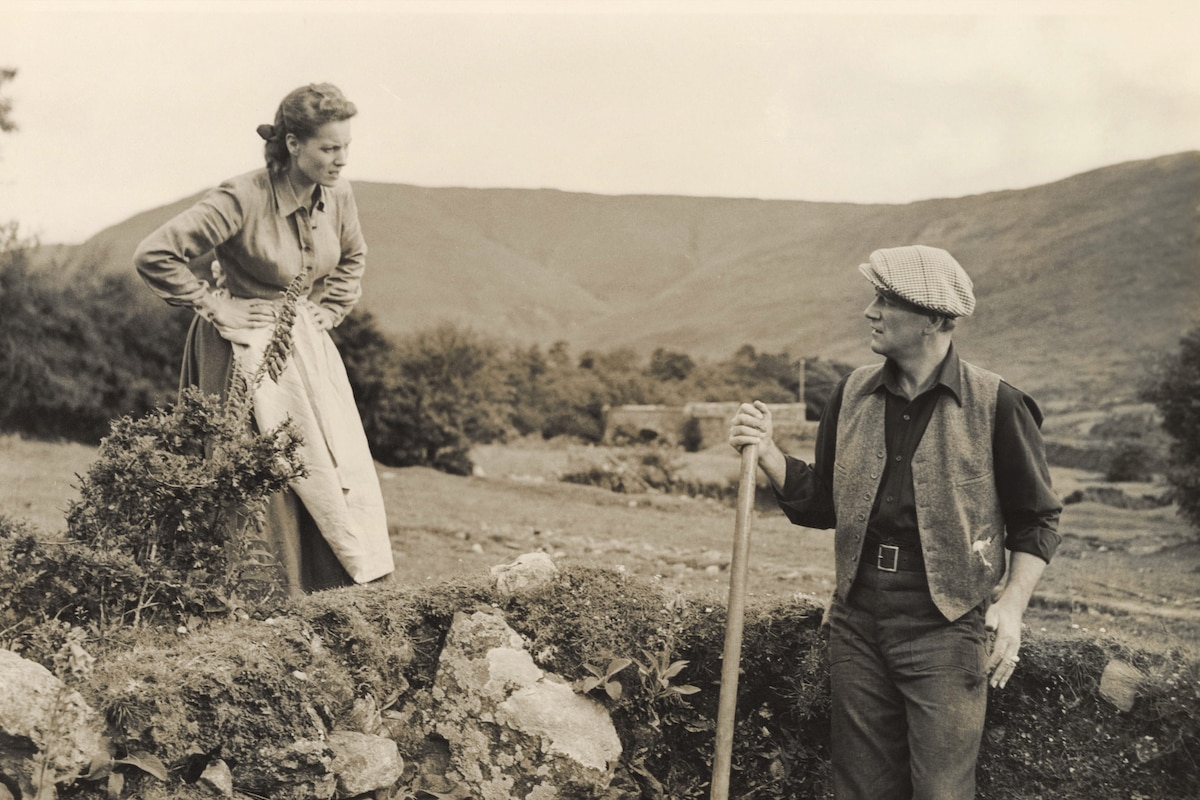
John Wayne and Maureen O'Hara were one of the most popular, yet critically underrated, romantic screen teams. They made five pictures together: Rio Grande (1950), The Quiet Man (1952) and The Wings of Eagles (1957), all for John Ford; McLintock! (1963), directed by Andrew McLaglen (Victor's son and assistant director on The Quiet Man); and Big Jake (1971), co-directed by Wayne and George Sherman.
Like O'Hara, Barry Fitzgerald began his acting career in Dublin's Abbey Players (though years earlier). Also like O'Hara, he got his first big break in a Hitchcock picture, recreating his stage role in Sean O'Caseys Juno and the Paycock (1930). He was brought to Hollywood by Ford for another O'Casey-based film, The Plough and the Stars (1936). He appeared in five Ford pictures, including The Long Voyage Home (1940) with Wayne and How Green Was My Valley (1941) with O'Hara.
Ford stock-company regular Ward Bond was in 25 of the director's movies between 1930 and 1957 (nine of them with Wayne). Like Wayne, he had been a college football player. Ford also directed an episode of Bond's popular Western TV series Wagon Train in 1957.
Victor McLaglen won an Oscar® for his portrayal of Gypo Nolan in Ford's production of The Informer (1935). He and Ford made 12 films together; six of them also featured John Wayne.
British-born McLaglen was a prizefighter in Canada before going into acting. He was once touted as a "great white hope" to stop famed black boxer Jack Johnson but lost the much-promoted fight in the sixth round.
Frank S. Nugent was one of Ford's favorite screenwriters. They worked on 11 films together between 1948 and 1963.
In She Wore a Yellow Ribbon (1949) and The Searchers (1956), cinematographer Winton C. Hoch created the Technicolor image of the West we associate so closely with Ford. The two worked on five pictures in all. Hoch won Academy Awards for his work on She Wore a Yellow Ribbon and The Quiet Man, as well as one for Victor Fleming's film Joan of Arc (1948).
Victor Young composed the scores for three Ford pictures. He was one of Hollywood's most productive musical talents, either writing, arranging, conducting or supervising the music for more than 300 films. He also wrote and conducted music for several top radio programs and recorded for Decca Records. No film composer of his period (the mid 1930s through the mid 1950s) made more recordings or had more hit songs drawn from his scores.
Producer Michael Killanin was later head of the International Olympic Committee.
Famous Quotes from THE QUIET MAN
SEAN (John Wayne): I'm Sean Thornton and I was born in that little cottage. I'm home and home I'm going to stay
FATHER LONERGAN (Ward Bond): I knew your people, Sean. Your grandfather, died in Australia, in a penal colony. And your father, he was a good man, too.
SEAN: (seeing Mary Kate for the first time) Hey, is that real? She couldn't be.
MICHALEEN (Barry Fitzgerald): Ah, nonsense, man. It's only a mirage brought on by your terrible thirst.
MARY KATE (Maureen O'Hara): The House may belong to my brother, but what's in the parlor belongs to me.
MICHALEEN: And I hope there's a bottle there, whoever it belongs to.
MICHALEEN: It's a fine soft night, so I think I'll go join me comrades and talk a little treason.
MARY KATE: I'll wear your ring, I'll cook, I'll wash, I'll keep the land. But that is all. Until I've got my dowry safe about me, I'm no married woman. I'm the servant I always have been. Without anything of my own.
SEAN: There'll be no locks or bolts between us, Mary Kate, except those in your own mercenary little heart.
MICHALEEN: (seeing the Thornton's broken bed the day after their wedding) Impetuous! Homeric!
Compiled by Rob Nixon
Trivia - THE QUIET MAN
by Rob Nixon | February 28, 2006
SIGN UP FOR OUR NEWSLETTERS

CONNECT WITH TCM