Behind the Camera on THE QUIET MAN
Production of The Quiet Man was a real family affair. Ford's daughter assisted editor Jack Murray and her husband played a small role. His son Patrick was one of the second unit directors, along with John Wayne (his first assignment behind the camera). Ford even brought his local Hollywood priest, Father Stack, to bless the film and serve as technical advisor.
Ford also cast his brother, respected stage actor Francis Ford, from whom he had long been estranged. Although this was Francis's 29th appearance in one of his brother's films, the two never socialized. Francis received his assignments by mail, shot his scenes and walked off without a word between him and his director brother beyond a short nod at the end of every day.
Wayne brought his four children with him to Ireland and they appear in the Inisfree race scene in the cart with Maureen O'Hara. The two youngest were given a couple of lines in that scene.
O'Hara's brother Charles Fitzsimons played one of the IRA men, and Barry Fitzgerald's brother, Arthur Shields, was cast in the key role of the Rev. Playfair, the town's Protestant vicar. Victor McLaglen's son Andrew served as an assistant director.
Several actors were brought in from Dublin's Abbey Players, where O'Hara and Fitzgerald had started their careers. Some of them had appeared in Ford's The Plough and the Stars (1936).
Wayne said the role, now considered one of his best, was difficult for him. "For nine weeks I was just playing straight man to those wonderful characters, and that's really hard."
One of Ford's budget-cutting measures was to forego using his usual make-up man Web Overlander. He told Wayne he would have to use O'Hara's make-up person. But the actor was sensitive to make-up (which Overlander knew) and his face puffed up like a blowfish after one treatment. Ford immediately sent for Overlander.
Ford sometimes resorted to cruel manipulation of his actors to get what he wanted. Although an ex-boxer, McLaglen was a very mild man, and Ford was not convinced he could pull off the lengthy fight scene with Wayne. The evening before shooting it, he ran McLaglen through the scene where his character throws the sister's dowry on the floor. In front of McLaglen's son, Ford cursed him for a lousy performance and said the next day's filming would be useless. McLaglen fumed all night and came on to the set the next day raging and primed for the big fight.
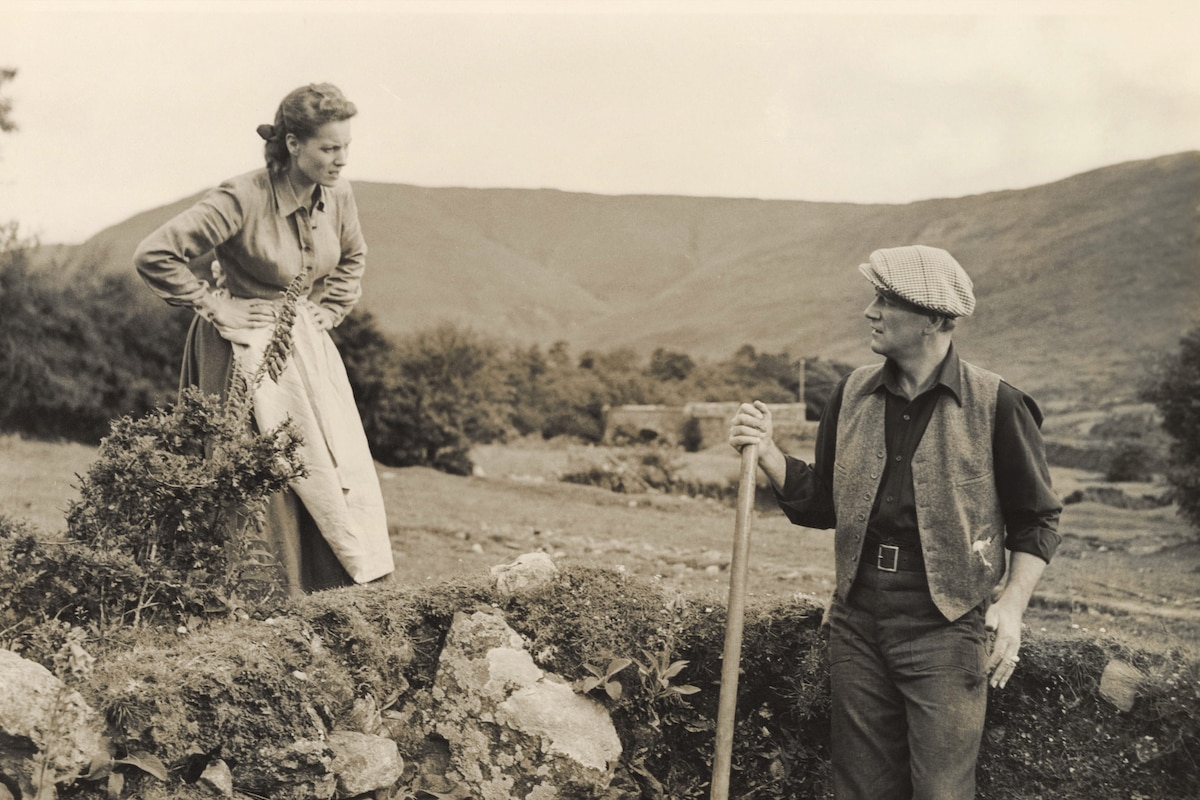
O'Hara endured her share of hardships on the film. She had no double for the scene where Wayne drags her across the fields back to the village and got bruised by the rough terrain. She broke a bone in her hand in the scene where she swings at Wayne and he blocks it. And in the scene where Wayne discovers her in his cottage, the wind whipped her hair so ferociously around her face she kept squinting. Ford screamed at her in the strongest language to open her eyes. "What would a bald-headed son of a bitch know about hair lashing across his eyeballs," she shot back.
Ford was noted for his ill temper and fierce control, which sometimes bred great tension on the set, but his actors often praised his working methods. "You become so tuned to him, one word of his becomes a volume," O'Hara said. "You become aware that he understands the story and knows how to get it out of you. It's a frame of mind he creates. He puts you at ease and sets you free to think, and you can move easily." Ford sometimes let his actors improvise their lines in run-throughs to get the sense of what they were saying rather than the exact words. "Consequently we can concentrate on playing, not remembering," O'Hara added. "You are able to invent, improvise, and use your body; then he spots things you do without thinking and uses them."
Republic head Herbert Yates wanted Ford to shoot using the studio's own TrueColor process, but Ford insisted on the vastly superior Technicolor.
Cinematographer Winton Hoch was a master of color photography (he never shot in black and white), but he encountered difficulties on location. During the six weeks of shooting in Ireland, there were only six days of intermittent sunshine, the rest were rainy and overcast. "Most of the time the clouds were moving across the sky, and the light was constantly changing," Hoch said. "I had to light each scene three different ways: for sunshine, for clouds, for rain. I worked out a set of signals with the gaffer, and we were ready no matter what the light was." It was difficult, but Hoch's method produced gorgeous results. Nevertheless, Yates did not like the look of the rushes. "It's all green," he commented, adding to Ford's frequent frustration and depression during the shoot.
Locals in the town of Cong, where location shooting took place, were understandably excited and thrilled to have the production there. Many of them got work on the set, including Joe Mellotte, whose job it was to stand by Wayne and provide him cigarettes throughout the day. But their enthusiasm also caused continuity nightmares because they were always hanging around the set, popping in and out of scenes where they shouldn't have been.
The local grocery store was converted into Cohan's pub. After shooting completed, the owner of the store decided to leave the pub sign up in front of his business.
Several scenes were shot that never appeared in the movie: O'Hara speaking in Gaelic to greet Wayne for the first time; a scene where Father Lonergan and Michaleen discuss betting on horses (deemed offensive because he is a priest); Wayne's first scene on the train, where he speaks to a mother and her child gives him an apple (in the existing opening scene, Wayne deboards the train holding the apple and thanks the unseen child).
Ford became unsure of himself and his story during production. Bickering with Yates took its toll on him, and he resented being at a minor studio where everything was generally second-class. At one point, nursing a bad cold, he told Wayne that for the first time he had no idea where the story should go. "I don't know whether I've got a picture here or not," he said. Wayne recalled that in all the years he worked with Ford, he never saw him so down and so willing to admit his fears. While Ford was in bed sick, Wayne took the crew to
In spite of his deteriorating mental and physical condition during production, Ford was sad to leave Ireland. "It seemed like the finish of an epoch in my somewhat troubled life," he wrote to an Irish friend. "Galway is in my blood and the only place I have found peace."
With the film in the can, Ford had to contend with one other problem from Yates. The studio boss insisted the film be no longer than 120 minutes. Ford's cut ran to 129 minutes. Yates insisted he cut the extra time off before a screening for Republic's distributors. The screening went very well, and everyone was enjoying the picture. Then, at exactly 120 minutes, just as the climactic fight between Wayne and McLaglen started, the movie stopped. Ford turned to Yates: "I couldn't figure out how to cut nine minutes without ruining it, so I figured, what the hell? Why knock myself out? I just cut out the fight and got it down to 120 minutes." The point was made, and Yates released the movie at 129.
At the end of production, Ford admitted he liked the movie for its "strange humorous quality and the mature romance."
by Rob Nixon
Behind the Camera - THE QUIET MAN
by Rob Nixon | February 28, 2006
SIGN UP FOR OUR NEWSLETTERS

CONNECT WITH TCM