The Big Idea Behind THE QUIET MAN
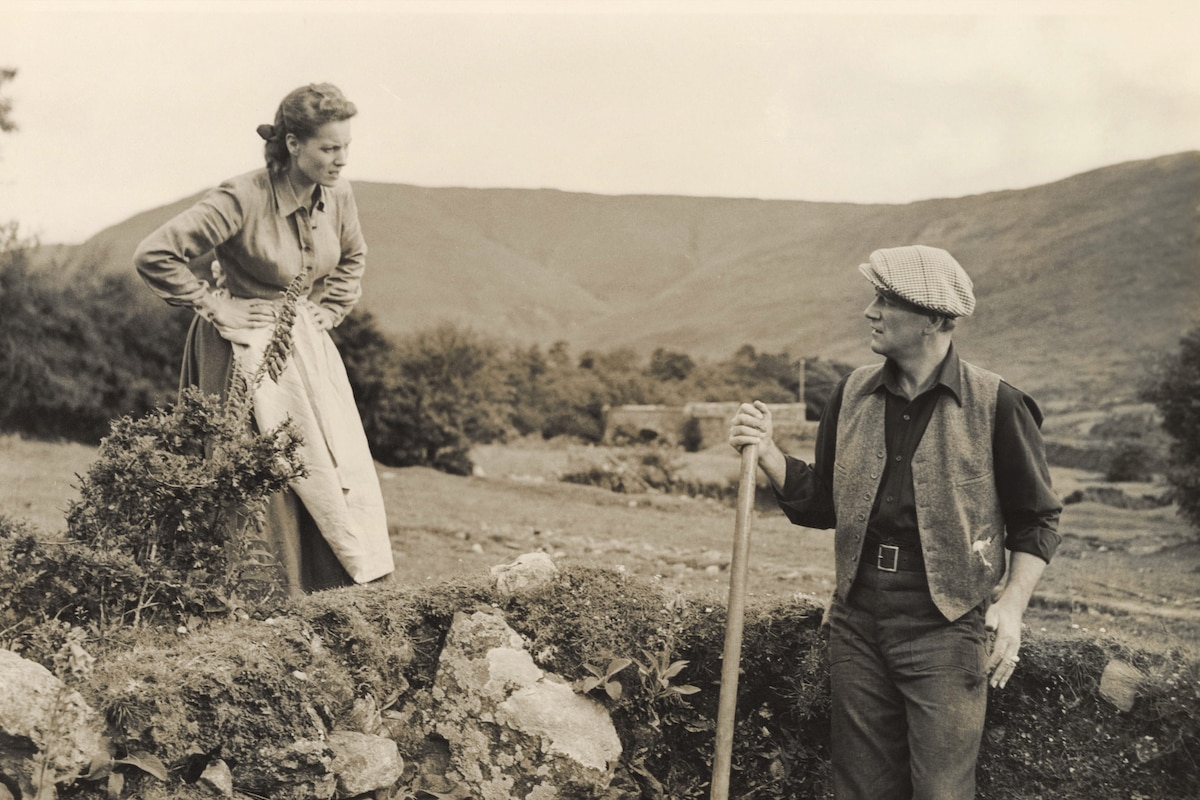
John Ford was captivated by Maurice Walsh's short story from the moment he read it in The Saturday Evening Post. He bought the film rights in 1936 for $10 and set about trying to find backers. But no one was interested in producing a romantic comedy set in an idealized Ireland, especially since Ford insisted on shooting on location.
In 1944 Ford made handshake deals with John Wayne, Maureen O'Hara, Barry Fitzgerald and Victor McLaglen to appear in the picture if he ever got backing. For several years after, O'Hara spent time in the summer with Ford and his family, taking dictation on the director's boat for story ideas and dialogue.
The script was first developed by Welsh writer Richard Llewellyn, whose book formed the basis for Ford and O'Hara's picture How Green Was My Valley (1941).
Ford later entrusted his and O'Hara's notes to scenarist Frank S. Nugent, who had written four scripts for Ford since 1948, to write the screenplay. Nugent had long been an admirer of Ford since his days as a New York Times film critic. While Nugent was writing a profile piece for the paper about Ford's production of The Fugitive (1947), Ford talked him into becoming a screenwriter and handling the script for his next picture, Fort Apache (1948).
"We had a lot of preparation on the script, laid out the story pretty carefully, but in such a way that if any chance for comedy came up, we would put it in," Ford told Peter Bogdanovich years later.
The title character of Walsh's story was changed from Paddy Bawn Enright to Sean Thornton. Sean is the Gaelic equivalent of Fords first name; Thornton the surname of Ford's cousins. The script also adds a character, Will Danaher's toady, named Feeney, the Anglicized version of Ford's real family surname.
Nugent also made a change to the lead character's motives. In the story, he is simply not interested in fighting for something as insignificant as a dowry. Nugent added a backstory that had Wayne's heavyweight giving up fighting after accidentally killing a man in the boxing ring.
In 1946 Ford and producer Merian C. Cooper formed Argosy Pictures to allow Ford more control over the selection and production of his films. His first Argosy project was to have been The Quiet Man. He wrote his old friend in Ireland Michael Killanin, telling him of his plans to film in Ireland and asking Killanin to work with him on the project. At the time, Ford believed British producer Alexander Korda would finance the film, but the deal fell through and the picture languished several years more. "Each year we would hold the summer open and each year there was no money and we couldn't make the movie," O'Hara recalled. "John Wayne and I used to go to the studio and say: "Mr. Ford, if you don't hurry up I'll have to play the widow-woman and Duke will have to play Victor McLaglen's role because we'll be too old!"
In the late 1940s, John Wayne was under contract to Republic Pictures and decided to use his clout there to get the film made. Studio head Herbert Yates, who made mostly B-pictures, jumped at the chance to have someone of Ford's stature working for his studio. But he told Wayne that Ford would have to prove himself with another hit movie before he gave the go-ahead to this project. Ford, Wayne, O'Hara, McLaglen and many of the same crew got together and made the cavalry picture Rio Grande (1950). The movie was a success, and Yates was compelled to back The Quiet Man.
Even though he agreed to the deal, Yates grew nervous as it neared time for Ford and company to pack off to Ireland with their proposed $1.75 million budget. By spring of 1951, he was convinced the film would be a "phony art-house movie" and a financial disaster. He tried to convince Wayne the part of Sean Thornton was all wrong for him and would ruin his career. To appease Yates, Ford agreed to cut his costs and got Wayne and O'Hara to work for well below their standard rates.
by Rob Nixon
The Big Idea - THE QUIET MAN
by Rob Nixon | February 28, 2006
SIGN UP FOR OUR NEWSLETTERS

CONNECT WITH TCM