SYNOPSIS
After spending most of his unhappy life in America, Sean Thornton arrives in the little Irish village of Inisfree to find the peace and paradise his mother used to talk about. The first thing to catch his eye (after the cottage where he was born) is the beautiful and fiery Mary Kate Danaher. Having bought the homestead from the wealthy Widow Tillane (much to the anger of Mary Kate's brother Will, who wants the property for his own), he sets about courting the young woman. But her brother will not permit it, so the local priest, the vicar and his wife, and Michaleen (the village matchmaker and bookie) trick Will into believing that if he marries Mary Kate off, he will finally be successful in his pursuit of the widow. At the wedding, however, Will discovers she has no intention of marrying him, even if he does fancy himself "the best man in Inisfree." He refuses to give Mary Kate her dowry. Sean thinks the furniture and money are unimportant, but Mary Kate insists they belong to her and without them she is not a married woman. She refuses to sleep with Sean and berates him for being a coward who won't stand up to her brother. But neither she nor anyone else in the village (except the vicar) know that Sean has sworn off fighting after accidentally killing a man in the boxing ring. When Mary Kate attempts to leave her husband, he follows her to the train station five miles away and drags her back to town on foot. Flinging her at Will's feet, he tells him the marriage is over unless she gets her full dowry. Will begrudgingly throws the money at him. Sean and Mary Kate pick it up and fling it into a furnace. Satisfied at last, she returns to their home while Sean and Will battle it out.
Director: John Ford
Producers: Merian C. Cooper, John Ford, Michael Killanin
Screenplay: Frank S. Nugent, Richard Llewellyn, based on the story "Green Rushes" by Maurice Walsh
Cinematography: Winton C. Hoch, Archie Stout
Editing: Jack Murray
Art Direction: Frank Hotaling
Music: Victor Young
Cast: John Wayne (Sean Thornton), Maureen O'Hara (Mary Kate Danaher), Victor McLaglen (Red Will Danaher), Barry Fitzgerald (Michaleen Flynn), Ward Bond (Father Lonergan), Mildred Natwick (Sarah Tillane).
C-130m.
Why The Quiet Man is Essential
One measure of this film's enduring appeal: In 1986, 34 years after its release, the wife of a young New York police officer, who was shot and paralyzed on the job, saw fit to tell reporters The Quiet Man was her husband's favorite movie and that he adored its female star, Maureen O'Hara. After reading the report, O'Hara flew to New York and went to the officer's bedside to offer comfort and boost his morale. She became actively involved with the couple during his long recovery and physical therapy, attended their baby's christening and marched in a parade on his behalf. Another measure: A short time later, New York Post writer Dick Ryan made a somewhat bizarre point of referencing the film in an article about President Ronald Reagan's Iran-Contra troubles. Whatever Ryan's thesis, the movie has remained in the consciousness of film audiences.
The Quiet Man is not often included in critics' lists of John Ford masterpieces - that distinction usually goes to The Searchers (1956), Stagecoach (1939) or his cavalry trilogy. But it has always been perhaps his most popular, even with Ford himself. A highly personal project for the legendary director, he often cited it as his favorite and considered it his "sexiest" picture. On those terms, it may seem tame to today's audiences who are used to scenes of nudity and near-explicit lovemaking, but the chemistry between O'Hara and John Wayne can't be denied. They were one of the best (and sadly underrated) romantic screen teams of all time in their five films together, largely because, as Wayne's son Michael has said, "She could match John Wayne kiss for kiss, punch for punch, stride for stride."
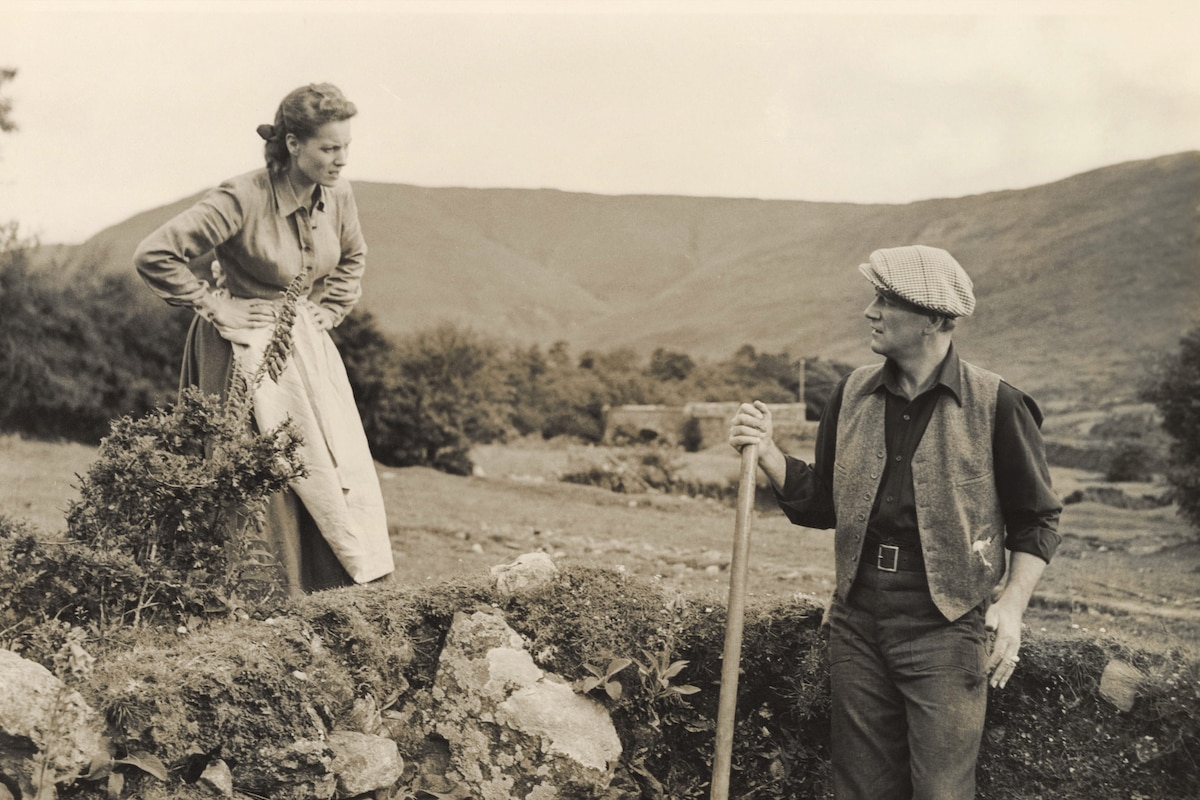
O'Hara's Mary Kate Danaher is no demure Irish lass. She's tough, outspoken, aggressive, stands up to her brother, wallops men and bridles at the term "spinster." She's hell bent on maintaining her identity and independence even after marriage by insisting her husband fight for the money and household goods that are rightfully hers but denied by her stubborn, bullying sibling. "In characteristic American fashion, he feels his masculinity and ability to provide for her impugned, until she finally makes him understand that it is not the money but what it stands for," remarked critic Molly Haskell. "The dowry and furniture are her identity, her independence."
At the same time, she's never pictured as a horrible shrew. She first appears as a vision in the meadow, her red hair gleaming in the sun, captivating the audience as surely as she does Wayne's Sean Thornton. Their romantic scenes together are both tender and highly charged (even "causing" a storm to whip up suddenly), and their marriage is a true partnership, an equality pushed by her insistence on the dowry. She doesn't resort to coy feminine wiles to get her way, but at the end of the movie, when she whispers something into her husband's ear and they race joyfully and eagerly back to their cottage, it's clear she's a freely sexual woman.
Perhaps that's why the film is often lauded for its depiction of a liberated woman, even within the confines of traditional Irish Catholic society. Brandon French - whose book On the Verge of Revolt (Frederick Ungar, 1978) carries a picture on its cover of O'Hara as Mary Kate standing toe-to-toe with Wayne - notes Mary Kate's rejection of her husband's mastery over her by tearing from his hands the stick another woman has given him to beat her and throwing it away. His delighted acquiescence to this act (and to her suggestive whisper at the end) is indicative of the sexual equality Ford depicts in this relationship. "This enlightened treatment of sexuality promotes, as few American films have, the superiority of a mature and liberated love relationship," French writes.
Ford also undercuts our expectations of Wayne as a strong, dominating man. He's no shrinking violet here, and the film isn't a comedy about a tough guy becoming henpecked. But Wayne's Sean Thornton arrives in Ireland carrying the emotional baggage of a troubled past, and he comes to see how this woman and the land she is an indelible part of can redeem him. When he kicks in their bedroom door after she's refused to have sex with him on their wedding night, we expect a scene of marital rape such as the one in Gone with the Wind (1939). Instead, he asserts his bond with her, throws her on the bed, then leaves the room to spend the night in his sleeping bag. And when he buys her a horse and cart, he lets her drive --an insignificant gesture in today's world but no small thing, either in 1950s Hollywood or the romanticized Ireland Ford portrays.
When critics do carp on the movie, it's exactly for this - the "unreality" of the world Ford creates. Yes, surely nowhere in Ireland is as stereotypical as Ford's glorification (and the country's troubles are only hinted at by the benign presence of two IRA men). But Ford isn't interested in presenting historical fact. This is the Ireland of his imagination and longing, the same sentiment felt by Sean Thornton when he arrives from America seeking the "heaven" his dead mother told him about. Ford's Ireland is peopled by impish, good-hearted folk (even Mary Kate's oafish brother has his clumsy soft spots), living in fairy tale thatched cottages surrounded by the lush green countryside (a natural environment given a tremendous boost by Winton Hoch's Oscar®-winning color photography). It's as mythically artificial as Ford's films of the American West, but he knows it and, for once, admits it by having all his characters acknowledge the audience in the film's final moments, as if to remind us we have seen actors playing a part and not a gritty slice of real life.
No one carps much about the "artificiality" of a musical like On the Town (1949), a glorification of a New York that never really was, or Singin' in the Rain (1952), doing the same for Hollywood. The Quiet Man lacks only musical numbers to be in the same company (although Victor Young's score and the Irish pub tunes make up for the songs, and the famous extended fight scene is as brilliantly choreographed as any dance sequence). But this film gives us even more, suffusing its romantic comedy, silly as it may be, with the hope and longing of difficult, driven career professional John Ford for what he imagined was the simpler, happier life of his ancestors, lost to him forever.
by Rob Nixon
The Quiet Man: The Essentials - THE QUIET MAN
by Rob Nixon | February 28, 2006
SIGN UP FOR OUR NEWSLETTERS

CONNECT WITH TCM