Behind the Camera on THE HUSTLER
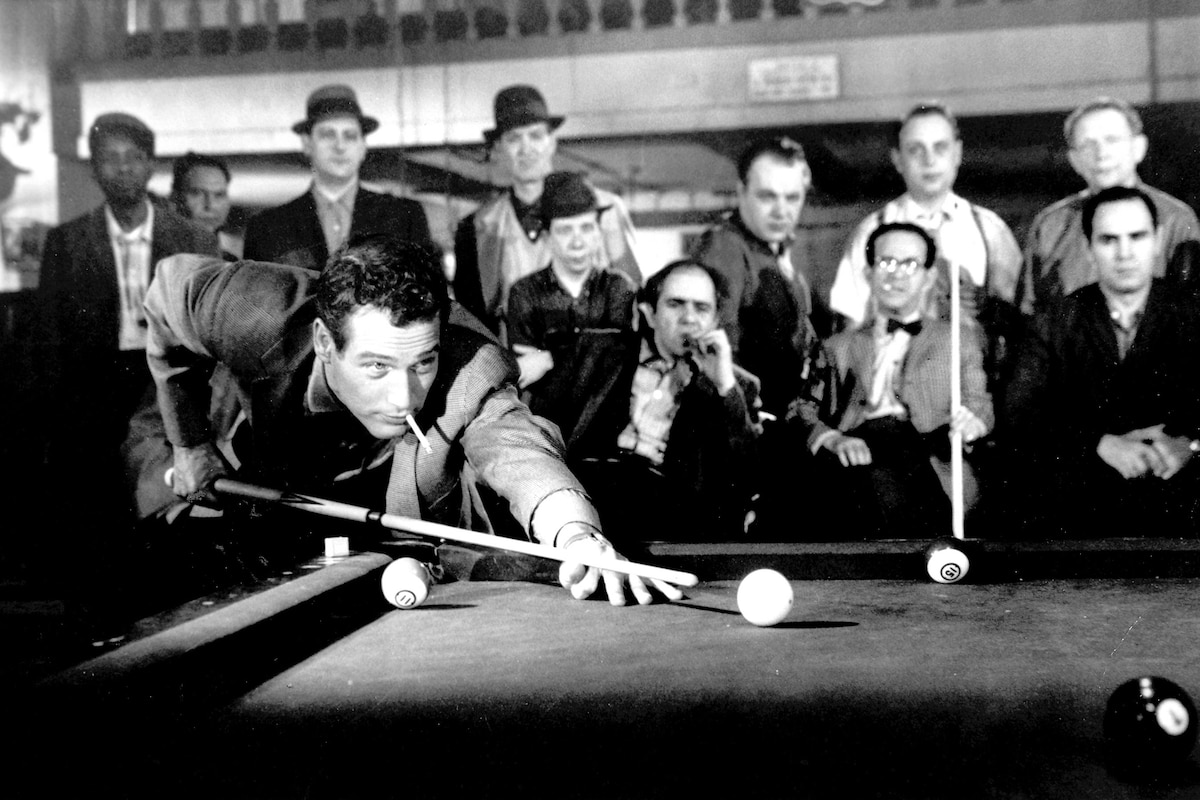
The great pool legend Willie Mosconi was brought in as technical adviser and stand-in for the actors on The Hustler (particularly Paul Newman) in the tougher pool shots. Crew members have noted how Mosconi was similar to the Minnesota Fats character as written: well-dressed, fastidious, a player who brought a deep concentration to the game. Other than seeing his hands making some of the shots, Mosconi appears in the picture as the guy who holds the stakes in the contest between Eddie and Fats. Assistant director Ulu Grosbard said that watching Mosconi in action was "like watching a great violinist or great cellist. There was nothing he couldn't do once he went to work on that pool table."
Paul Newman had never even held a pool cue before but picked it up quickly under Mosconi's training. Newman used to go via motorcycle in disguise (to avoid being mobbed by fans) to a girls' high school in New York to practice for many hours. He also removed most of the furniture from the dining room of the home he shared with wife Joanne Woodward to make way for a pool table and spent hours there working with Mosconi. Mosconi not only taught him how to play but how to move about a pool hall like a professional player and hustler.
Except for some shots done inside Union Station in Los Angeles, the film was shot on location in New York. The scenes of Eddie's matches against Fats were done in the famous Ames Pool Hall near Times Square.
The picture was shot by Eugene Shuftan, who had invented an optical effects process that employed mirrors to create backgrounds. According to crew reports, many of the pool room shots employed this process to varying degrees. The picture was also shot in CinemaScope, a wide-screen process usually reserved for big epics and action pictures.
Ulu Grosbard later noted that the interior of Sarah's apartment was built in a studio at 55th St. and 10th Ave. He said the actors' dressing rooms there were very small and, in his memory, without windows, "like cells," but that Piper Laurie furnished hers "as if she were going to live in it the rest of her life." It was Grosbard's impression that Laurie would sometimes spend the night there.
Laurie apparently kept mostly to herself during shooting. "It was just a working set," she recalled. "Just intense work- not particularly fun at all. I never met Gleason, although I visited the poolroom. It was fun to meet George C. Scott. It was really just a working set- some fun, some anger."
Laurie did become friendly with Newman and Woodward during shooting. At first, she was a little intimidated by his looks. The cast had two full weeks of rehearsal, and on the first day of script table work, Laurie said she found it hard to look at him. She soon got over that, however, and found him extremely easy to work with and to be around.
Laurie also learned how modest and unassuming Newman was. "He really didn't believe in himself as an actor at all. He thought he had great limitations, and owed everything to other people- the Actors Studio, Joanne- he seemed not to take credit for himself."
To achieve her character's limp, Laurie first experimented with walking around with pebbles in her shoes. "Finally, I just did it without anything, because Rossen didn't want an obvious limp; he didn't want it consistent because he felt he wanted the audience to be aware of it sometimes and not other times."
Newman and Gleason established a friendship on the set. At one point, Newman got a little cocky about his newfound pool skills and challenged the much more experienced Gleason to a $50 bet on a game. Newman broke, then it was Gleason's turn. He knocked all 15 balls in and Newman never got another shot. Gleason recalled that the next day Newman paid him off with 5000 pennies.
The Hustler was edited by Dede Allen near the beginning of her career; she is now one of the most respected professionals in her field. Allen liked working with Rossen because he was the kind of director who shot scenes from every possible angle, providing her with a wide range of cover footage that allowed for various interpretations and possibilities.
by Rob Nixon
Behind the Camera - THE HUSTLER
by Rob Nixon | February 28, 2006
SIGN UP FOR OUR NEWSLETTERS

CONNECT WITH TCM