Come Blow Your Horn (1963) is notable for being the first of many films based on a play by Neil Simon (his first big stage hit). The screenplay was written not by Simon, however, who did not yet have the clout to call his own shots in Hollywood, but by Norman Lear in only the second time he had written for the big screen. Lear went on to a highly successful television career where he created such influential series as All in the Family, Sanford and Son (both inspired by British TV shows), Maude (a spin-off from All in the Family), and Mary Hartman, Mary Hartman.
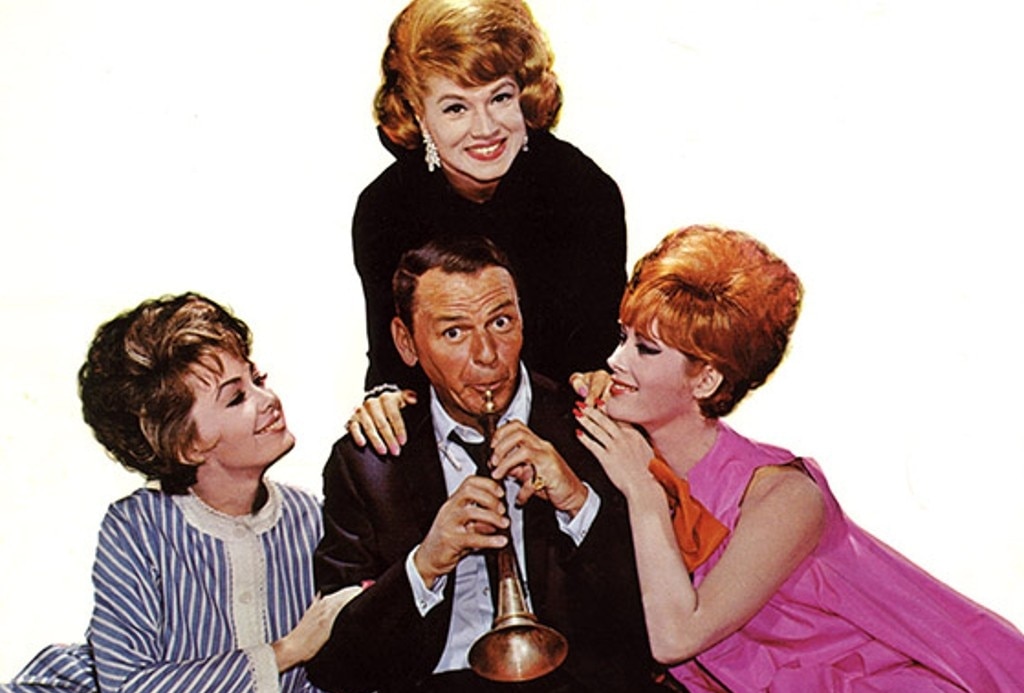
As with much of Simon's work, the story is closely based on his life, in this case his relationship with his older brother Danny, a successful producer-director-writer who worked on many hit TV series from the medium's earliest days (shows for Sid Caesar and Carol Burnett) through the 1970s (Facts of Life, Diff'rent Strokes). Fresh off the heavy demands of The Manchurian Candidate (1962), Frank Sinatra eased back into a role he could do in his sleep. The movie was tailored to his own image as a "ring-a-ding-ding" ladies man who plays mentor to his rebellious young brother Buddy (the Neil Simon stand-in). Sinatra teaches his younger sibling the ropes while juggling three romances. As Buddy starts to take on his dress, mannerisms, and speech patterns, the older brother begins to see the error of his ways, and drops the playboy torch, settling down with his one true love.
Sinatra added to his swingin' image by doing an interview with Playboy magazine during production of Come Blow Your Horn. The interview was conducted both on the set, during breaks in a recording session (where he performed the hit title song as one of many album tracks under the guidance of his frequent musical arranger Nelson Riddle), and in his sports car on the way to and from the studio. He also carried on an affair with glamorous co-star Jill St. John and had his "Rat Pack" buddy Dean Martin do a funny unbilled cameo in the movie. He also threw in a brief imitation of President John Kennedy, who had befriended Sinatra (an early supporter) then dropped him from his inner circle when the singer's lifestyle and reputed mob connections became politically risky.
This was Tony Bill's screen acting debut. Bill has continued to take on smaller roles in films throughout the years (Ice Station Zebra, 1968, Shampoo, 1975, Pee-wee's Big Adventure, 1985). But his real success came as a producer and director for film - a Best Picture Oscar® for The Sting (1973) - and TV (Felicity, Monk).
Mrs. Eckman, the glamorous buyer for Neiman-Marcus, is played by Phyllis McGuire, one of the McGuire Sisters, the famous singing trio of the 1950s. Her life - and her long-term relationship with mob boss Sam Giancana, reputedly a good friend of Sinatra's - was the basis for the TV movie Sugartime (1995), with John Turturro as Giancana and Mary-Louise Parker as McGuire.
Although he played Sinatra's father, Lee J. Cobb was actually only four years older than his co-star (who was 25 years older than Tony Bill as his kid brother). Cobb was also 13 years younger than his screen wife, Molly Picon. The gruff character actor generally played older in his career. In 1949, at only 38, he starred as the aged title character in the stage premier of Arthur Miller's Death of a Salesman opposite Mildred Dunnock, cast as his wife but 10 years older.
Director: Bud Yorkin
Producer: Howard W. Koch
Screenplay: Norman Lear, based on the play by Neil Simon
Cinematography: William H. Daniels
Editing: Frank P. Keller
Art Direction: Roland Anderson, Hal Pereira
Original Music: Nelson Riddle, songs by Jimmy Van Heusen
Cast: Frank Sinatra (Alan Baker), Lee J. Cobb (Harry Baker), Molly Picon (Sophie Baker), Barbara Rush (Connie), Jill St. John (Peggy John), Tony Bill (Buddy Baker).
C-112m. Letterboxed.
by Rob Nixon
Come Blow Your Horn
by Rob Nixon | February 22, 2006
SIGN UP FOR OUR NEWSLETTERS

CONNECT WITH TCM