Tommy Dorsey, "The Sentimental Gentleman of Swing," appeared in roughly a dozen feature films as himself, usually billed as "Leader of the Tommy Dorsey Orchestra." Dorsey and his orchestra (along with an uncredited vocalist named Frank Sinatra) made their movie debut in Paramount's Las Vegas Nights (1941), but spent the remainder of their movie career of the early 1940s in such MGM musicals as Presenting Lily Mars (1943), DuBarry Was a Lady (1943), Girl Crazy (1943) and Broadway Rhythm (1944).
The latter movie is a barely recognizable screen treatment of the 1939 Jerome Kern/Oscar Hammerstein II Broadway hit Very Warm for May, in which most of the original numbers except "All the Things You Are" were cut. (Three others are sung in mere fragments by star George Murphy.) The Dorsey numbers are two written by Don Raye and Gene de Paul: "I Love Corny Music," with vocals by Tommy Dorsey and Charles Winninger; and "Irresistible You," with vocals by the Tommy Dorsey Quartet. A reviewer for Variety wrote that "Tommy Dorsey and his orchestra provide the musical background... to get picture away to a good start."
As originally conceived, Broadway Rhythm was to have been the fifth entry in MGM's Broadway Melody series and was to have starred Gene Kelly and Eleanor Powell. All this changed when studio head Louis B. Mayer became interested in promoting the career of Ginny Simms, the young radio vocalist who costars opposite Murphy. After his divorce, Mayer frequently served as Simms' escort; the story goes that, after she turned down a marriage proposal, he lost interest in her film career, which ended in 1951.
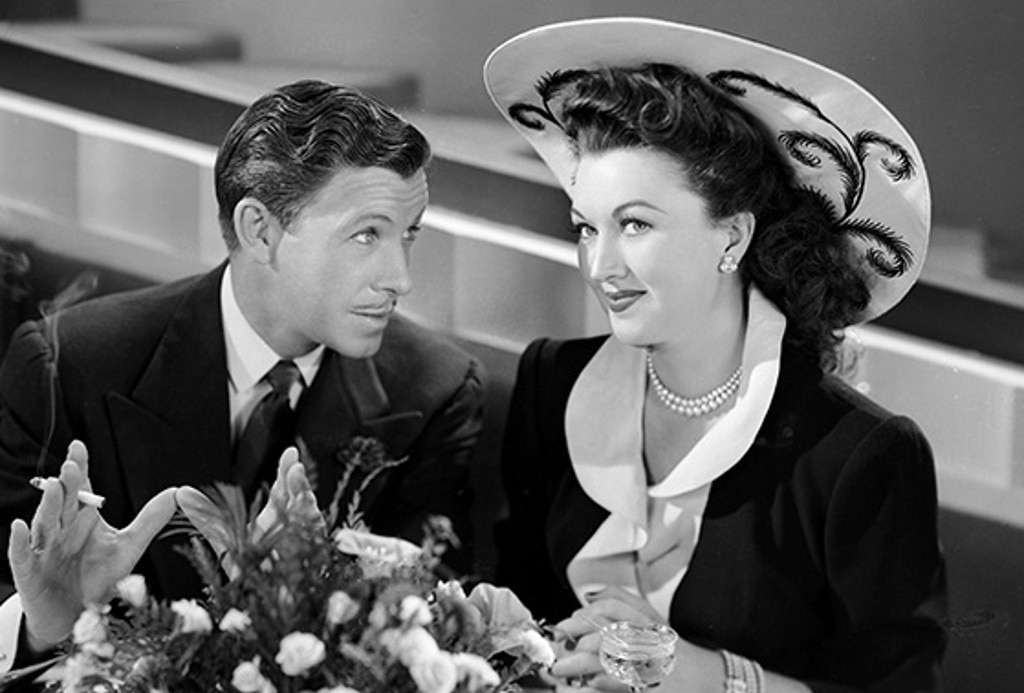
Broadway Rhythm spins a backstage tale in which Murphy's character, a Broadway producer, seeks big-name talent for an upcoming show, oblivious to the fact that he is surrounded by family and friends who are more than talented enough to fill the bill. These include his dad (Winninger) and sister (Gloria DeHaven). Even Simms, as the Hollywood star hired to headline Murphy's musical, tries in vain to open his eyes to the obvious.
Meantime, the movie is enlivened by a parade of guest stars including Lena Horne singing "Brazilian Boogie" and "Somebody Loves Me"; the Ross Sisters performing "Solid Potato Salad"; and a young Nancy Walker bringing down the house with "Milkman, Keep Those Bottles Quiet." Hazel Scott, Ben Blue and Eddie "Rochester" Anderson also appear. Time magazine called the movie "a Technicolored, tune-stirred summer salad into which MGM's chefs seem to have whipped practically everyone and every thing on the lot except Leo the Growl and Louis B. Mayer."
Thomas "Tommy" Dorsey (1905-1956) was born in Shenandoah, Pa., the younger brother of famed jazz clarinetist Jimmy Dorsey. Tommy was known in his youth as both a trumpet and trombone player. He eventually settled on the trombone, becoming a successful free-lance radio and recording artist in the early 1930s. Before forming "The Dorsey Brothers Orchestra" with Jimmy in 1934, Tommy worked with Jean Goldkette, Paul Whiteman, Bix Beiderbecke, Joe Venuti, Eddie Lang and Red Nichols.
After splitting with his brother, Tommy Dorsey formed his own band and chose "Sentimental" as his signature number. His group became the top band in the country, a title it held through much of the "swing" era. In addition to collaborating with many of the leading musicians of his time, Tommy worked with such outstanding vocalists as Sinatra, Jo Stafford, Connie Haines and The Pied Pipers.
Tommy Dorsey's distinguished recording career was capped by his biggest-selling record, an orchestrated version of the Pinetop Smith classic "Boogie-Woogie" that sold four million copies. The Dorsey Brothers reformed their band in 1953 and had their own television show on CBS in 1955-56.
Producer: Jack Cummings
Director: Roy Del Ruth
Screenplay: Harry Clork, Dorothy Kingsley, from story by Jack McGowan and play Very Warm for May by Oscar Hammerstein II
Cinematography: Leonard Smith
Art Direction: Cedric Gibbons, Jack Martin Smith
Original Music: Tommy Dorsey, Ricardo Lopez Mendez, Don Raye, Gabriel Ruiz, Egbert Van Alstyne, Gene de Paul
Editing: Albert Akst
Costume Design: Irene, Irene Sharaff, Gile Steele
Cast: George Murphy (Johnny Demming), Ginny Simms (Helen Hoyt), Charles Winninger (Sam Demming), Gloria DeHaven (Patsy Demming), Nancy Walker (Trixie Simpson), Ben Blue (Felix Gross), Lena Horne (Fernway de la Fer), Eddie "Rochester" Anderson (Eddie), Hazel Scott (Herself), Tommy Dorsey (Himself, and his Orchestra).
C-115m.
by Roger Fristoe
Broadway Rhythm
by Roger Fristoe | February 22, 2006
SIGN UP FOR OUR NEWSLETTERS

CONNECT WITH TCM