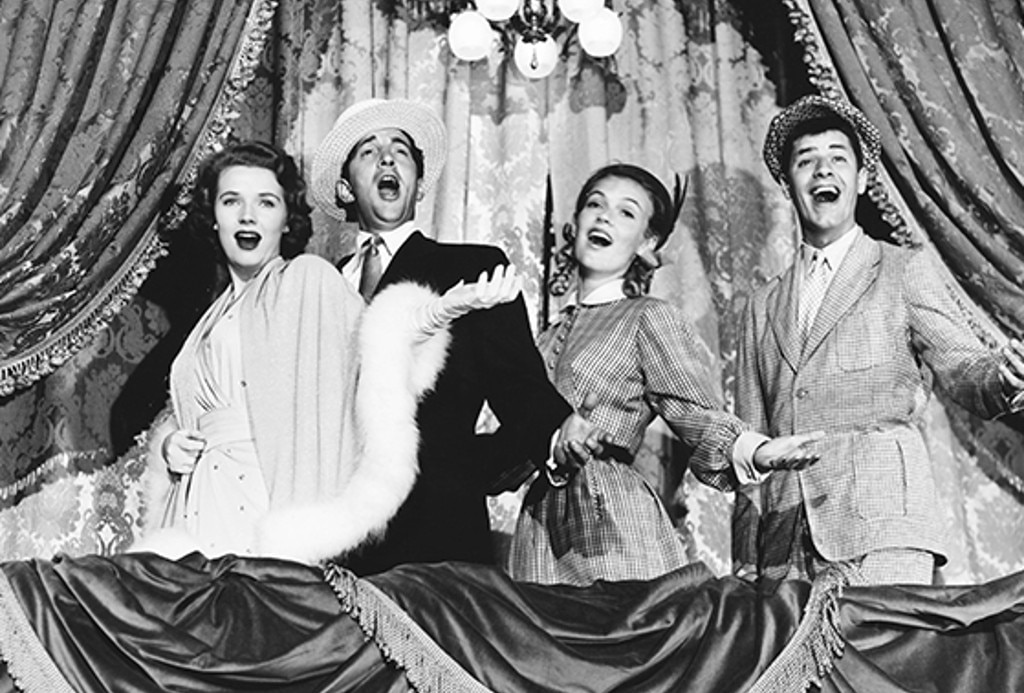
The seventh movie featuring Dean Martin and Jerry Lewis to be released, The Stooge (1953) was actually the fifth to be filmed. Production took place in early 1951, but producer Hal B. Wallis put the finished work on the shelf for almost two years. In the intervening time, two more Martin and Lewis films were made and released: Sailor Beware (1952) and Jumping Jacks (1952).
The reason for the delay is unclear, but many biographers and historians believe that it likely had to do with the film's unusual tenor. This is not a typical, outlandishly comedic Martin-Lewis vehicle. It actually works more as a poignant and sometimes cruel melodrama laced with comedy sequences. Wallis likely felt the tone was not in keeping with the duo's persona and would find trouble with audiences at a time when the team's star power was still climbing to its peak: in 1951, Martin and Lewis entered theater owners' annual list of top money-making stars at #2. In 1952, they would rank #1, and in 1953 and 1954, they were #2 again, all proof of their enormous popularity.
The script by Fred Finklehoffe and Martin Rackin was based on a story by Finklehoffe and Sid Silvers, the latter of whom had worked in vaudeville in the 1920s as a professional "stooge" to Phil Baker, a comedian and accordionist. Silvers would sit in the audience and heckle Baker, but it was all an act to create comedy. In the film, the time period is the 1930s, and Lewis takes the role of stooge to help resuscitate Martin's foundering singing career. The pair's clash of ego had some parallels to the real-life Martin and Lewis, and the result was Lewis's favorite of their films together.
Critics received the film well, though some were surprised by the change in tone. The New York Times commented: "The mixture of slapstick and sentiment that is tossed off in The Stooge is a little bewildering for [Martin and Lewis], not to mention their customers." Trade paper Variety called the film "more subdued" than usual, noting: "The change of pace, mixing as it does schmaltzy sentiment into the fun, will make a favorable impression on those, particularly the femmes, who heretofore have not wholeheartedly accepted the team's uninhibited antics." And The Hollywood Reporter observed that "something new in the way of a solid, well-plotted story has been added to the multifaceted Martin and Lewis antics... Martin is in excellent voice and handles his lines deftly... Jerry does his best job to date... [Director Norman] Taurog does a topnotch job, blending comedy sequences with an often moving story in wonderful fashion, so that the hilarious laughter is always there to break up the more poignant moments."
This was the first of six Martin-Lewis pictures that would be directed by Taurog (though his second effort, Jumping Jacks, was released first.) Years later, Taurog remembered Dean Martin as "a very peculiar guy. He knew his words every morning when he came in. But he did it a la Crosby. He was a lousy rehearser. He'd just mumble his way through a scene until I turned the cameras on. Then he'd be fine. He wanted to get through the scene as quickly as possible so he could get onto the golf course."
Martin and Lewis often played practical jokes on the set. One time, Lewis bound and gag an electrician on a catwalk high above the stage. Taurog resorted, only somewhat jokingly, to giving them lollipops if they behaved themselves, but one day the director got even with his own joke on Martin: as the actor napped in his trailer, Taurog had the trailer towed three miles away, and Martin awoke to find himself parked alone on a beach.
The correct year of release for The Stooge is a little unclear. Some sources proclaim a release date of Dec. 31, 1952, but that might have been simply the premiere, as most sources indicate Feb. 4, 1953, which is when many major newspapers reviewed it.
By Jeremy Arnold
Sources:
Shawn Levy, King of Comedy
William Schoell, Martini Man: The Life of Dean Martin
Nick Tosches, Dino
The Stooge
by Jeremy Arnold | February 26, 2016
SIGN UP FOR OUR NEWSLETTERS

CONNECT WITH TCM