The Art of Love (1965) seemed to have everything going for it: a talented producer in Ross Hunter, who had spearheaded many lush Douglas Sirk melodramas of the previous decade; director Norman Jewison, then coming off the Rock Hudson-Doris Day hit Send Me No Flowers (1964) and whose talent would, in the years ahead, bring him seven Oscar nominations; man of the hour Dick Van Dyke, who had not only just starred in Mary Poppins (1964) but was still starring in his juggernaut, Emmy Award-winning TV show; screenwriter Carl Reiner, the creator and producer of that TV show; handsome actor James Garner, who was transitioning into a feature film phase of his career following his own television series, Maverick; and two stunning actresses in Angie Dickinson and Elke Sommer, the latter a German bombshell who had just scored a big impression in A Shot in the Dark (1964). Even the cinematographer, Russell Metty, was one of the best in the business, with a recent Oscar for Spartacus (1960) and a distinguished career going back thirty years.
Reiner's screenplay was a comic spoof on the modern art world, with Van Dyke as an unsuccessful young artist living in Paris whose jump into the Seine to save a woman (Sommer) is thought to result in his death. Now his art starts to sell, big-time, and when Van Dyke turns up alive, his roommate (Garner) persuades him to hide out and keep painting. As the works continue to sell, Garner lives it up at Van Dyke's expense, moves in on Van Dyke's girlfriend (Dickinson), and provokes the resentful artist to frame Garner for the supposed "murder."
All through production, Jewison and Reiner had a ball, convinced they were making one of the funniest movies in some time. "It remained fun all the way," Jewison later recalled. "The material cracked me up, even though I'd already spent months with it. That was how much Carl and I loved our own jokes." But at the premiere, no one laughed, and on reflection, Jewison realized why: "It was the movie's basic premise... A painter like our Dick Van Dyke character remains as obscure in death as he had been in life, and his paintings are just as worthless. The bottom fell out of our plot. And the audience knew it. I had directed my first bomb."
Critics weren't much kinder. The New York Times characterized The Art of Love as coming "straight from the assembly line," while Variety was a bit more nuanced: "[It] has sidesplitting moments [and] some unusually fine character performances, but so much of everything it never once settles down to a consistent point of view.... Elke Sommer and Angie Dickinson are gorgeous to look at and perfect for their roles. One even forgives Miss Sommer for emerging from the Seine after attempted suicide with nary a trace of makeup off, her eye shadow still intact and beautifully coiffed."
Exteriors were shot on location in Paris. Jewison had to plead with producer Hunter for this, as the budget didn't permit it, but finally Hunter gave in and allowed Jewison to take Van Dyke to Paris for two weeks. Sommer joined them from Germany. Jewison said he shot the pair "in every scene from the script that featured the two in Paris exteriors. I also shot the French actors, and...scenes that gave up Parisian flavor." The rest of the movie was filmed on a Universal soundstage.
In his memoir, Jewison remembered Van Dyke as "a marvelous comedian, kind of a latter-day Stan Laurel, lanky and rubbery, likeable, a master of the double take." Jewison had some challenges working with supporting actor Pierre Olaf, however, who plays the role of Inspector Carnot. One line of dialogue was especially problematic: "If there is no body, there is no suicide." Olaf kept pronouncing "no body" as "nobuddy" no matter how many times Jewison tried to fix his pronunciation. Jewison felt as if he was directing Inspector Clouseau! "We tried twenty takes to get the scene," he recalled. "Then I gave up. Pierre would never speak the line if we tried one hundred and twenty takes."
Also in the cast: Ethel Merman, as a brothel madam named Coco La Fontaine. The filmmakers' first choice for this role had been Mae West, but upon meeting with her they found that she had penciled in many changes to the script, insisting that she would only do it if it was rewritten to make her the star. Merman dons pink and green wigs through the film, her character is loud and brassy, and she sings a song -- in French. Merman told a reporter at the time, "I can't even say 'oui,' so I had to learn the song phonetically."
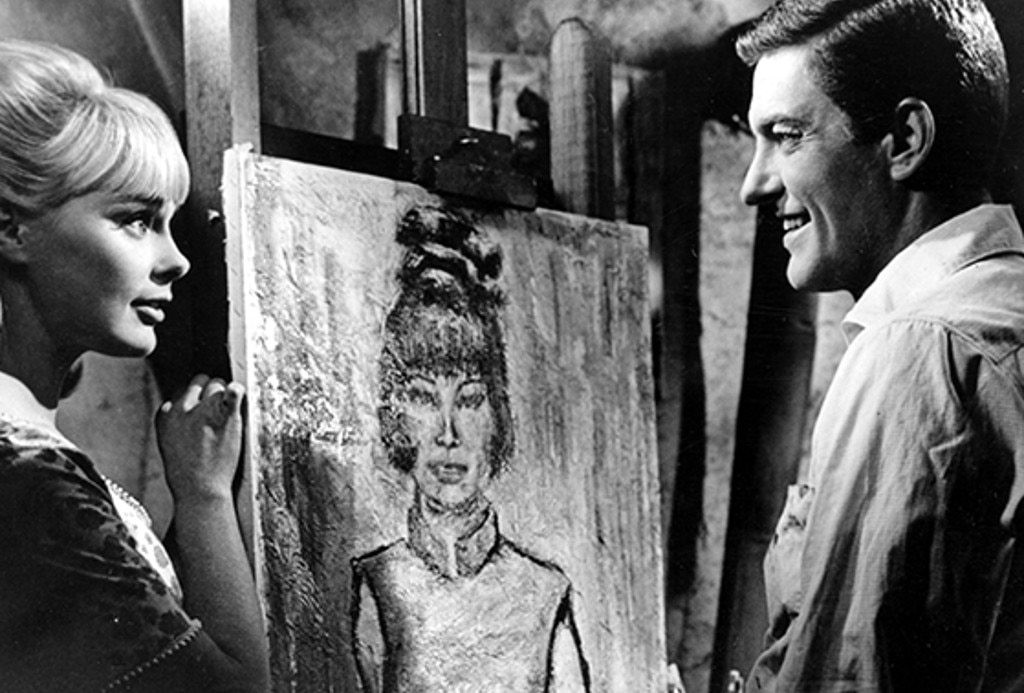
The paintings in the film were created by a southern Californian artist named Don Cincone. Sixty-five of his works are shown on screen, including several duplicates that he painted to be comically destroyed by Van Dyke in a wild early scene.
The Art of Love's animated credit sequence was created by David DePatie and Fritz Freleng, the artists behind the Pink Panther movies' cartoon sequences.
By Jeremy Arnold
SOURCES:
Norman Jewison, This Terrible Business Has Been Good to Me
Brian Kellow, Ethel Merman: A Life
The Art of Love
by Jeremy Arnold | February 23, 2016
SIGN UP FOR OUR NEWSLETTERS

CONNECT WITH TCM