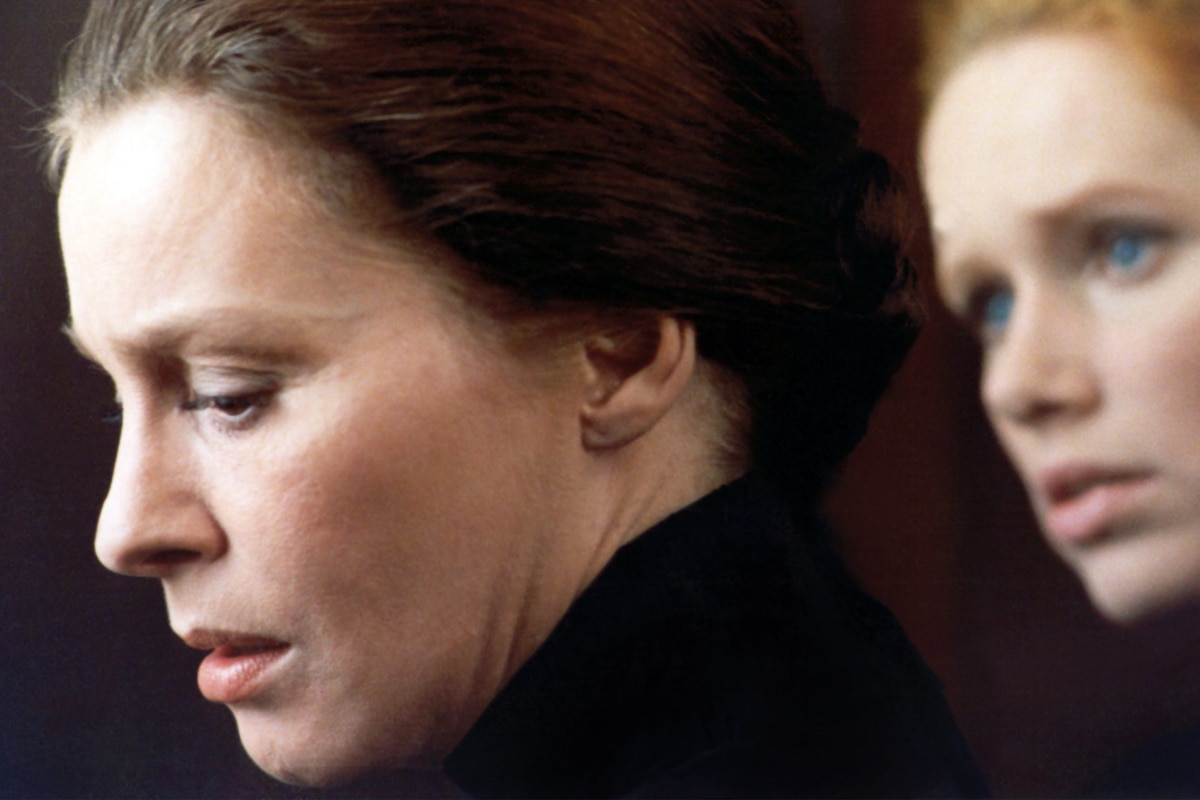
Visually striking and emotionally devastating, Ingmar Bergman's Cries and Whispers (1972) shows the Swedish master at the peak of his craft, and was one of his own personal favorites. It is one of Bergman's most mysterious films, and one that, as critic Roger Ebert later noted, "had a greater impact" than most of his other films, yet did not "inspire a lot of complex interpretations." Perhaps, Ebert concluded, that was because the film defies analysis. "The emotions it portrays and evokes speak for themselves."
Bergman variously described the origin of Cries and Whispers as a recurring vision, or a dream that he had: several women, dressed all in white, in an all-red room. He began making notes for the film in the spring of 1970, but it took two more years to develop, write and shoot Cries and Whispers, which premiered in late 1972. The women are three sisters -- Agnes, who is dying painfully of cancer, and her sisters Maria and Karin. Along with the family maid Anna, they have gathered at the family estate to be with Agnes in her last days. The sisters are played by Bergman regulars Harriet Andersson as Agnes, Liv Ullman as the indolent, adulterous Maria, and Ingrid Thulin as the repressed, neurotic Karin. Their servant Anna, who gives Agnes the maternal warmth her sisters lack, is played by dancer Kari Sylwan, who had worked with Bergman in two theatrical productions. While writing the script, Bergman had considered casting American actress Mia Farrow in the film, but it's not clear for which role.
Bergman originally planned to finance the Cries and Whispers himself, but when it turned out to be more expensive than originally planned, the Swedish Film Institute stepped in with additional funding. The three stars and Bergman's longtime cinematographer Sven Nykvist invested their salaries into the production; if it was a success they would share the profits, and if it did not make money, they would not get anything. The film was originally going to be shot in the Film Institute's newly-built studios so that the Institute could recoup some of their investment from the studio rental, but Bergman found an early 19th century country estate in southeastern Sweden that was ideal, and decided to shoot the entire film there rather than building sets in the studio. The estate was decrepit, but its condition allowed Bergman and his crew to decorate all the rooms entirely in red -- Cries and Whispers was Bergman's third color feature, and his use of color is masterful.
When he began writing Cries and Whispers, one of Bergman's ex-wives and his father had recently died, and that likely informed the film's meditation on dying. By the time the film went into production, it was a much happier time for the director. He was in love with Ingrid von Rosen, soon to become his final wife, and he was surrounded by longtime colleagues whom he trusted and respected. In spite of Cries and Whispers's somber subject matter, some who worked on the film remembered a lighthearted atmosphere on the set. As they were setting up one particularly intense scene, an upbeat pop song was playing on the radio, and Bergman, cast and crew members began a cheerful singalong just before shooting a harrowing scene of marital discord.
But the mood was less jolly and more focused when it needed to be. When it was time to shoot Andersson's "scenes of suffering and death," Ullman later told Roger Ebert, the director banished everyone who was not involved. "When we saw the completed scenes, we were overwhelmed," Ullman added. "It was almost as if those great scenes had been Harriet's secret -- which in a way they were supposed to be, since in the film she died so much alone."
Bergman found an unlikely American distributor: schlock movie producer Roger Corman's New World Pictures. Corman paid 75 thousand dollars for the rights, and made one million dollars in profits when Cries and Whispers became Bergman's biggest hit in America. The director and his colleagues made back the money they put into the film, and then some. As Bergman later told an interviewer, "It was also a big hit around the world, and the reviews were excellent, everywhere but in Sweden." One critic wrote in a Swedish Communist paper, "Bergman makes art for company directors and their like, a sort of Playboy art. It always involves a little nudity, something a bit shocking and a few emotional entanglements. Made for export."
But elsewhere, the reviews ranged from mostly favorable to ecstatic. The New Yorker's Pauline Kael called it "smooth and hypnotic; it has oracular power and the pull of a dream," although she added, "There's a 19th century dullness at the heart of it....the film mingles didacticism with erotic mystery." In the New York Times, Vincent Canby wrote that Cries and Whispers was "Magnificent, moving, and very mysterious....Bergman dramatizes states of mind that have seldom been achieved, outside of written fiction."
Cries and Whispers was nominated for five Academy Awards®, becoming one of only nine foreign language films to ever be nominated for best picture. It also earned a best director nod for Bergman. Sven Nykvist won the best cinematography Oscar®, the first cinematographer of a foreign language film to be nominated for and win that award.
Director: Ingmar Bergman
Producer: Ingmar Bergman, Lars-Owe Carlsberg
Screenplay: Ingmar Bergman
Cinematography: Sven Nykvist
Editor: Siv Lundgren
Costume Design: Marik Vos-Lundh
Production Design: Marik Vos-Lundh
Principal Cast: Harriet Andersson (Agnes), Kari Sylwan (Anna), Ingrid Thulin (Karin), Liv Ullman (Maria), Erland Josephson (David, the doctor), Henning Moritzen (Joakim, Maria's husband), Georg Arlin (Fredrik, Karin's husband)
94 minutes
by Margarita Landazuri
Cries and Whispers
by Margarita Landazuri | February 23, 2016
SIGN UP FOR OUR NEWSLETTERS

CONNECT WITH TCM