When it was first released in 1983, The Big Chill drew decidedly mixed reactions despite its commercial success. Some saw it as an insightful portrait of a generation lost between youthful idealism and middle-aged disillusionment, while others found it glib and self-conscious. True, it doesn't always hold up well with today's younger audiences, who don't always relate to the time period and the dilemmas that are the film's focus. But it was nonetheless a box office hit and it garnered three Academy Award nominations - for Best Picture, Best Original Screenplay and Best Supporting Actress (Glenn Close) - and a Writers Guild of America Award for Best Comedy Written Directly for the Screen.
The Big Chill definitely tapped into the prevailing zeitgeist. The story of a group of former 1960s college radicals, now following divergent paths in life, who are reunited over the course of a weekend after the suicide of one of their group, struck a chord with baby boomers (a theme that was also explored in John Sayles's Return of the Secaucus 7, 1980). Producer-director-writer Lawrence Kasdan, 34-years-old when he made the movie, summed up the picture's theme and appeal in defining the meaning of the title: "The Big Chill deals with members of my generation who have discovered that not everything they wanted is possible, that not every ideal they believed in has stayed in the forefront of their intentions. The Big Chill is about a cooling process that takes place for every generation when they move from the outward-directed, more idealistic concerns of their youth to a kind of self-absorption, a self-interest which places their personal desires above those of the society or even an ideal."
In Kasdan's self-described "comedy of values," audiences of a certain age and background found some truths about their own past and present lives in the film, and if the harsher realities seemed to be downplayed and glossed over, the central concept was well developed through the strength of a witty script by Kasdan and Barbara Benedek and the fine ensemble work of a cast of actors who were among the most popular and accomplished working in film at the time.
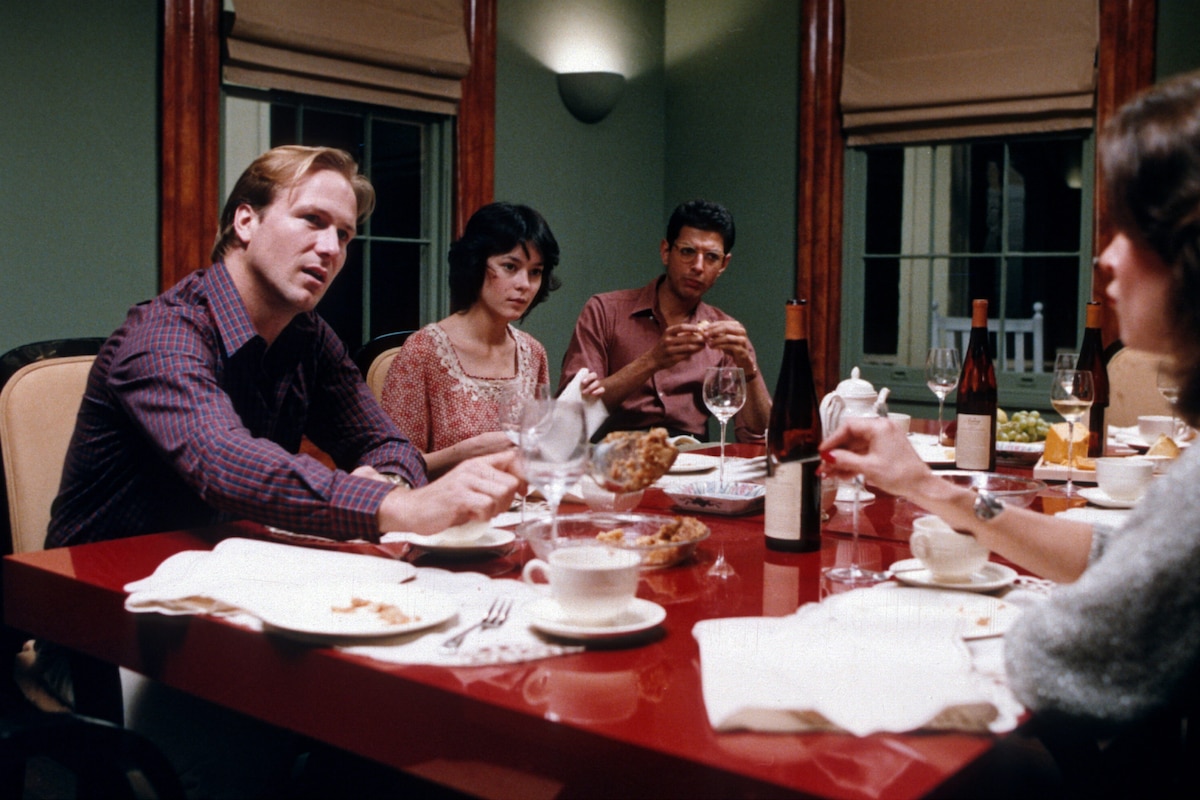
The actors took part in a month-long rehearsal process with the director in Los Angeles and then Atlanta and the Tidalholm estate in Beaufort, SC, where it was shot, giving each one the chance to develop a solid character while also fostering the group dynamic needed for a story about a group of friends with a long history and complicated relationships. One night while rehearsing at the house used as the central location, something clicked. Kasdan recalled, "It happened kind of spontaneously...everyone was in costume and we decided it might be great if we all cooked a meal. That way they'd have to split up the tasks and approximate a group of close friends putting together a dinner. I chose to leave at that point...and for five hours they remained in character without any authority figure, without any director to tell them if they were behaving or reacting in the correct way according to the writer's or director's ideas...It became a very intense experience and they all came out of it exhausted and drained...But that happened at a crucial, crystalizing moment and it turned eight individual actors into an ensemble."
Each of the actors had their own interpretation of what The Big Chill was really about. Tom Berenger commented that the film "is about that period in life when you're beginning to realize you have limitations, that you will never accomplish certain goals and dreams…Suddenly, you know you're not a kid anymore." For William Hurt, "the basic theme of The Big Chill is the reconstruction of hope." Mary Kay Place offered the observation, "When you're in college, you think you can do anything, be anything, accomplish anything...Then suddenly you reach a point where you're settled into what you're going to be and once you realize it, everything stops. Then the questions begin."
The sense of the era evoked in the story is boosted by a soundtrack of about 20 songs from the characters' collective past. "The '60s were an explosion, an incredibly varied explosion of pop music," Kasdan noted. "It's not just background to these people. These songs mean something very real and different to each of these characters. It's a strong, strong reference for them -- a sense memory of that time." Meg Kasdan, the director's wife, sifted through hundreds of tunes before narrowing it down to the ones used in the film, popular numbers by such performers as Creedence Clearwater Revival ("Bad Moon Rising"), The Beach Boys ("Wouldn't It Be Nice"), The Temptations ("Ain't Too Proud to Beg," "My Girl"), Marvin Gaye ("I Heard It Through the Grapevine"), Percy Sledge ("When a Man Loves a Woman"), The Steve Miller Band ("Quicksilver Girl") and others. One song used to great ironic effect is The Rolling Stones' "You Can't Always Get What You Want." At the end of the wrenchingly sad funeral of their friend, one of them gets up to perform the song, the deceased's favorite, on a church organ. The combination of the appropriateness of the title to the suicidal friend's lost hope and the comical effect of hearing it played that way brings a welcome smile to the group's faces, and the Stones version swells onto the soundtrack as they leave the church to head off to their momentous weekend reunion.
The Big Chill also benefited greatly from Kasdan's enviable reputation in the industry at the time. He was already well-known for his scriptwriting work on The Empire Strikes Back (1980), Continental Divide (1981), and Raiders of the Lost Ark (1981), which was paid homage in The Big Chill (Kevin Kline hums the adventure movie's theme music while doing battle with a bat that flew into the house). And two years earlier, Kasdan made a big splash with his directorial debut, the sexy neo-noir thriller Body Heat (1981), so there was much expectation for this, his second movie.
Kevin Costner was supposed to have played a key role in the picture as the suicidal Alex, seen in flashback scenes to the group's college days at the University of Michigan. But Kasdan decided to cut these scenes, and all that survives of Costner are brief close-ups of parts of his corpse being dressed for the funeral. Kasdan made it up to the actor, however, by later giving him important roles in the westerns Silverado (1985) and Wyatt Earp (1994).
As noted earlier, The Big Chill generated much discussion among critics who lived through the same era as the film's characters. Isidore Silver, in an article for the magazine Society, wrote "the movie affirms a sneaking suspicion I have always harbored that the sixties generation was better at proclaiming than at achieving such values as sensitivity, mutual caring, and emotional closeness. In short, if The Big Chill somehow represents an important truth about that generation (and I think it does), it demonstrates that many quondam radicals were as boring as their immediate predecessors (my generation), and remain so in the 1980s. The movie is replete with embarrassing examples of unfulfilled aspirations, misremembrances of the past, and simple ennui." Pauline Kael expressed a similar opinion believing the movie would be despised by "anyone who believes himself to have been a revolutionary or a deeply committed radical during his student demonstration days." On the other hand, she acknowledged the film as an entertainment: "There are pleasures to be had from this kind of wise-cracking contemporary movie that you can't get from anything else." And most reviewers had nothing but praise for the film's script and acting ensemble. Vincent Canby of The New York Times proclaimed The Big Chill "sweet, sharp, melancholy" and wrote "the performances represent ensemble playing of an order Hollywood films seldom have time for, with the screenplay providing each character with at least one big scene. If the actors were less consistent and the writing less fine the scheme would be tiresome. In The Big Chill, it's part of the fun."
Director: Lawrence Kasdan
Producers: Lawrence Kasdan, Marcia Nasatir, Michael Shamberg
Screenplay: Lawrence Kasdan, Barbara Benedek
Cinematography: John Bailey
Editing: Carol Littleton
Production Design: Ida Random
Original Music: Yuji Nomi
Cast: Kevin Kline (Harold), Glenn Close (Sarah), William Hurt (Nick), Mary Kay Place (Meg), Tom Berenger (Sam), JoBeth Williams (Karen), Jeff Goldblum (Michael), Meg Tilly (Chloe).
C-105m. Letterboxed.
by Rob Nixon
The Big Chill
by Rob Nixon | January 24, 2006
SIGN UP FOR OUR NEWSLETTERS

CONNECT WITH TCM