A college halfback turned rodeo stuntman turned cut-rate leading man with two failed series and a slew of forgettable programmers to his credit, Burt Reynolds was near to throwing in the towel when he got a game-changing pep talk from another former stuntman turned B movie actor: Jock Mahoney. While the specifics of Mahoney's wisdom have been lost to time, Reynolds returned to his craft with renewed purpose and saw his fortunes change dramatically with Deliverance (1972), the film that made him after fifteen years in the business a certifiable - and marketable - movie star. Though his commanding presence as the sole alpha male of John Boorman's masterful adaptation of the James Dickey novel drew estimable critical praise, Reynolds seemed most content to work with friends, among them stuntman turned first-time director Hal Needham. Needham's redneck road movie Smokey and the Bandit (1977), starring Reynolds and then-girlfriend Sally Field as a couple on the run from an apoplectic lawman (Jackie Gleason), was an unexpected boxoffice barnstormer in the year of Star Wars, earning over $300,000,000 on a $5 million budget that had been trimmed back by Universal in the 11th hour to $3.3 million.
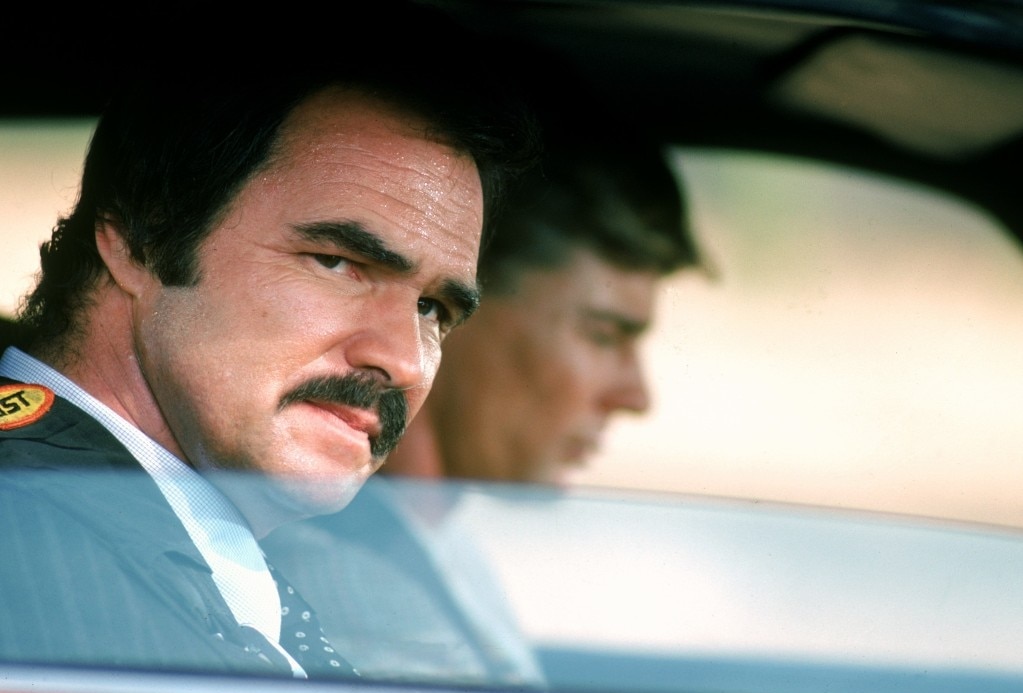
The success of Smokey and the Bandit demanded more of the same, though a true sequel would take three years. In the interim, Reynolds and Needham dreamed up Hooper (1978), a paean to Hollywood stunt performers that amps up the magnitude of daredevilry and pyrotechnics. As the eponymous "fall guy" (the surname Hooper was a nod to veteran stunt coordinator Buddy Joe Hooker), Reynolds was surrounded again by old friends: Needham as director, Field as his long-suffering girlfriend, acting mentor James Best in a supporting role, and Adam West (who had won the part of TV's Batman away from Reynolds in the mid-Sixties) as the vain movie star for whom Hooper doubles. Added to the cast was Jan-Michael Vincent as an up-and-coming stuntman and Brian Keith as Fields' ex-stuntman father, Jocko Doyle - a character created in tribute to Jock Mahoney. Among the film's many plot points drawn from real life was the stroke that befalls Keith's irascible Jocko; Jock Mahoney had suffered a similar stroke in 1973 and was confined for a time to a wheelchair. (Reynolds worked Mahoney into a stunt bit - wheelchair and all - in his 1978 black comedy The End.) Reynolds and Needham had hoped Mahoney could play Jocko in Hooper but were overruled by executives at Warner Bros.
Laced with laughs aimed both low (a barroom brawl featuring Pittsburgh Steelers q-back Terry Bradshaw) and high (Robert Klein as a snooty auteur patterned after Peter Bogdanovich) and capped by a nigh-apocalyptic stunt jump (and the actual destruction of a former World War II era military hospital complex in Tuscaloosa, Alabama), Hooper was another win for the Reynolds-Needham-Field axis (if not quite on par with the windfall of Smokey and the Bandit). Audiences were amused and satisfied but the critical consensus was, not surprisingly, split. While Pauline Kael came down on the production like the proverbial falling smokestack, branding Hooper "a half-cocked piece of movie-making," New York magazine's David Denby - no fan of Reynolds or Needham - offered a dissenting opinion: "A raucous celebration of the childish daring of Hollywood stuntmen, Hooper is one of the most entertaining movies of the year... I don't think we've had a movie about Hollywood filmmaking as funny as this one since Singin' in the Rain." Hooper also helped usher in a vogue for stories (for screens big and small) about stuntmen, among them Richard Rush's The Stunt Man (made in 1977 but unreleased until 1980), Brian Trenchard-Smith's Stunt Rock (1980), and the long-running TV series The Fall Guy, starring Lee Majors as a seasoned stuntman who moonlights as a bounty hunter.
By Richard Harland Smith
Sources:
But Enough About Me by Burt Reynolds (Bonnier Publishing, 2015)
Jock Mahoney: The Life and Films of a Hollywood Stuntman by Gene Freese (McFarland & Company, 2013)
Review of Hooper by David Denby, New York (August 28, 1978)
Hooper
by Richard Harland Smith | December 29, 2015
SIGN UP FOR OUR NEWSLETTERS

CONNECT WITH TCM