The 1947 film Ivy, a murder mystery known in the trade as a "gaslight noir," is set in the Edwardian age and based on the novel The Story of Ivy, a 1927 novel by Marie Belloc Lowndes. This elegant black-and-white film from Universal Pictures was directed by Sam Wood and produced by William Cameron Menzies, the legendary art director who had won a special Academy Award for his monumental production design of Gone With the Wind (1939).
Although Richard H. Riedel is the nominal art director for Ivy, it is generally considered that Menzies' guiding hand is responsible for the movie's striking visuals, which also include the cinematography of Russell Metty and costume designs by Orry-Kelly and an uncredited Travis Banton. Wood and Menzies had worked together on some half-dozen other films including, notably, 1942's Kings Row, 1943's For Whom the Bell Tolls - and Gone With the Wind itself, for which Wood directed some scenes.
Frequent Hitchcock collaborator Charles Bennett (1935's The 39 Steps and 1940's Foreign Correspondent) wrote the screenplay for Ivy, in which the title character, played by Joan Fontaine, is a beautiful and seemingly sweet yet ruthless woman who cares only for riches and the lovely things they can bring her. Already involved in a loveless marriage and a fading love affair, Ivy sets her sights on the congenial and super-rich Miles Rushworth (Herbert Marshall). When he refuses to become involved with a married woman, she plots to slowly poison her husband (Richard Ney) and frame her lover (Patric Knowles) for the murder, freeing herself of both bothersome men in her life and moving on to richer pastures.
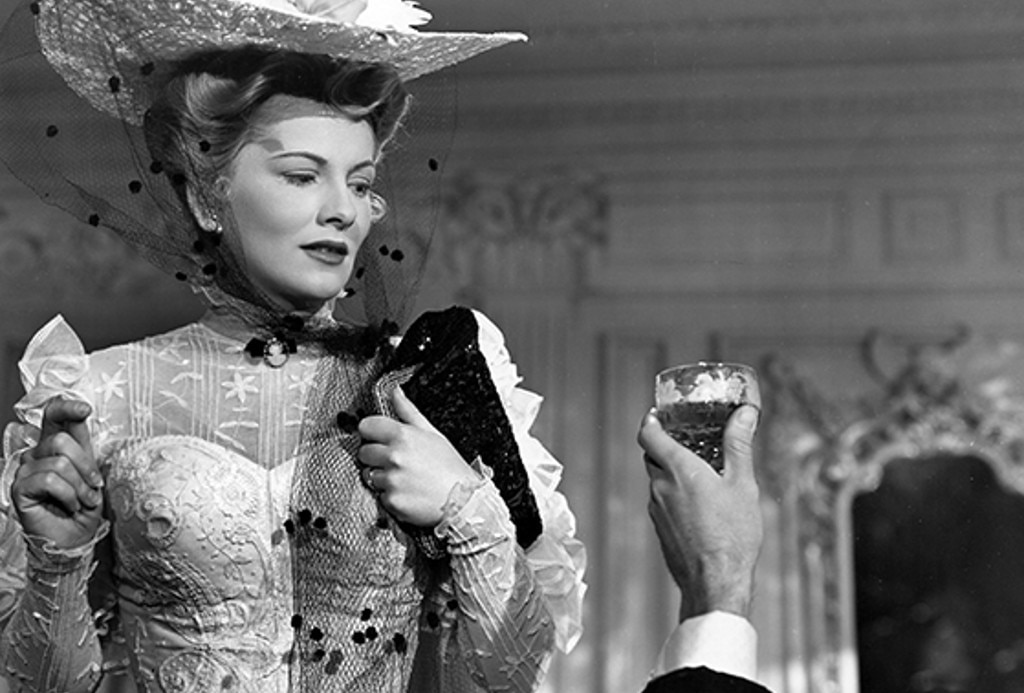
The setup allows Menzies and his associates to offer their dazzling designs in service to the story, in which Ivy constantly lusts for opulence. As John DiLeo writes in his book Screen Savers II: My Grab Bag of Classic Movies, "Every awful thing Ivy does is in the name of beauty: glittering gowns, enormous hats, jeweled handbags. Her accoutrements are the content of the film; they drive Ivy to commit reprehensible acts." Fellow production designer Richard Sylbert described Ivy, because of its reliance on art direction, as "the perfect Menzies movie."
The capable supporting cast is headed by Sir Cedric Hardwicke as the Scotland Yard inspector investigating the case, Una O'Connor as a fortune-teller who sees Ivy's future all too clearly, and Lucile Watson as Knowles's mother. Lillian Fontaine, the star's mother, appears to little effect as Lady Flora, whose daughter is engaged to the Marshall character. Hoagy Carmichael wrote the film's title song and sings it on the soundtrack.
Originally set for the leading role was Fontaine's competitive sister, Olivia de Havilland. She was only four days from costume tests with her old friend from her home studio of Warner Bros., Orry-Kelly, when she announced that she was dropping out of Ivy. She had misgivings about the role from the start, fearing that the character was so unsympathetic that audiences would not identify and the film would be a commercial disappointment. De Havilland had recently played a pair of twins in The Dark Mirror (1946), one good and one bad, and hated playing the evil sister. The crowning blow came when de Havilland learned that her agents, Berg-Allenberg, secretly had financial interests in the production company that would make the film and wanted her cast for that reason. It was a costly decision for her to exit the movie because she had already turned down other roles and was out of work for six months, losing income of some $100,000.
The sisters were at the height of their famous feud, and many in Hollywood felt it was an act of retaliation when agent Phil Berg offered the role to Fontaine. She was only too happy to step into de Havilland's elaborate Orry-Kelly wardrobe and to be cast against type as a scheming femme fatale. (Travis Banton completed the costume scheme after Fontaine entered the picture.) Many of Ivy's lacy gowns are a virginal white, offering ironic contrast to her decadent ways, and Fontaine's generous displays of creamy cleavage are slightly shocking for a film of this period.
Heretofore, Fontaine's best-known roles had been those of shy, retiring heroines in such movies as Rebecca (1940) and Suspicion (1941). The former had brought her a Best Actress Academy Award nomination and the latter the Oscar itself. Ivy not only shattered the typecasting mold for Fontaine, leading to more complex and not always sympathetic roles, but established her as one of the movies' true beauties. Metty photographs her as lovingly as any of the film's other gorgeous artifacts, and the result is stunning.
Like de Havilland, who had worked with Sam Wood on Gone With the Wind and Raffles (1939), Fontaine did not enjoy working with her director. She felt that Wood considered her merely one part of the film's design, a lovely and exquisitely dressed mannequin but not a commanding dramatic figure. She did, however, appreciate Menzies' work and reportedly was "fascinated" by the expressionistic paintings he created to illustrate each of the movie's major setups.
Ivy received mixed reviews; Variety's reviewer praised the look of the film but complained of "directorial obviousness." The star received her share of praise, with The New York Times critic noting that "Miss Fontaine has sunk her teeth into a role that is nothing short of a tour de force." However, de Havilland was correct in predicting that, because of the unsympathetic nature of its heroine, the movie would perform poorly at the box office.
Fontaine recreated her role in three radio adaptations of Ivy: two for "The Screen Guild Theater," on January 19, 1948, and March 13, 1952; and another for "Screen Director's Playhouse" on January 11, 1951. Martha Hyer starred in an adaptation on Lux Video Theatre on January 19, 1956.
by Roger Fristoe
Ivy
by Roger Fristoe | December 15, 2015
SIGN UP FOR OUR NEWSLETTERS

CONNECT WITH TCM