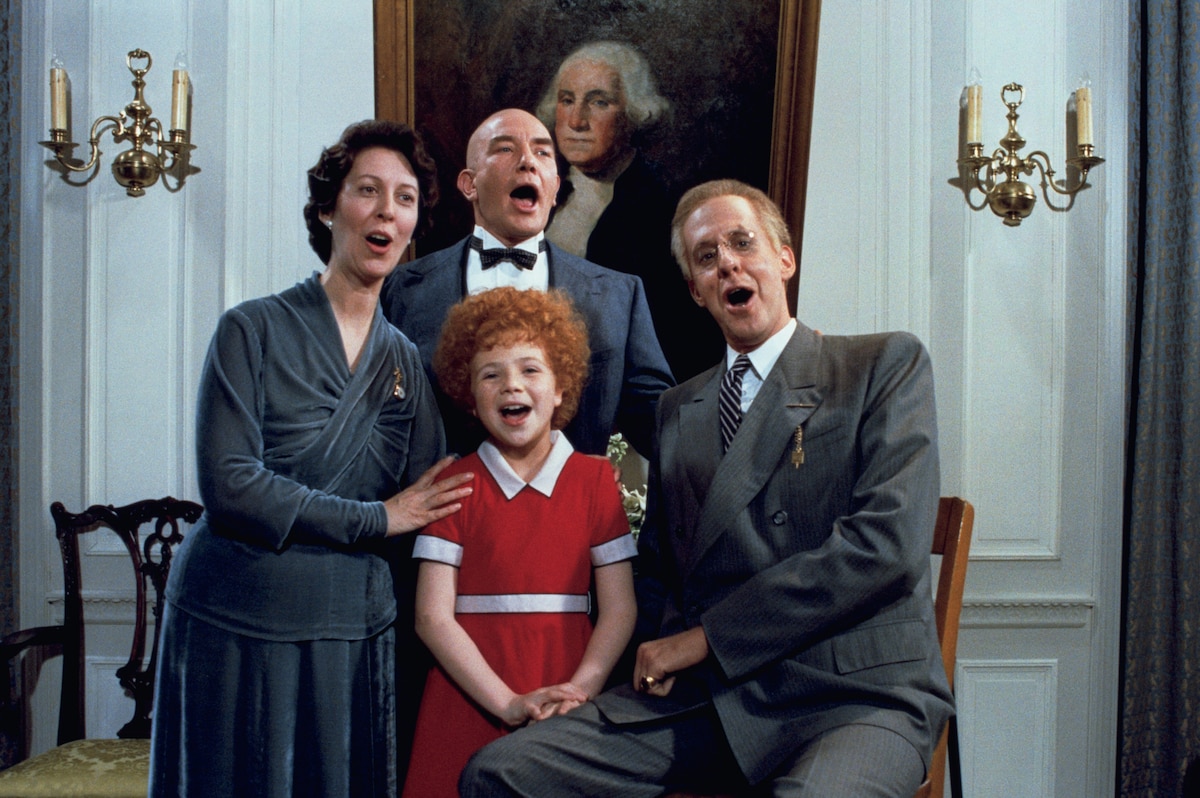
John Huston's Annie (1982), starring Aileen Quinn as Annie, Albert Finney as Daddy Warbucks and Carol Burnett as Miss Hannigan, is part of the ongoing saga surrounding the character of Little Orphan Annie as created by comic-strip artist Harold Gray.
The strip, which took its title from James Whitcomb Riley's 1885 poem "Little Orphant Annie," made its debut in the New York Daily News in 1924 and ran in syndication in various newspapers through 2010. Gray's original plan had been to create a male hero called Little Orphan Otto, but editor James Patterson convinced him to write instead about a resourceful, red-mopped girl named Annie who would never grow old and remain relentlessly cheerful despite surviving the Depression and other tribulations. Annie's faithful dog Sandy was added soon after the strip's debut, and her millionaire benefactor Oliver "Daddy" Warbucks entered the scene about a year later. The strip, designed to appeal to adults as well as children, was topical and offered commentary about politics, organized labor, the New Deal and communism.
The 1982 Annie is a film version of the smash Broadway musical of that name, adapted in turn from the comic strip with music by Charles Strouse, lyrics by Martin Charnin and book by Thomas Meehan. The show had opened in 1977 and ran for almost six years, setting a record for New York's Alvin Theatre (now the Neil Simon Theatre). Starring Andrea McArdle as Annie, Reid Shelton as Daddy Warbucks and Dorothy Loudon as Miss Hannigan, it won seven Tony awards including those for Best Musical, Book, Score and Leading Actress in a Musical (Loudon). Annie spawned national tours and productions in numerous countries as well as Broadway revivals in 1997 and 2012.
Columbia Pictures purchased the rights to the property for $9.5 million in 1978 (a record at the time for a Broadway musical). Annie was to have been produced by David Begelman but was inherited by Ray Stark when Begelman became president of MGM. Stark dismissed Begelman's choice of director, Randal Kleiser (1978's Grease) and raised Hollywood eyebrows by giving the assignment to John Huston, then 75 years old and best know for austere dramas. Stark and Huston had a history, having worked together on The Night of the Iguana (1964), Reflections in a Golden Eye (1967) and Fat City (1972). Carol Sobieski, who wrote the movie's screenplay, commented of Huston's hiring that "Ray is a major gambler. He loves this kind of high risk situation."
Despite the fact that movie musicals appeared at the time to be a dying breed, the film was given a lavish production, employing 19,000 personnel that included an impressive lineup of stars. Jack Nicholson had been announced for the role of Daddy Warbucks when Kleiser was still on board, but Albert Finney was cast after Huston took over as director. Huston himself had once been considered for the role of Warbucks, and it has been said that Finney modeled the role after his director.
Bette Midler was considered for the role of Miss Hannigan, the boozy, scheming mistress of the New York orphanage where Annie initially lives. When Midler let it known that she was more interested in "serious" comedy than musical caricature, choreographer/executive producer Joe Layton suggested Carol Burnett, a friend since the two had worked together during their early days in New York. Burnett, loving the idea a movie role as over-the-top as some of her television characters, quickly signed on.
Tim Curry was cast as Hannigan's con-artist brother, Rooster, with Bernadette Peters as his thieving girlfriend, Lily St. Regis. Mick Jagger reportedly had coveted the role of Rooster. Steve Martin had been offered the part but turned it down because his real-life romantic relationship with Peters was on the rocks and he thought it would be too painful to work with her at that time. Ann Reinking took the role of Daddy Warbucks's secretary and love interest, Grace Farrell. Edward Herrmann, a specialist in playing President Franklin D. Roosevelt, repeated his interpretation here. Geoffrey Holder plays Punjab, a Warbucks bodyguard; Peter Marshall appears as a radio host called Bert Healy; and Ray Bolger has an uncredited cameo as a radio sound-effects man.
After a one-year search during which casting director Garrison True arranged for 20,000 girls to submit photographs, 8,000 of these to be interviewed and more than 500 to be videotaped, nine semifinalists for the role of Annie were selected. Finally, nine-year-old Aileen Quinn of Yardley, Pa., was chosen. In explaining the criteria for the plum part, True said, "I needed a child with charisma who was shorter than 4 feet 6 inches. She had to have singing, dancing and acting potential. But those things weren't as important as personality." Shortly after being told by True of her casting, Quinn said, "My first thought was that he was kidding, that he was teasing. I felt like I was going to cry. I still can't believe it." Among future stars who had auditioned for the role were Drew Barrymore, Kristin Chenoweth, Elizabeth Berkley and Amanda Peterson.
Annie was shot in the summer of 1981. Locations included New Jersey's Monmouth University, which has two mansions that suited the movie's purpose. Representing the home of Daddy Warbucks is Woodrow Wilson Hall, called "Shadow Lawn" when it was built in 1929 by Hubert Parson, president of F.W. Woolworth. A climactic sequence was filmed at an abandoned railroad bridge over the Passaic River in Newark. Back in Los Angeles, studio filming took place on lots at Universal and Warner Bros.
A scene where Annie, Daddy Warbucks and others go to see the 1935 movie Camille was shot at New York's Radio City Music Hall (where Annie would premiere on May 17, 1982). This sequence contains a couple of anachronisms since Annie is set in 1932, four years before the release of Camille, and the movie is shown in widescreen rather than in its original ratio. Interestingly, Margaret Booth, the supervising film editor of Annie, was the original editor of Camille.
Carol Sobieski's script made several changes to the story as told in the Broadway musical, most notably changing the climax from a Christmas setting to the Fourth of July. Since the movie was shot during the summer, it was felt that creating enough fake snow to cover the grounds of the mansion would be exorbitantly expensive. A couple of "goddamns" were deliberately added to the screenplay so the movie would get a PG rating. Studio thinking was that the only adults who would come to see a G-rated film were the parents of small children.
Among the songs retained from the original score are "Maybe," "Easy Street," "It's the Hard Knock Life," "You're Never Fully Dressed Without a Smile," "Little Girls," "I Think I'm Gonna Like It Here," "I Don't Need Anything But You" and the show's most famous tune, that paean to optimism, "Tomorrow." Songs dropped from the original score were "NYC," "We'd Like to Thank You, Herbert Hoover," "You Won't Be an Orphan For Long," "Annie" and "A New Deal For Christmas." Created especially for the movie were "Dumb Dog," "Sandy," "Let's Go the Movies," "Sign" and "We Got Annie" (which was written for the stage show but dropped before the opening).
"Sign" was written in two days after Finney and Burnett asked for a duet they could perform together. (The characters hadn't shared a number on Broadway.) "Easy Street" had been planned as the most elaborate number in the movie, with an outdoor street set specially created at a cost of more than $1 million. A week of shooting time was devoted to the sequence, but later it was judged as "overstuffed" and "sour." Almost two months after the completion of principal filming, the performers were called back in and the number was re-shot indoors in an intimate style closer to what had been done in the stage musical. In the interim Burnett (thinking her work on the film was done) had her chin reconstructed through plastic surgery, so that her face looks different in "Easy Street" than in the rest of the movie.
Annie had a mixed critical reception. Roger Ebert found fault with some of the "particulars," but praised the performances and allowed that "In the abstract, Annie is fun. It has lots of movement and color, dance and music, sound and fury." The New York Times reviewer, Vincent Canby, liked the movie more than the stage musical but still found it "slightly vulgar, occasionally boring and full of talent not always used to its limits." When producer Ray Stark proudly said of Annie, "This is the film I want on my tombstone," Time magazine's Richard Corliss responded with, "Funeral services are being held at a theater near you." The movie was a mild box-office success if not a runaway hit, becoming the 10th highest-earner of its year yet barely recouping an investment of $42 million. Eventually, however, through foreign sales and video sales and rentals, it doubled that amount. And contemporary critics have seen a thread of continuity with Huston's other films in that Annie is a dreamer and a striver like many of his other heroes.
Annie won two Oscar nominations, for its art direction/set decoration by Dale Hennessey and Marvin March, and for Ralph Burns' adapted score. Hennessey died in the middle of the film's production and fellow art director Gene Callahan finished the film, but declined to have his name listed so that full credit for the film's production design would go to Hennessey. Golden Globe nominations went to Burnett and Quinn as Best Actress and Supporting Actress in a Musical or Comedy, with an additional nomination to Quinn as Best New Female Star. But the film's uneven reception was reflected in the Razzie Awards, where Quinn was named Worst Supporting Actress and nominated as Worst New Star, with additional nominations to the film for Worst Picture, Director (Huston) and Screenplay (Sobieski).
Preceding the original Broadway version and the Huston film were adaptations of Little Orphan Annie on radio and in the movies. A 15-minute radio show made its debut on WGN Chicago in 1930 and went national on NBC, running until 1942. David O. Selznick produced a film version of Little Orphan Annie for RKO in 1932 with Mitzi Green in the title role, and Paramount produced their version, starring Ann Gillis, in 1938. Although these films were made during the height of the comic strip's popularity, neither was well-reviewed or popular with the public.
In 1977, the year the Broadway musical opened, The "Annie" Christmas Show was shown on NBC-TV. Following Huston's Annie were a handful of other adaptations. In 1995 came Annie: A Royal Adventure! , a sequel shown on ABC and set in London, with Ashley Johnson as Annie, George Hearn as Warbucks and Joan Collins as an evil noblewoman who threatens to blow up Buckingham Palace. A 1999 Walt Disney remake of Annie was broadcast on NBC, directed and choreographed by Rob Marshall with Alicia Morton as Annie, Victor Garber as Warbucks and Kathy Bates as Miss Hannigan. It was well received and won a prestigious Peabody Award. Annie again became a theatrical film musical in 2014, directed by Will Gluck and starring Quvenzhané Wallis as Annie, Jamie Foxx as a version of Warbucks called Will Stacks, Rose Byrne as his assistant and Cameron Diaz as Miss Hannigan. The last film was poorly reviewed but succeeded at the box office.
Producer: Ray Stark
Director: John Huston
Screenplay: Carol Sobieski
Based on the stage musical by Thomas Meehan, Charles Strouse and Martin Charnin, and the comic strip Little Orphan Annie by Harold Gray
Cinematography: Richard Moore
Art Direction: Dale Hennesy
Music: Charles Strouse
Cast: Albert Finney (Daddy Warbucks), Carol Burnett (Miss Hannigan), Bernadette Peters (Lily), Ann Reinking (Grace Farrell), Tim Curry (Rooster), Aileen Quinn (Annie), Geoffrey Holder (Punjab), Edward Herrmann (FDR), Peter Marshall (Bert Healy), Lu Leonard (Mrs. Pugh), Pam Blair (Annette), Colleen Zenk (Celette), Ken Swofford (Weasel), Shawnee Smith (Dancer).
C-127m. Letterboxed.
by Roger Fristoe
Annie
by Roger Fristoe | December 15, 2015
SIGN UP FOR OUR NEWSLETTERS

CONNECT WITH TCM