A specialized subgenre of romantic comedy centered around divorce was a staple of screwball comedy, the humorous battle-of-the-sexes style that flourished between roughly the mid 1930s and the early 1940s. Tweaking the Production Code's dictates to preserve the sanctity of marriage, couples are brought to the brink of divorce - sometimes even going through with it - usually over some silly misunderstanding, only to be reunited in the film's final act when they realize what has been obvious to the audience all along, that they are meant for each other. Handling the subject this way allowed filmmakers to comically skirt notions of infidelity and sexual misadventure without actually breaking Hollywood's internal censorship rules. The greatest expression of the trope is Leo McCarey's The Awful Truth (1937), and it can be found in such other movies as I Love You Again (1940), My Favorite Wife (1940), and His Girl Friday (1940).
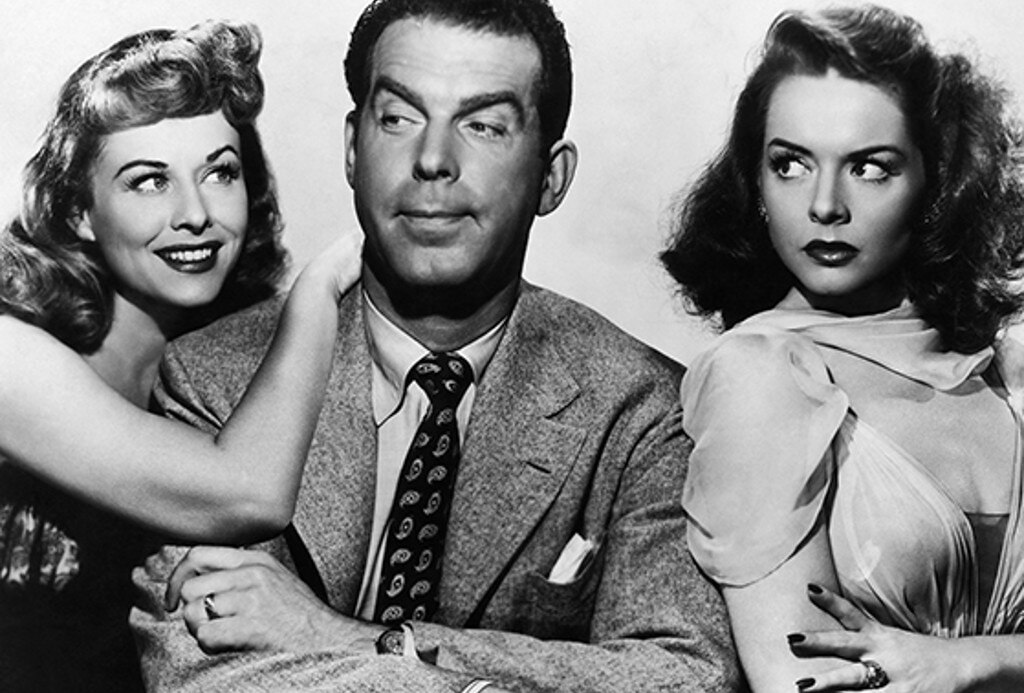
Paramount trotted the formula out again with a postwar twist in Suddenly It's Spring, in which Paulette Goddard, as an Army marital-relations expert known as "Captain Lonelyhearts," returns from overseas escorting some G.I. war brides and tries to salvage her relationship with her estranged husband, played by Fred MacMurray. As always, there are complications in the form of the Other Woman (Arleen Whelan here) and Other Man (Macdonald Carey); the style's perennial losers Gail Patrick and Ralph Bellamy must have been relieved their careers had taken them beyond such typecasting by this point.
Scripter P.J. Wolfson (1903-1979) was an old hand at this sort of thing, having come up with other comedies of divorce and remarriage in The Bride Walks Out (1936) and the provocatively titled He Stayed for Breakfast (1940) and Our Wife (1941). One of the studio's highest-paid screenwriters, Wolfson was snapped up by Hollywood after the success of his bleak, gritty novel Bodies Are Dust (1931), which Universal bought with the intention of filming but never did, likely because its dark and rather nonlinear storyline was too radical even for the pre-Code era. Once described as "a pulp Emile Zola, a noir Frank Norris," Wolfson also wrote a violent abortion-themed novel, a racy romance, and a story of a construction worker who lusts for his brother's wife. His film output was something quite different, including the Joan Crawford showbiz melodrama Dancing Lady (1933), the Astaire-Rogers musical Shall We Dance (1937), and the John Wayne Colonial America adventure Allegheny Uprising (1939). The few films he wrote that may have satisfied his taste for the dark and lurid included the horror story Mad Love (1935), with scenes of torture, guillotining, and strangulation that got it banned in several countries, and Public Enemy's Wife (1936), whose story of an escaped con out to kill his ex-wife's new husband feels like an extreme version of his marital comedies. Late in his career Wolfson produced the TV sitcoms I Married Joan and Love and Marriage.
Suddenly It's Spring was a fairly minor blip in the careers of Goddard and MacMurray. She bracketed this slight comedy with roles in Jean Renoir's The Diary of a Chambermaid (1946) and Alexander Korda's film version of the Oscar Wilde play An Ideal Husband (1947). After the dark doings of the film noir par excellence Double Indemnity (1944), MacMurray sandwiched this one in between a couple of antic rural-set comedies, Murder, He Says (1945) and The Egg and I (1947). This was the third film to pair the longtime Paramount contract players after The Forest Rangers (1942) and Standing Room Only (1944). They appeared in two other films, the all-star anthologies Star Spangled Rhythm (1942) and On Our Merry Way (1948), but they had no scenes together.
Suddenly It's Spring had the distinct advantage of being directed by one of Paramount's leading filmmakers, Mitchell Leisen. A multi-talented sculptor, illustrator, and designer of sets, costumes, and interiros, Leisen was known for sparkling romances, including Hands Across the Table (1935) and the more dramatic Swing High, Swing Low (1937), both starring MacMurray and Carole Lombard. He directed MacMurray in nine films altogether; this was the last. Heavily dependent on scripts written for him by Preston Sturges and Billy Wilder before those two turned to directing in the early 40s, Leisen's career began to wane in the postwar period and he left Paramount to freelance in 1951, finishing out his career in television in the 1950s and 60s.
Although not the height of either the stars' or the director's careers, this picture was popular enough to be broadcast in two 30-miunte radio adaptations, one in 1948 starring most of the original cast and again in 1949 with MacMurray recreating his role. The film was also reissued to theaters in 1948.
The film also features 61-year-old Lilian Fontaine in her third screen appearance (spelling her name with a double L in the credits here), mother of Joan Fontaine and Olivia de Havilland.
The cinematography is by Daniel L. Fapp, who later won an Academy Award for West Side Story (1961).
Although titles are generally not copyrighted, Paramount went into arbitration with David O. Selznick over the use of Suddenly It's Spring. Selznick wanted it for the title of the movie that became The Bachelor and the Bobby-Soxer (1947).
According to the studio's in-house PR publication, the film's nightclub set was constructed from panels of the ballroom of the 60-year-old Vanderbilt mansion in New York City, which had been purchased by Paramount in 1945 and was once the largest private ballroom in the United States. Shots of the luxury liner the Queen Mary were filmed at San Pedro Harbor, and the scene of the break-away phone booth was shot at LaGuardia Field, New York.
Director: Mitchell Leisen
Producer: Claude Binyon
Screenplay: P.J. Wolfson, Claude Binyon, story by Wolfson
Cinematography: Daniel L. Fapp
Editing: Alma Macrorie
Art Direction: Hans Dreier, John Meehan
Music: Victor Young
Cast: Paulette Goddard (Mary Morely), Fred MacMurray (Peter Morley), Macdonald Carey (Jack Lindsay), Arleen Whelan (Gloria Fay), Lillian Fontaine (Mary's mother), Frank Faylen (Harold Michaels).
By Rob Nixon
Suddenly It's Spring
by Rob Nixon | December 14, 2015
SIGN UP FOR OUR NEWSLETTERS

CONNECT WITH TCM