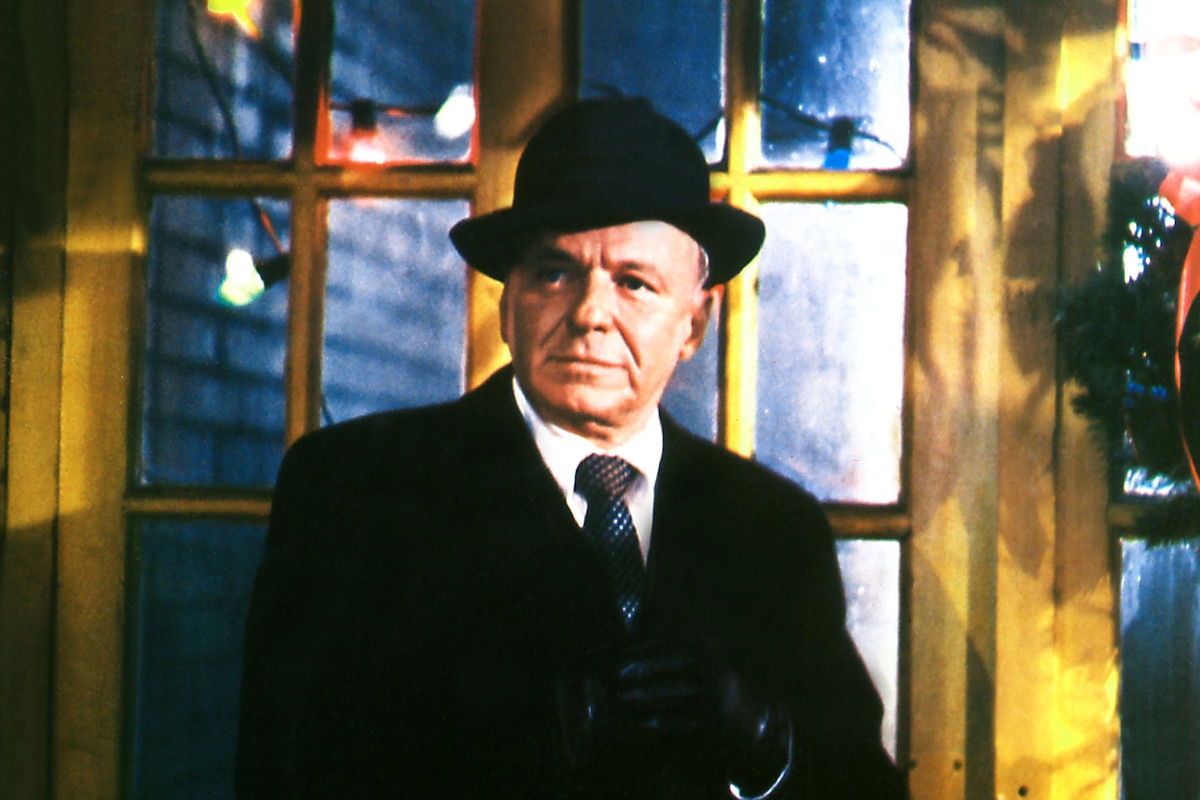
Frank Sinatra returned to the big screen in his first starring role in a decade with The First Deadly Sin (1980), a detective thriller based on the novel by Lawrence Sanders. He had made a couple of cameo appearances since starring in Dirty Dingus Magee in 1970, and despite an official retirement in 1971 had returned to performing and turning out TV specials through the 1970s. He even starred in a TV movie, Contract on Cherry Street (1977), playing a veteran New York Detective. The First Deadly Sin was to be a screen comeback of sorts. It turned out to be his final screen appearance in a leading role.
The novel, the second in what became a series of novels featuring New York Police Detective Edward X. Delaney, was published in 1973 and immediately optioned and developed as a project for Columbia Pictures. Don Siegel was attached in 1974, then replaced by Roman Polanski, who was weeks away from the start of principle photography when he was arrested and indicted on charges of statutory rape in what became one of the most notorious Hollywood scandals of the decade. The film was put into turnaround, as they say, and revived a few years later by producer Elliot Kastner, who eyed Marlon Brando for the lead.
It took Sinatra's commitment as both star and executive producer to finally get the production underway. The role was good fit for the star. Sinatra had played swinging, smart-aleck detective Tony Rome in two films and a tough, hardboiled NYPD detective in The Detective (1968), but Det. Delaney was a different kind of character. A world-weary veteran weeks away from retirement, he's a married man whose wife (Faye Dunaway) is dying of a liver ailment. Helpless to save her from her pain, he steers his energies efforts into a street murder that he thinks may be part of a string of serial killings. He has to work around the squad's new hotshot captain (Anthony Zerbe), an ambitious careerist more interested in statistics than justice, and he defies proper procedure to track down the killer in what becomes a personal quest.
Sinatra exudes an easy gravitas and unforced confidence and the wise-guy attitude so familiar to his earlier characters has aged to resignation. Faye Dunaway is relegated to a bed for the film--her entire performance is played in the supine position--but their scenes together gives Sinatra the opportunity to reveal a vulnerable, tender side of his character. James Whitmore is the sardonic coroner who provides Delaney's only help in the department and Brenda Vaccaro and Martin Gabel create memorable characters out of two civilians who volunteer to help Delaney's investigation. The role of the enigmatic, psychologically tormented killer, appropriately named Blank, was given to David Dukes, a busy actor best known for his stage work. He was in fact performing on Broadway in the play Bent, for which he earned a Tony nomination, while he was shooting The First Deadly Sin over a ten week period. Sinatra called him "one of the really great actors."
Brian Hutton, director of the sixties action capers Where Eagles Dare (1968) and Kelly's Heroes (1970), shoots the film on location on the streets of New York City, mostly at night, giving the film the atmosphere of a modern film noir. Composer Gordon Jenkins, a longtime Sinatra collaborator as arranger and conductor on numerous albums, provides an appropriately moody score.
The film received mixed reviews and the slow, deliberate direction and dark nature of the drama didn't connect with audiences at the time but Sinatra's performance was singled out for praise. "The movie is one of the season's pleasant surprises," wrote Roger Ebert, who noted the "quiet, poignant, and very effective performance" by Sinatra, who "looks and acts very touchingly like a tired old cop on the threshold of retirement." Sinatra biographer Tom Santopietro, with the benefit of hindsight, is even more effusive. "Nuanced, complex, and extremely moving in its portrayal of one aging man's vulnerability, he work therein is really of the highest rank, right up there with his turns in From Here to Eternity, Suddenly, and The Manchurian Candidate. In fact, in strictly emotional terms, it is the most involving of all..." Sinatra left the big screen with one of his finest performances.
By Sean Axmaker
Sources:
Sinatra: Hollywood His Was, Timothy Knight. Running Press, 2010.
Sinatra In Hollywood, Tom Santopietro. St. Martin's Press, 2008.
I Married the Icepick Killer: A Poet in Hollywood, Carol Muske-Dukes. Random House, 2002.
"The First Deadly Sin," film review by Roger Ebert. Chicago Sun-Time, October 30, 1980.
AFI Catalog of Feature Films
IMDb
The First Deadly Sin
by Sean Axmaker | November 18, 2015
SIGN UP FOR OUR NEWSLETTERS

CONNECT WITH TCM