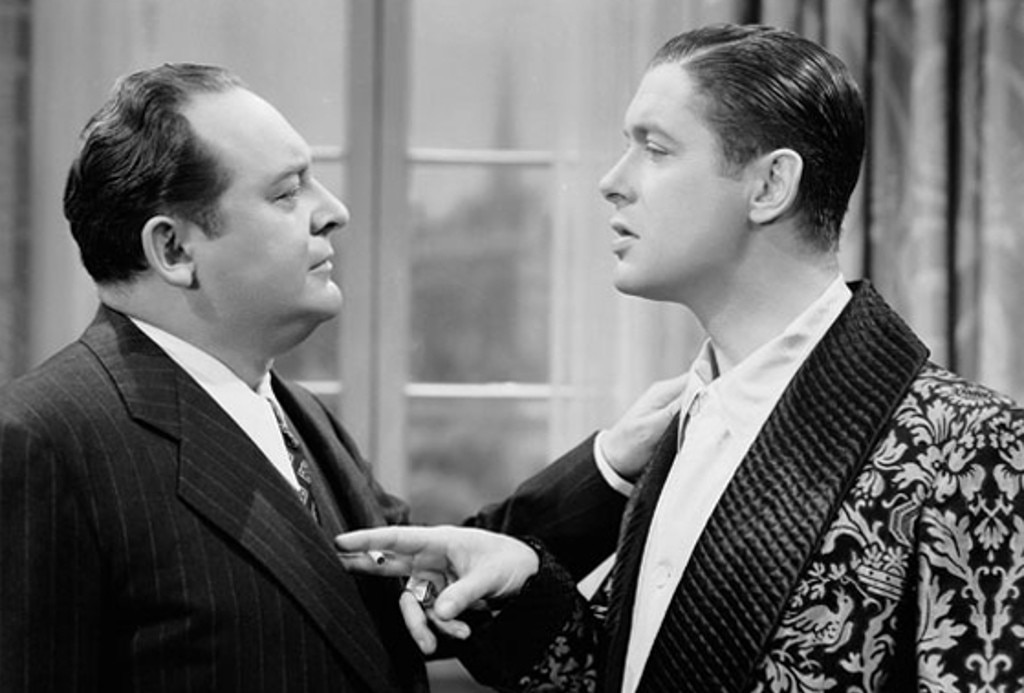
The Earl of Chicago (1940) is a striking and unusual film. What begins as a typical bootlegging gangster yarn takes an unexpected turn when reformed Chicago gangster Robert Montgomery learns that he has inherited an English title, an estate, and a membership in the House of Lords. Interested only in "the loot," he goes to England with his trusted lawyer friend (Edward Arnold) to collect, and things take a comic slant. Montgomery's total lack of education, and lack of knowledge in the ways of the aristocracy, hinder him left and right. His new butler Munsey (an outstanding Edmund Gwenn) does his best to help him navigate this new world, and then defends him with admirable loyalty when comedy gives way to tragedy and Montgomery is put on trial in the House of Lords for murder.
Even though the underlying premise of this story is not very credible, it moves from drama to comedy to tragedy with impressive credibility - thanks not only to a well-crafted script and impeccable production values but to Robert Montgomery's fascinating performance. As the movie unfolds, it feels all external - stereotypical gangster swagger - but by the ending one realizes that he has brought a surprisingly effective poignancy to the role. Montgomery accomplishes so much with his voice. His character's struggle even to speak basic English goes through the same arc as the story itself. First he sounds simply like a typical gangster. Then, in England, his speech sounds comically idiotic. And later, when he struggles to defend himself in court, his simplistic speaking ability comes off as tragic. In this sense alone, it is quite a brilliant piece of acting.
The Earl of Chicago was directed by Richard Thorpe, but the real guiding force was producer Victor Saville. Saville was an experienced English director, writer and producer who had recently overseen some of Britain's most prestigious films, such as The Citadel (1938) and Goodbye, Mr. Chips (1939). While he had previously come to America in 1929 to direct Woman to Woman, starring Betty Compson for Tiffany Pictures, The Earl of Chicago began his Hollywood producing career.
The rights to the Brock Williams novel on which the picture is based were originally owned by David Selznick, who planned to produce it with Edward G. Robinson in the starring role. Instead, he wound up selling the rights to MGM in July 1938, at Robert Montgomery's urging. With his recent Oscar® nomination for Night Must Fall (1937), Montgomery had some pull at MGM. In a conversation with John Kobal, Saville later recalled that even though this film was based on a novel, "the man who was really responsible for the story and style was Robert Montgomery," whose ideas for radically altering the book's plot were fashioned into a screenplay by Lesser Samuels.
MGM planned to make The Earl of Chicago in England at their facility in Denham, but when war broke out in September 1939, the Denham studios closed and MGM shifted production to Hollywood. Victor Saville had already shot a few exteriors in England, some of which survive in the picture. The movie certainly feels as if it was shot in England, which is a testament to the craftsmanship of everyone involved. Paintings, matte shots and clever framing do much to create the illusion of grand, authentic sets. For the House of Lords set, for instance, Saville said that "only a bit of the entrance hall and a bit of the balcony" were constructed. Watching the finished film it is almost impossible to believe this.
One important person was fooled at the time, too. Saville recalled with glee being summoned into Louis B. Mayer's office to be chastised for overly lavish spending. "Victor, you ruin us making a picture of this cost!" fumed Mayer. Saville replied that he had in fact not gone over cost - that he had delivered the picture for the half-million dollar budget. "But all those buildings, and the Houses of Parliament, Westminster Hall," protested Mayer, fully believing all the interiors to have been the real thing. The studio chief was astonished when Saville proved his case by showing him the budget breakdown.
The New York Times hit the nail on the head in its 1940 review of this picture: "To miss it would be to miss a major treat."
Producer: Victor Saville
Director: Richard Thorpe
Screenplay: Charles de Grandcourt, Gene Fowler, Lesser Samuels, Brock Williams (book)
Cinematography: Ray June
Film Editing: Frank Sullivan
Art Direction: Cedric Gibbons
Music: Werner R. Heymann
Cast: Robert Montgomery (Robert Kilmount), Edward Arnold (Quentin Ramsey), Reginald Owen (Gervase Gonwell), Edmund Gwenn (Munsey), E.E. Clive (Mr. Redwood), Ronald Sinclair (Master Gerald Kilmount).
BW-87m. Closed captioning.
by Jeremy Arnold
The Earl of Chicago
by Jeremy Arnold | December 28, 2005
SIGN UP FOR OUR NEWSLETTERS

CONNECT WITH TCM