Set in the 14th century, Japanese director Hayao Miyazaki's film Princess
Mononoke (1997) depicts a battle between human beings destroying the earth
and the gods of the forest led by the wolf god Moro. During Japan's Muromachi Period,
the film's hero Ashitaka is bitten by a demon-possessed wild boar and sets off on
an epic journey for the deer-God Shishigami who can destroy the evil growing inside
him. Ashitaka begins his adventure riding his faithful antelope-like steed Yakul.
He comes upon an Iron Town presided over by Lady Eboshi who is stripping the forest
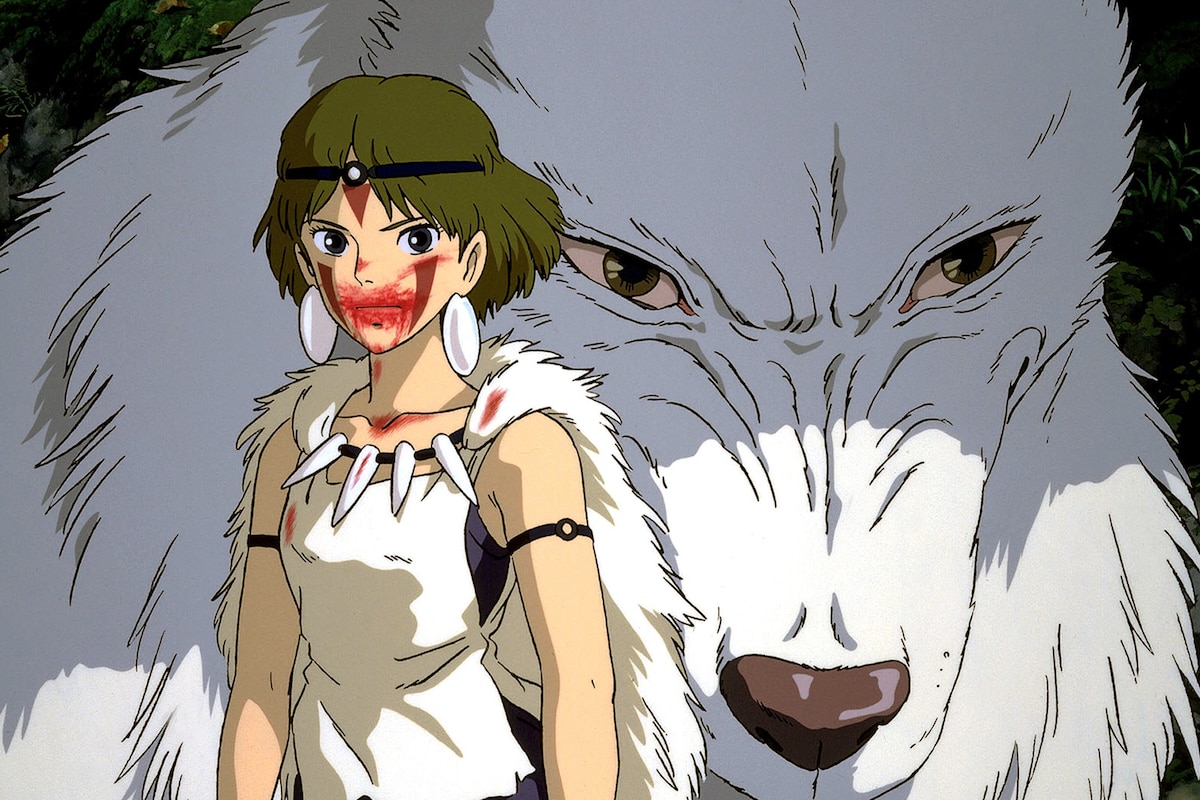
of natural resources to make weapons. The Wolf God Moro and the human companion
he has raised, San, battle Lady Eboshi's incursions into their domain. San communicates
with the nature spirits in opposition to humankind and is the Princess Mononoke
of the film's title. Miyazaki was greatly influenced by his intellectual and strong-willed
mother whose personality can be seen in some of Miyazaki's notably tough, independent
female characters including San and Lady Eboshi.
Ashitaka tries to find a way for humanity and nature to coexist in Miyazaki's story
which is heavily influenced by Japanese folklore and history. In Japan, a mononoke
translates to "spirit of a thing," a kind of ghost held responsible for
everything from natural disasters to aches and pains.
But Japanese culture was not the only influence on Miyazaki's story. In the late
Seventies Miyazaki made sketches involving a beautiful princess living in the forest
with a beast in a storyline reminiscent of the classic fairy tale Beauty
and the Beast. Ashitaka's quest, which takes him far from home, also
echoes the classic novel Pilgrim's Progress and the ancient fable
Gilgamesh. Drawing from a diverse narrative tradition, Miyazaki
has also acknowledged the influence of contemporary life on his work, even seeing
in Ashitaka's injury from the boar demon, a parallel to the modern scourge of AIDS,
which also infects contemporary children with a curse and potential death sentence.
Princess Mononoke (1997) became the highest grossing Japanese
film in that country's history, an honor previously held by E.T.
(1982) until the release of James Cameron's Titanic (1997) unseated
Miyazaki's status as the most successful film in that country. Princess
Mononoke was later usurped as the country's second highest grossing Japanese
Film by Miyazaki's Spirited Away (2001).
Princess Mononoke was acquired by Disney/Miramax for U.S. distribution
and the contract specified that Disney could not make any changes to the film other
than dubbing it. The script was rewritten by Neil Gaiman, to make its Japanese
dialogue comprehensible to an English-speaking audience. The film was dubbed with
the voices of famous English-speaking actors like Billy Bob Thornton and Billy Crudup.
Ironically enough, Miyazaki has said that he does not like Disney movies - "I
can't help but feel that it looks down on the audience."
"I think that a popular movie has to be full of true emotion, even if it's
frivolous."
Hayao Miyazaki's film is anything but frivolous, containing a message of environmentalism and humanism within its engrossing action-adventure plot line. Princess Mononoke was the first of Miyazaki's films to utilize computer generated animation, in 15 minutes worth of the film's total 133 minute running time. Ten of those minutes were comprised of digital painting, but the bulk of the film is
drawn by hand. The film boasts an unprecedented five art directors.
A perfectionist with an unusual degree of involvement in his films, Miyazaki personally
checked all the animation in the film and redrew cels he was dissatisfied with,
work generally left to a technical director. But Miyazaki has said his hands and
eyes no longer allow him to work in this detailed a manner and that Princess
Mononoke will be the last film he does under such rigorous scrutiny.
Themes of love, nature, the struggle of the weak against the strong are all recurring
themes in Miyazaki's work and especially evident in Princess Mononoke.
For Miyazaki, the Muromachi Period (1392-1573) in which the film is set marked a
turning point in Japan's history, when instead of revering and worshiping nature,
the Japanese began to exploit it, mining and clearing primeval forest land. In
many ways the upheaval and confusion of that period echoes the similar tumult of
our own age.
One of the key animators along with Isao Takahata, at the Japanese film Studio Ghibli,
Miyazaki eventually became one of the Japanese film industry's greatest international
successes and animation's heir to renowned directors like Akira Kurosawa. He has
said he makes his films strictly with a Japanese audience in mind. As he told Newsweek, "Of course, I'm delighted that people from other countries also enjoy my films. But I try not to think of this as an international business."
PRINCESS MONONOKE (JAPANESE VERSION)
Producer: Yutaka Narita, Seiji Okuda, Toshio Suzuki, Yasuyoshi Tokuma, Seiichiro Ujiie
Director: Hayao Miyazaki
Screenplay: Hayao Miyazaki
Cinematography: Atsushi Okui
Film Editing: Hayao Miyazaki, Takeshi Seyama
Art Direction: Satoshi Kuroda, Kazuo Oga, Yoji Takeshige, Naoya Tanaka, Nizou Yamamoto
Music: Joe Hisaishi
Cast: Yoji Matsuda (Ashitaka), Yuriko Ishida (San), Yuko Tanaka (Eboshi-gozen), Kaoru Kobayashi (Jiko-bo), Masahiko Nishimura (Kouroku), Tsunehiko Kamijo (Gonza).
C-134m. Letterboxed.
PRINCESS MONONOKE (ENGLISH VERSION)
Producer: Scott Martin, Bob Weinstein, Harvey Weinstein
Director: Hayao Miyazaki
Screenplay: Hayao Miyazaki, Neil Gaiman
Cinematography: Atsushi Okui
Film Editing: Hayao Miyazaki, Takeshi Seyama
Art Direction: Satoshi Kuroda, Kazuo Oga, Yoji Takeshige, Naoya Tanaka, Nizou Yamamoto.
by Felicia Feaster
Princess Mononoke
by Felicia Feaster | December 20, 2005
SIGN UP FOR OUR NEWSLETTERS

CONNECT WITH TCM