Every three months, Fox Film Noir turns out another three
gems on DVD. There have now been twelve releases, and all
have been good movies well-presented in fine prints with
commentary tracks and other extras. Even the box covers have
been thoughtfully prepared, using original poster art in
eye-catching designs. One of the latest releases is The
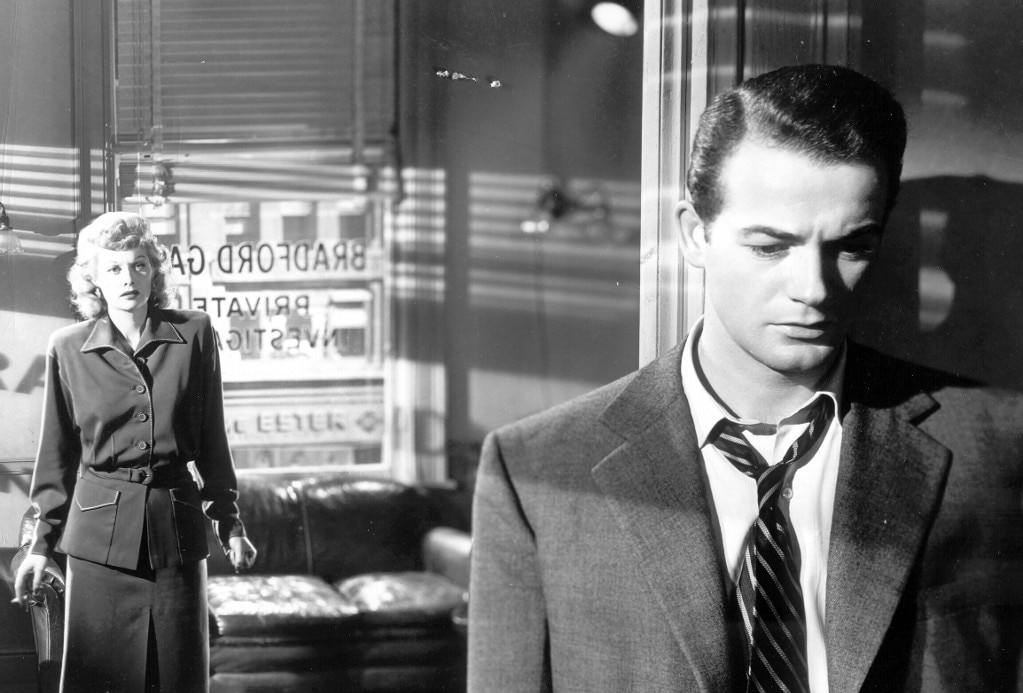
Dark Corner(1946), Henry Hathaway's moody and stunningly
photographed drama of a private investigator whose past
continues to ensnare him.
Mark Stevens plays Bradford Galt, a P.I. who has set up shop
in San Francisco after serving a jail term on manslaughter
charges. Galt was framed by his former partner, Tony Jardine
(Kurt Kreuger), and when he finds himself now tailed by a
thug in a white suit (William Bendix), Galt believes Jardine
is after him once more. Soon Galt finds himself in a
complicated maze which also includes Clifton Webb as an
effete art dealer named Hardy Cathcart and Cathy Downs as his
trophy wife Mari. Helping Galt work his way out of this mess
is his secretary Kathleen - the top-billed Lucille
Ball.
In all, The Dark Corner is a rather implausible story
(even for this era) which suffers somewhat from having its
main character - Galt - sit around brooding and depressed
much of the time, trying to figure out what to do. He's
rather passive until light bulbs start popping off inside his
head and he then springs into action. Stevens is OK but never
quite feels right for the part. He was a Fox contract player
who started in musicals, and this film was an attempt to
change his pretty-boy image. But he still looks too polished
and young to be a tough guy, and as a result his hard-edged,
Chandleresque dialogue is prone to sounding forced and
unconvincing. Stevens later directed a film noir, Cry
Vengeance (1954), in which he virtually recreated this
character but made him even more violent and moody.
Lucille Ball was not a happy camper on this set. She had
recently sued MGM to get out of her contract, and as revenge
they loaned her to Fox for this low-budget movie. She is
perky and energetic as the secretary who falls in love with
her boss and sticks by him no matter the dark morass he falls
into. But Ball hated her performance and suffered a nervous
breakdown during filming because of the tyrannical methods of
director Henry Hathaway.
Clifton Webb plays pretty much the same part as he did in
Laura (1944), which is a movie that Darryl Zanuck
desperately wanted The Dark Cornerto emulate. Zanuck
put one of the primary writers of Laura, Jay Dratler,
to work on The Dark Corner, and the script is partially set
in the same upper-crust world and even features a painting of
one of the female characters (Cathy Downs), which Webb
(another Laura alum) loves more than the real
thing.
While the script doesn't rise to the level of Laura,
and while Stevens was not ideal casting, the movie is still a
winner thanks to several inspired scenes of hard-hitting
violence and shocking murder, as well as to the real star of
the movie - cinematographer Joe MacDonald. MacDonald was
approaching the golden period of his career at this point.
His next assignment would be My Darling Clementine
(1946), and collaborations with Elia Kazan and Sam Fuller
were around the corner. The Dark Corner is full of
deep, velvety blacks and hard shadows which create wonderful
menace and make otherwise ordinary scenes stunning. From one
scene to the next, it's a beautiful-looking movie (which
thankfully has received an excellent transfer onto
DVD).
The commentary track by film noir historians James Ursini and
Alain Silver gets a bit dry in places but is otherwise quite
good. They have done several of these DVDs now and have
comfortable conversing styles, covering both the thematic
content of the film and its techniques. One interesting
tidbit of many is their observation of a sequence in which
Ball and Stevens enter a diner after Stevens has narrowly
avoided being hit by a car. All the characters and extras in
the diner, Silver and Ursini point out, are wearing dark
clothing "so the light mostly highlights their faces and
other bits and pieces. It's a very painterly rendering by
MacDonald in anticipation of the motifs that have to do with
Cathcart and his obsession with art."
Fox Film Noir will return in March, 2006, with No Way
Out (1950), Fallen Angel (1945) and The House
on Telegraph Hill (1951).
For more information about The Dark Corner, visit Fox Home
Entertainment. To order The Dark Corner, go to
TCM
Shopping.
by Jeremy Arnold
The Dark Corner on DVD
by Jeremy Arnold | December 20, 2005
SIGN UP FOR OUR NEWSLETTERS

CONNECT WITH TCM