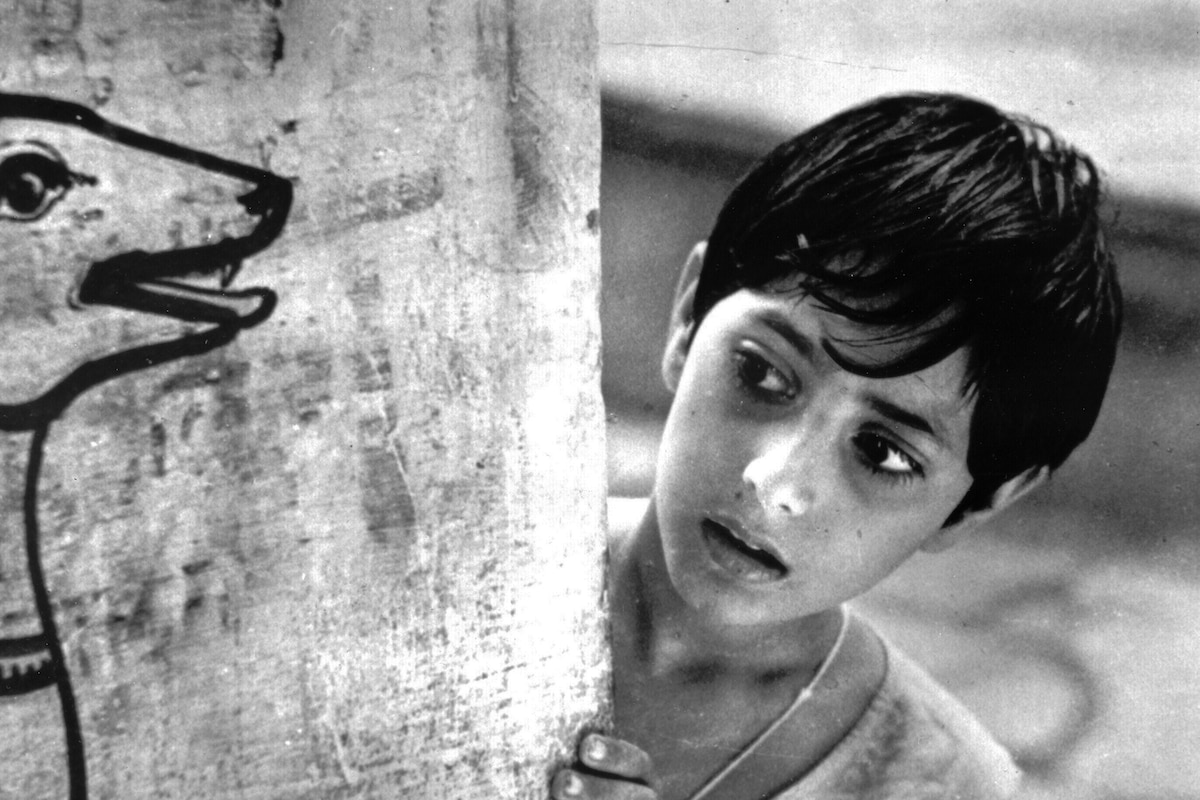
This middle entry in director Satyajit Ray's world-renowned "Apu Trilogy" was released one year after the first film, Pather Panchali (1955), which he also wrote and produced. Based on novels by Bibhuti Bhushan Banerji about a young boy's path to adulthood, the cycle eventually finished in 1959 with The World of Apu, though after making each film Ray had no plans to undertake another.
Aparajito, whose title translates as "The Unvanquished," takes place largely in Banaras, a Northern Indian city also known as Varanasi. "I was drawn irresistibly to the idea of Benaras as a backdrop of the first half of the story," Ray recalled in his 1994 book, My Years with Apu: A Memoir. "I had been to Benaras before and I knew there was quite frankly no other place more photogenic in the world." He stayed in the actual location to write the first half of the script, and it was the process of writing and completing this film that motivated him to make the definitive step of giving up a career in advertising to become a full-time filmmaker.
"A company called Epic Films, owned by, among others, the owner of a radio store, came to my rescue," Ray recalled, providing a budget that allowed him to buy an Arriflex camera. At first the logistics of the new camera proved to be a challenge, but it was ultimately hammered out and proved to be useful for capturing the delicate visuals of the story. Less cooperate was one challenging scene involving the use of a trained monkey, which improvised on camera and lunged at one of the actors-- a bit of business that remains in the finished film.
Aparajito opened in India in October of 1956, and on the basis of the acclaim for its predecessor, India's Prime Minister Jawaharlal Nehru Nehru and its President, Rajendra Prasad, requested a special screening, which was also attended by Indira Gandhi. Following the film Nehru asked, "What happens to Apu now?," which planted the seeds for what would become The World of Apu.
However, the reception for this film wasn't quite as warm at first as the acclaim for Pather Panchali. Fans of the books objected to the more complicated, conflict-laden relationship between Apu and his mother, the aspect that fascinated Ray the most. In a 1958 interview with Hugh Gray republished in 2007's Satyajit Ray Interviews, the director explained, "I made whatever changes I felt were demanded by the medium, departing, that is, only from the literary form, not from the truth. Cinema has its own way of telling the truth and it must be left free to function in its own right. I am interested first and last and only in the cinematic way of motion-picture making."
Overseas the film was given a much warmer reception with numerous accolades including top prize at the Venice Film Festival. In its November 9, 1958 review, Variety called it "a worthy successor to the first film... It doesn't have quite the tension or quite the variety of mood that the first picture had, but it has a special brooding quality and a more explicit conflict between East and West." Likewise, Saturday Review noted in its February 14 review the following year during the official United States art house release by distributor Edward Harrison, praised "Ray's deep feeling for his characters, his ability to transform a commonplace incident into a moment of revelation, and a gift for imagery that often soars into poetry without disrupting the realistic tenor of his approach."
Even decades later, the film continues to inspire numerous critical appraisals and devoted fans among world cinema devotees. In one of his books on Ray's cinema, The Apu Trilogy: Satyajit Ray and the Making of an Epic (2011), Andrew Robinson looks back at the film and finds that "its characterization is the deepest in the three films, by virtue of Sarbajaya and her relationship with her son. Although one may have little sympathy for her comparatively narrow and passive outlook on life, one cannot avoid becoming emotionally entangled in the poignancy of her predicament."
Unfortunately, survival has been difficult for this film and its cinematic bookends, with a 1993 lab fire partially destroying the negatives of all three features. Fortunately they were salvaged from the jaws of oblivion by a years-long undertaking by the Criterion Collection, the Academy of Motion Picture Arts and Sciences, and L'Immagine Ritrovata, restoring each as closely as possible to its original luster and allowing this middle chapter in the story of Apu to solidify its status as one of the screen's great coming-of-age stories.
By Nathaniel Thompson
Aparajito
by Nathaniel Thompson | October 30, 2015
SIGN UP FOR OUR NEWSLETTERS

CONNECT WITH TCM