One of the key indie filmmakers of the New York scene in the 1960s, Shirley Clarke remains a unique artist in any realm with her transition from choreographer and skilled dancer to documentarian to narrative filmmaker. Her first fictional feature film, The Connection was released to considerable controversy in 1962 and played a pivotal role in breaking down censorship barriers in her home state. Today it may be difficult to see what all the fuss was about, but the film itself remains a compelling snapshot of a subculture that remains with us today, albeit in a different form.
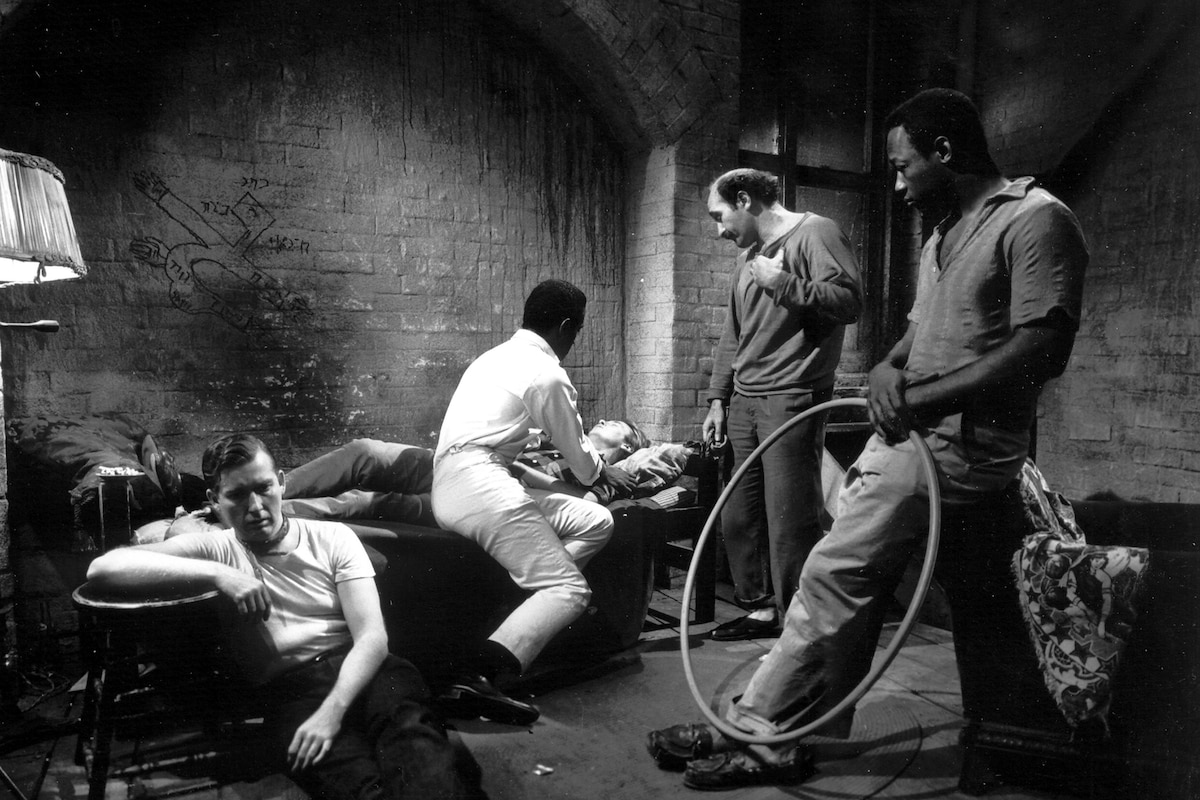
Based very closely on a play by Jack Gelber, the film chronicles a day in the lives of Big Apple junkies waiting for their dealer, Cowboy (Carl Lee), to deliver the goods. An aspiring young documentarian, Jim Dunn (William Redfield), aims to capture their "natural" behavior in all its squalid realism, but the presence of the camera itself has an unavoidable effect on the subjects - with Jim himself and his cameraman soon getting closer to his subject than they ever planned.
Gelber's play, which was originally presented by the Living Theater in 1959, was a natural choice for Clarke, who had co-founded the documentary collective Filmmakers with D.A. Pennebaker, Albert Maysles, and Richard Leacock, with her other friends at the time including such names as Maya Deren, Roger Corman, and John Cassavetes. Rumors persisted that the play (which featured no filmmaker character) containing actual drug use in its second half (following an intermission with the actors staying in character and begging for change from the audience), so the decision to work cinéma vérité into the film adaptation was an extension of that concept.
Clarke acquired the rights to the play in February of 1960 from Gelber, who was 27 years old at the time and told The New York Times, "I was practically brought up on movies and circuses in Chicago, where I was born. I've seen every movie I could ever since I was 5. I love them. And when Mrs. Clarke came to me with her offer--the money isn't stupendous--which gave me a great deal of artistic control when we write the script, I jumped at the chance. The point is, we're both willing to gamble on it, and that makes it a wonderful challenge."
The asides to the audience in the play were transformed by Clarke and Gelber into statements to the camera, with the seemingly improvisatory style actually very controlled with only minor leeway granted for inflection. The film was shot for three weeks on a budget of approximately $150,000 on one-sixth of a sound stage at New York's Production Center, with several members of the press stopping by including Howard Thompson from The New York Times. "I watched this play fascinated and it struck me that a camera could come in on these guys--these dope addicts--and you'd believe them," she told the journalist. "This is hard, tough work. The picture costs twice what I'd expected because it's union-made... Yet all this is such fun, a real challenge--like a marvelous game you want to win."
Indeed, Clarke and company seemed to have triumphed when the film took home the Critics' Prize at Cannes, but stormier seas lay ahead. The film was denied a New York license to be shown in the state because of the repeated use of the word "shit" as a slang term for heroin, but it was booked anyway at Times Square's D.W. Griffith art theater in late September of 1962. The state shut down the release, which led to a decision by the Court of Appeals in Albany on November 6 that the film's release could continue as "at most, the use of the word may be classified as vulgar, but it is not obscene."
However, the marketing and legal costs had taken their toll, and the film was unable to recoup its budget. The rest of the country was poised for attack as well, with local Los Angeles editorialist Hazel Flynn railing against it in the Citizens News when the film opened at the Cinema Theater: "The constitutional rights always are those of the filmmakers, not the viewers. There may be millions of people who don't want to see filth or want their children to have the opportunity of seeing it, but they are helpless... I consider The Connection the most vulgar and disgusting celluloid work ever turned out, and just having to detail its contents makes me want to vomit." She concluded her tirade by encouraging a public pledge: "I will not vote in any coming election for people in this state or our local government who stand by and allow such films as this to be exhibited. The Connection brings shame to Los Angeles and to the United States. It marks the outright abuse of freedom."
Of course, history turned out to be firmly on the side of the film and its director. Already an Oscar nominee for her 1960 short subject Skyscraper, Clarke went on to direct the Academy Award winner for Documentary Feature for 1963, Robert Frost: A Lover's Quarrel with the World, and she continued to explore the world of the disenfranchised with two more groundbreaking films, The Cool World (1963) and Portrait of Jason (1967), all of which now stand as milestones in American cinema. The historical value of The Connection was solidified when it was selected for a full restoration by the UCLA Film and Television Archive in 2012 with its first genuine theatrical release quickly following. The film also retains value for its rare jazz performance footage of Jackie McLean and Freddie Redd, regulars on the Blue Note jazz label, and the fact that it featured the debut screen performance by the great Roscoe Lee Browne (as J.J.), whose distinctive voice ensured a long and prestigious career in film, television and the theater until his death in 2007. Clarke would pass away earlier in 1997, but her entire body of work has since been drastically reappraised with home video releases under Milestone's "Project Shirley" banner introducing a far wider audience to her work. Perhaps her most famous quote came in the 1970s when she said, "It was years before it dawned on me that if I had been a man, I would have been Stanley Kubrick," but in hindsight we're fortunate for the films she did create, which could have come from no one else.
By Nathaniel Thompson
The Connection
by Nathaniel Thompson | October 30, 2015
SIGN UP FOR OUR NEWSLETTERS

CONNECT WITH TCM