By the time A Time to Kill was released in 1996, author John Grisham was a veritable name brand in legal thrillers. He averaged a novel a year, his books were consistent bestsellers, and The Firm and The Client had already been turned into hit movies. The small-town lawyer and former state legislator was successful enough to give up his law practice to write full time.
A Time to Kill is the fourth film based on Grisham's books but it was his very first novel. A lawyer by profession, Grisham was inspired to write the novel while attending a trial (one that he wasn't involved in professionally) and hearing the heartbreaking testimony of 12-year-old girl who had been raped. "Every juror was crying," he later recalled. "I remember staring at the defendant and wishing I had a gun. And with that, a story was born." He spent three years writing the novel, about an ambitious young white lawyer in the small town of Clanton, Mississippi, who defends a black man for the murder of the two men, both virulently racist white men, who raped his ten-year-old daughter and left her for dead. The case stirs up racial tensions in town and brings the Klu Klux Klan out in force to threaten and intimidate the lawyer, Jake Brigance, defending the father, Carl Lee Hailey.
The novel was rejected by 28 publishers by his count before a small press published a small run of 5,000 copies, which Grisham promoted by personally taking copies around to libraries and bookstores. While it was not a hit on it original release, his second novel The Firm became a New York Times bestseller and was made into a hit movie starring Tom Cruise and Gene Hackman. After a string of subsequent bestsellers, the novel A Time to Kill was republished and sold over 1.5 million copies. Director Joel Schumacher directed The Client and approached Grisham to follow up with A Time to Kill, with co-producer Akiva Goldsman scripting. It was the fourth film based on a Grisham novel, but this one was more personal to Grisham, who has called it his favorite.
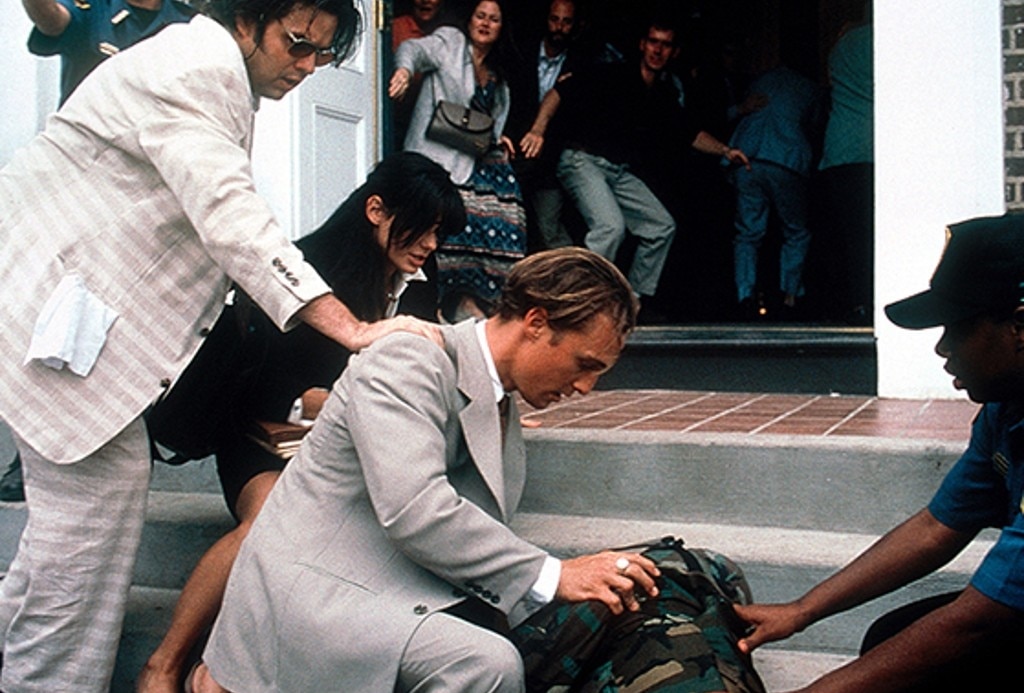
Matthew McConaughey, then a rising young actor best known for his scene-stealing role as twentysomething stoner Wooderson in Richard Linklater's Dazed and Confused (1993), was originally cast in a small role as Freddie Lee Cobb, the brother of one of the rapists, when he approached director Joel Schumacher and proposed himself for the leading role of Jake Brigance. Kevin Costner and Woody Harrelson had both expressed interest in the role and Brad Pitt's name was being discussed but Schumacher didn't think they were right for the role. Schumacher agree to a screen test and Grisham was duly impressed. He agreed that this unknown was right for the role and defended the choice to the studio, which wanted a bigger name. "I had script approval, casting approval, location approval, so I got way too involved," he told Entertainment Weekly in 2004. "When all was said and done I was happy with it, happy we were able to find a kid like Matthew McConaughey." It was McConaughey's first leading role in a major motion picture and his breakthrough role.
McConaughey is surrounded by an impressive cast. Samuel L. Jackson, fresh off an Oscar nomination for his role in Quentin Tarantino's Pulp Fiction, was cast as the vengeful father Carl Lee, a blue-collar man who doesn't believe that the legal system in this small southern town deliver justice. Sandra Bullock, a star thanks to Speed (1994), is the passionate young law student who volunteers to assist on the case. Kevin Spacey, using the same honeyed southern accent that defines his manipulative Francis Underwood in House of Cards, is the District Attorney who sees the case as a stepping stone in his campaign for Governor. Donald Sutherland plays Jake's mentor Lucien Wilbanks, an idealistic civil rights champion no longer allowed to practice law, and Sutherland's son Keifer Sutherland took over Freddie Lee Cobb from McConaughey. Other members of the cast include Oliver Platt, Charles S. Dutton, Brenda Fricker, Patrick McGoohan, and Ashley Judd. It also marked the film debut of actress and future Oscar-winner Octavia Spencer, who was originally hired as a casting assistant. She has a small part as a nurse in a couple of scenes. In an uncredited role, character actor M. Emmett Walsh plays a psychiatrist whose testimony is essential to Jake's case.
Though the film was a commercial hit and mostly well reviewed--"This is the best of the film versions of Grisham novels," wrote Roger Ebert in 1996--it was also controversial for defending and justifying vigilante justice. This portrait of the "new" South, decades after the passage of the Civil Rights act and the end of legal segregation, suggests that at least in some pockets, things haven't changed as much as the rest of the country may think, and the portrait of blatant racism and a culture of rednecks who continue to terrorize blacks with impunity is central to the story and essential to the theme.
In the years since, the story has gone to the stage in a play adapted by playwright Rupert Holmes and directed by Ethan McSweeny, which opened in Washington D.C. in 2011 and arrived on Broadway in 2013. Also in 2013, Grisham published a sequel to the novel Sycamore Row, catching up with Jake Brigance 25 years later.
By Sean Axmaker
Sources:
John Grisham official website (jgrisham.com)
"Chart the History of John Grisham's A Time to Kill, From Bestselling Novel to Broadway Thriller," Lindsay Champion. Broadway.com, October 15, 2013.
"A Time To Kill film review, Roger Ebert. Chicago Sun-Times, July 26, 1996.
"John Grisham issues judgment on ALL his novels," Tina Jordan. Entertainment Weekly, February 6, 2004.
"Matthew McConaughey: Lone Star Rising," Matt Zoller Seitz. Austin Chronicle, September 1, 1995.
A Time to Kill
by Sean Axmaker | October 22, 2015
SIGN UP FOR OUR NEWSLETTERS

CONNECT WITH TCM