It is the end of the "War to End All Wars," a conflict that was also known as
World War I. One soldier, James Allen (Paul Muni), returns to the United States
fully invested with the promise of a new life, a new career, and a new direction
that was impossible before victory in Europe and the advent of the "Roaring
Twenties." So, Allen refuses his family's advice of returning to his stable,
but dull factory job, and strikes out on his own, with the hopes of becoming an
engineer. But from town to town, year to year, success eludes him and
unemployment takes its toll. Penniless and destitute in the Deep South, Allen
becomes implicated in a crime that he did not commit and is sentenced to 10
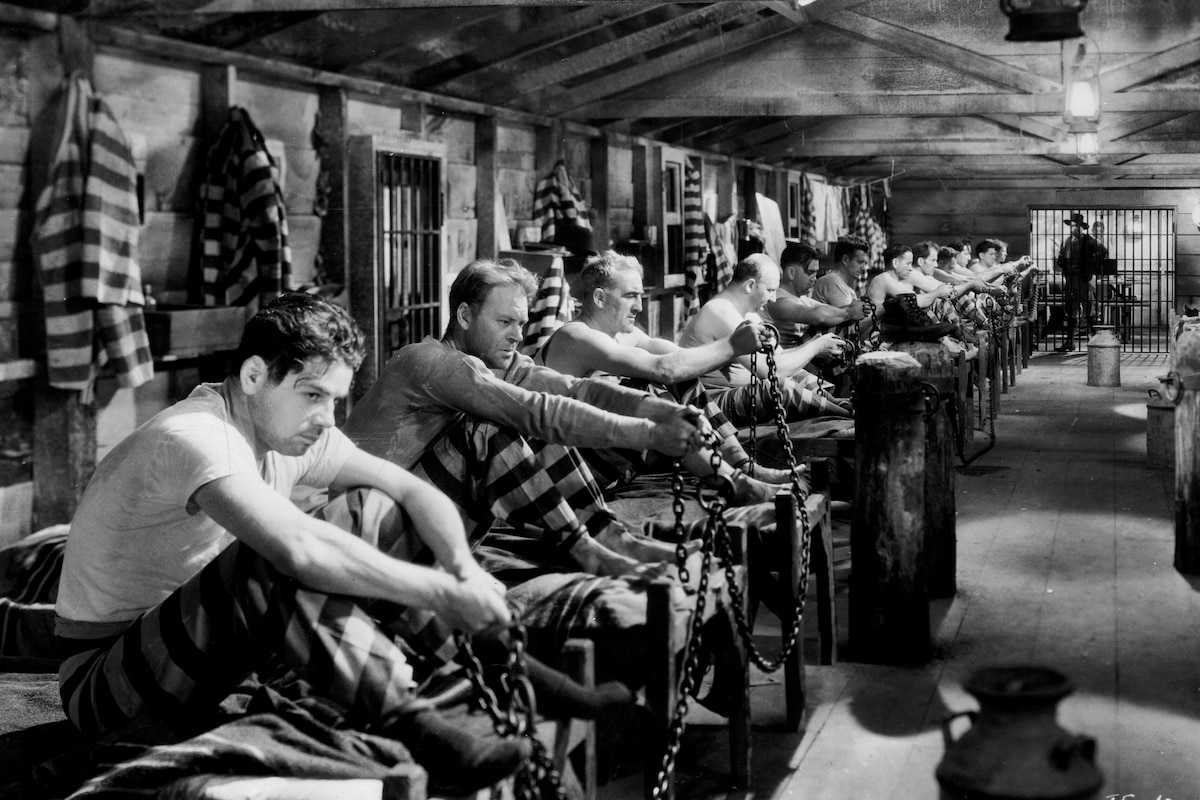
years of hard labor on a chain gang. He spends years of being treated like an
animal by the inhumane prison system. But he waits, biding his time for the
perfect moment to make a break for freedom.
When I Am a Fugitive From a Chain Gang (1932) was first released, it
arrived in American movie theaters in a storm of controversy. As opposed to
other controversial films of its time, the furor was not over issues of
censorship concerning sex and violence, but the film's depiction of the barbaric
penal systems in use in the Deep South, particularly in the state of Georgia.
Public knowledge of the harsh chain gang system was nothing new. In fact,
Robert Elliot Burns, the person on whom the James Allen character is based,
wrote a book entitled I Am a Fugitive From a Georgia Chain Gang, so the
general public was aware of Burns' harrowing story. But to a much larger
audience than the novel could ever reach, I Am a Fugitive From a Chain
Gang showed in striking detail just how powerful the talking picture medium
could be, particularly in the field of social change. The film fueled a storm
of protest from the general public that resulted in the reform of the prison
chain gang system in the American south.
Cinematically, the film is a striking example of the economy of Hollywood
narrative storytelling. Robert Elliot Burns' real-life tale is condensed into a
tight 90-minute plot, with no superfluous plot threads. Despite its relatively
short running time, Chain Gang shows just how powerful a film story could
be, providing it is told right. And director Mervyn LeRoy took every pain to
make sure that this story was filmed just right, starting with the perfect lead
in Paul Muni. One of the most revered actors of his day, Muni revolutionized
screen acting in the post-silent screen years. At a time when actors were still
struggling to find the right "voice" for the talkies, Muni, a celebrated stage
actor, brought a theatricality to the screen that helped "legitimize" the
relatively new talking picture from a technological phenomenon to the natural
evolution of the film medium.
Producer: Hal B. Wallis
Director: Mervyn LeRoy
Screenplay: Howard J.
Green & Brown Holmes, Sheridan Gibney (uncredited), based on the autobiography
by Robert E. Burns.
Film Editing: William Holmes
Cinematography: Sol
Polito
Art Direction: Jack Okey
Original Music: Leo F. Forbstein,
Bernhard Kaun
Cast: Paul Muni (James Allen), Glenda Farrell (Marie Woods),
Preston Foster (Pete), Helen Vinson (Helen), David Landau (Warden), Allen
Jenkins (Barney Sykes), Noel Francis (Linda), Berton Churchill (Judge).
BW-93m. Closed captioning.
by Scott McGee
I Am a Fugitive from a Chain Gang
by Scott McGee | February 26, 2003
SIGN UP FOR OUR NEWSLETTERS

CONNECT WITH TCM