By the 1960s, the world had become quite used to news of frequent coups d'etat in developing nations, particularly those of Latin America, known by the derogatory term "banana republics." Woody Allen would later parody the political turmoil in his comedy Bananas (1971), but a decade earlier, this British release would take a serious approach to the subject.
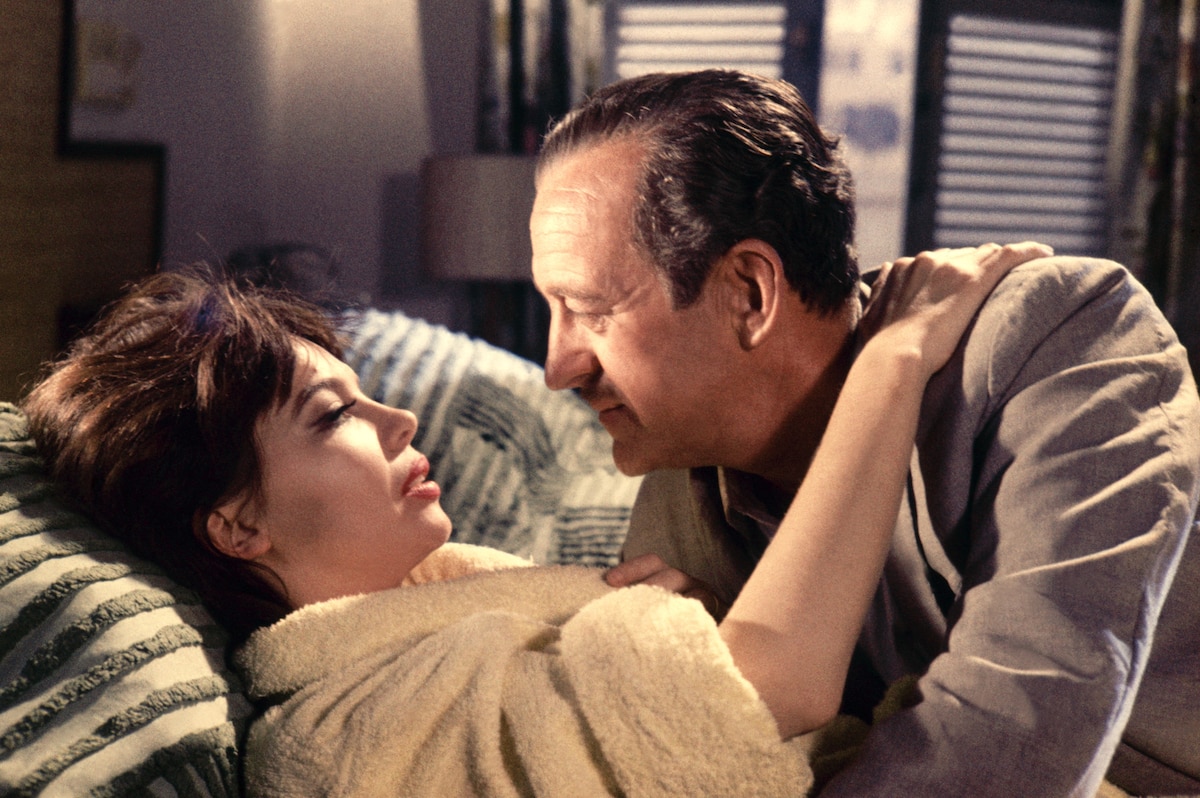
Based on Francis Clifford's novel An Act of Mercy and adapted for the screen by John Mortimer (Bunny Lake Is Missing, 1965), this British suspense drama finds a married couple, played by Leslie Caron and David Niven, trapped in a fictional South American country during one such coup. Quite by accident, the couple becomes embroiled in helping the former president escape before he is caught and publicly executed. The president is played by American character actor David Opatoshu, best known around this time for his work in Alfred Hitchcock's Torn Curtain (1966) and Otto Preminger's Exodus (1960).
The novel's title was actually closer to the drama's theme, but it was likely changed to capitalize on the success of Niven's earlier film, the blockbuster war adventure The Guns of Navarone (1961), co-starring Gregory Peck and Anthony Quinn.
Caron made her first mark as a featured dancer with the Ballet des Champs-Elysees in Paris, where she was discovered by Gene Kelly and given the co-starring role in the Oscar-winning musical An American in Paris (1951). Her early successes were in musicals, among them Lili (1953) and Gigi (1958), but by this point in her career she was making the transition into more dramatic roles, notably in Joshua Logan's Fanny (1961), with Maurice Chevalier and Charles Boyer.
As the manager of a sugar plantation thrust into a deadly situation, Niven delivers a multi-faceted performance as a man with alcohol and marital problems, distinctly apolitical and apparently heedless of the feelings of others, who taps into a heroic, humanitarian side in the arduous effort to smuggle the deposed ruler across the border. Along the way, Niven regains the love and respect of his wife.
Oddly, although Niven had been in films for 30 years at this point and won a Best Actor Academy Award for his performance in Separate Tables (1958), he was given second billing to Caron on this production.
English actor Derek Godfrey was cast as a Che Guevara-like revolutionary, but for greater authenticity he was dubbed by Roger Delgado, also London born but the son of a Spanish father and French mother.
The film was directed by venerable English director Anthony Asquith (Pygmalion, 1938; The Importance of Being Earnest, 1952) and shot by Robert Krasker, the Academy Award-winning cinematographer of The Third Man (1949). Their work stands out in the film's most tense sequence as the couple's car becomes caught in a quicksand bog.
Editor Frederick Wilson must have picked up some skills here in cutting a picture for suspense. A few years later, he would receive two Academy Award nominations in a single year for the thrillers Arabesque (1966) and The Quiller Memorandum (1966).
The picture was partially shot in Malaga, Spain, standing in for the strife-torn South American country. The rest was filmed at England's Elstree Studios .
Director: Anthony Asquith
Producer: Thomas Clyde
Screenplay: John Mortimer, based on the novel An Act of Mercy by Francis Clifford
Cinematography: Robert Krasker
Editing: Frederick Wilson
Art Direction: John Howell
Music: Benjamin Frankel
Cast: Leslie Caron (Claire Jordan), David Niven (Tom Jordan), James Robertson Justice (Hugo Bryant), David Opatoshu (President Rivera), Derek Godfrey (Hernandez)
By Rob Nixon
Guns of Darkness
by Rob Nixon | September 16, 2015
SIGN UP FOR OUR NEWSLETTERS

CONNECT WITH TCM