The massive worldwide success of Hercules (1958), an Italian-made fantasy vehicle for bodybuilder and actor Steve Reeves, created an insatiable demand around the world for sword and sandal films, commonly called peplum. By the time The Warrior Empress opened in 1960, pepla mania had resulted in numerous competing films churning out of Italy at the same time with its release competing with Sergio Leone's The Colossus of Rhodes, Revenge of the Barbarians, Messalina, The Slave of Rome, Giants of Thessaly, Fury of the Pagans, and many others.
This particular production was launched in Italy by two minor production companies, Documento Film and Orsay Films, under the title Saffo - Venere di Lesbo, or "Sappho - Venus of Lesbos," variations of which were used throughout Europe (such as Germany, where it was called Sappho, Venus von Lesbos). Needless to say, the script by Ennio De Concini (1960's Black Sunday), Pietro Francisci (Hercules), and Luciano Martino (future production of a slew of gialli and spaghetti westerns as well as brother of director Sergio Martino) owes very little to the real Sappho, the famed Greek poet from the island of Lesbos whose work is famous today for inspiring the term "lesbian."
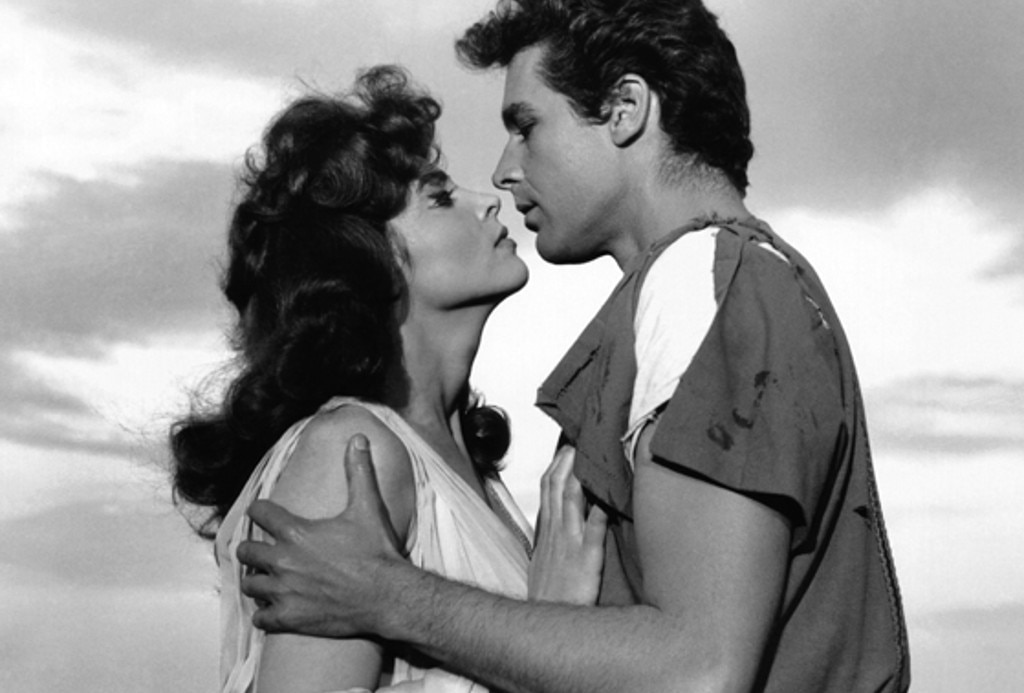
What we have here instead is a strictly heterocentric costume melodrama with the title character played by glamourous Tina Louise, a New York-born actress who had scored a Broadway hit with Li'l Abner and debuted on the screen in 1958 with Anthony Mann's God's Little Acre. By this time she had been studying at the Actors Studio with Lee Strasberg but was finding major film roles few and far between, with this one following a modest turn in Day of the Outlaw (1959) opposite Robert Ryan and Burl Ives. Her greatest claim to fame would come four years later when she took a role as Ginger, the movie star castaway on Gilligan's Island.
Interestingly, director Pietro Francisci (who helmed the original Hercules and its sequel, Hercules Unchained, 1959) opted for a change of pace from the muscleman traditions of the time and went with traditionally handsome leading man Kerwin Mathews, who had just finished shooting the Ray Harryhausen fantasy The 3 Worlds of Gulliver for Columbia (still under its shooting title of Gulliver's Travels at the time) and was best known for the first Harryhausen classic, The 7th Voyage of Sinbad (1958). Announced as the film's star in December of 1959, Mathews was still under his seven-year contract at Columbia, who released The Warrior Empress with plans for a major saturation release in April of 1961. The number of screens was pared down when it actually opened a month later on American screens as a double bill with the violent Hammer pulp adventure, Terror of the Tongs. Shot in March of 1960 at Cinecitta for twelve weeks, the film had already opened much earlier in August of 1960 with its English dialogue dubbed in Italian, a common practice in the industry. Rounding out the supporting Italian-speaking cast were several familiar character actors including Riccardo Garrone, who had appeared in La Dolce Vita the same year and would go on to Girl with a Suitcase immediately afterwards, and the great Enrico Maria Salerno, still a relative newcomer at the time but soon to be a fixture in Italian films like The Bird with the Crystal Plumage (1970), Candy (1968), and The Assassination of Trotsky (1972). One other major player was the film's composer, Angelo Francesco Lavagnino, an extremely busy peplum fixture who also worked on the Orson Welles versions of Othello (1952) and Chimes at Midnight (1965) as well as Antonio Margheriti's string of '60s space operas like Wild, Wild Planet (1965).
Not surprisingly, critics were growing tired of the sword and sandal craze at the time, though it would be another five years before the peplum torch would be handed over to spaghetti westerns. For example, Charles Stinson of The Los Angeles Times noted, "It's all done in bright and vacuous Eastmancolor; the stilted dialogue is unusually florid and the primitive direction moves the comic book plot along in spasms. Miss Louise, who is visually luscious except for spike-like eyelashes, commands the dramatic impact of a powder puff." Fortunately that mixture of splashy color, vivid spectacle, and high glamour turned out to be an asset in the long run as the film can still be savored as a glossy reminder of a time when Italians still reigned in movie theaters across America.
By Nathaniel Thompson
Warrior Empress
by Nathaniel Thompson | August 27, 2015
SIGN UP FOR OUR NEWSLETTERS

CONNECT WITH TCM