The gangster movies exploded in the sound era with Little Caesar (1931) and The Public Enemy (1931) but it was Josef von Sternberg who gave birth to the modern gangster movie with two crime dramas that took a more romantic approach to the genre. Underworld (1927), a silent film, was the director's first big hit and Thunderbolt (1929) was his first sound film. It's "less a gangster film than a gangster fantasy," wrote critic and film historian Andrew Sarris in 1966. "Its speech is stylized, it noise of gunfire muted." Like many films made during the crossover, the film exists in both silent and talkie versions but the sound version reveals a director famed for his images using the new audio dimension as an additional expressive tool. Sarris describes it as "a startling experiment... his use of sound and music for mood effects, and the very unreality of his style seems to justify the unusual density of his sound track."
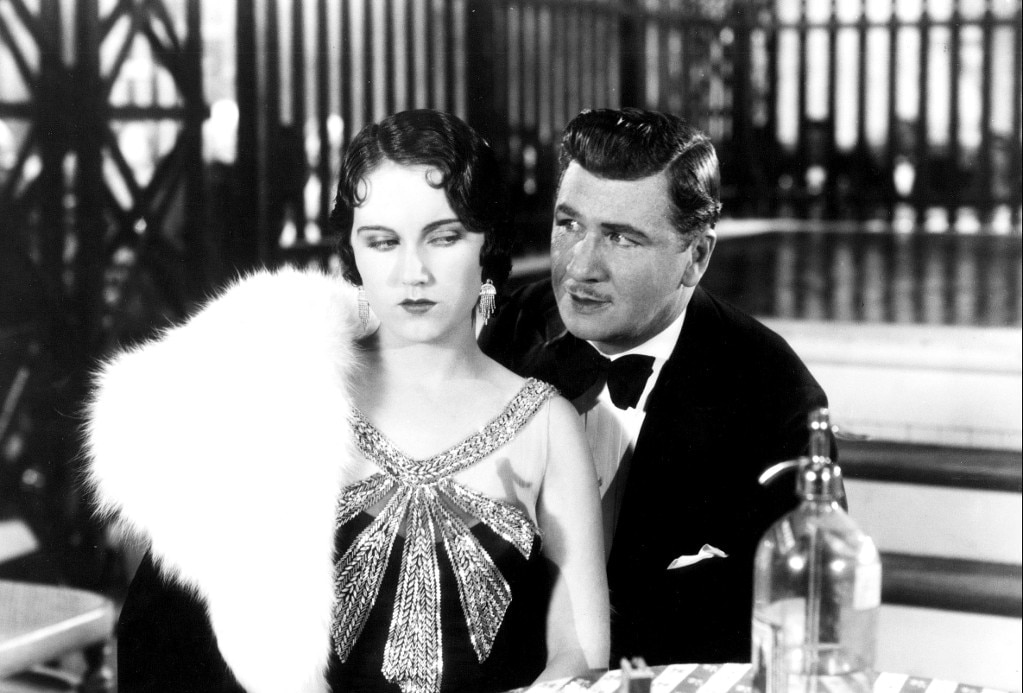
George Bancroft, a gangster in two previous Sternberg films and the star of his bowery romance The Docks of New York, stars as Thunderbolt Jim Lang, a notorious bank robber and gangster, and Fay Wray is his girl Ritzy, but as the film opens she wants nothing more than to leave her most wanted beau. She yearns for a normal life and is secretly dating Bob Morgan (Richard Arlen), a modest, stalwart bank teller who lives with his doting mother. The idea that his girl is throwing him over for another man, let alone a civilian, is more than Thunderbolt can endure and his ego becomes his Achilles heel. The gangster movie drama leaves the streets and hideouts and nightclubs for the stillness of death row in the final act. It's a far more ascetic set where Sternberg uses the bars of the cells the same way he uses nets and screens and smoke in other films to layer the images on the screen.
The cliché of the early sound era is that the films are all stiff and static, with awkward, overly-theatrical dialogue and performances, flat sound, and stagey direction. While that is true for some films, it's also true that many filmmakers embraced and experimented with the new dimension and brainstormed solutions to overcome the limitations of early microphones and cameras locked in soundproof booths. While Sternberg's camera is still in many shots, with action and energy created through editing and the movement of actors within the frame, he moves the camera in other scenes and introduces one of the film's defining relationships (between Thunderbolt and a stray dog) with a graceful tracking shot.
The tough-guy drama and gangster romanticism of Thunderbolt is co-written by Jules Furthman, a favorite collaborator who went on to script Morocco (1930), Shanghai Express (1932), and Blonde Venus (1932) for Sternberg, with dialogue by the witty Herman J. Mankiewicz, future co-writer of Dinner at Eight (1933), The Pride of the Yankees (1942), and of course Citizen Kane (1941). The banter among the crooks and the cops is terse and snappy, a rough draft for the patter and byplay of the rapid-fire movies of the early 1930s. In contrast to the speedy delivery of the cast, Bancroft takes his time, making the characters wait for him to respond. He lets everyone know who is in charge, even when he's behind bars.
Throughout the film, Sternberg uses sound to paint audio images. When the cops raid a speakeasy, a lively underground nightclub where black and white patrons mingle, Thunderbolt's escape is heard in muffled gunfire in the distance while the camera remains on Ritzy, sitting alone at the table she earlier shared with Thunderbolt. It doesn't only suggest offscreen action, it eloquently illustrates Ritzy's situation, once again abandoned by a man whose violent life keeps them apart and whose brazen ego refuses to let her go. Sternberg also ingeniously scores the film with music that arises organically out of the scene, from the nightclub act of the speakeasy to the prison scenes where one inmate plays a piano, a handful of condemned men form an a cappella quartet, and a small prison orchestra plays on execution days. The songs set the mood, pace the story, and provide counterpoint when appropriate (the song "Rock-a-Bye-Baby" plays when Thunderbolt knocks out a fellow inmate). German filmmaker Ludwig Berger sent Sternberg a telegram praising his use of sound: "I saw your film Thunderbolt and congratulate you with all my heart. It is the first fully realized and artistically accomplished Sound film. Bravo!"
George Bancroft earned an Academy Award nomination for his performance, the only one of his career. Sternberg, meanwhile, took the lessons he learned making his sound film debut and went to Germany to direct the sound debut of German actor Emil Jannings, who Sternberg had directed to an Academy Award in The Last Command (1928). The film was The Blue Angel (1930) and, under the direction of Sternberg, it launched a new star: Marlene Dietrich, who Sternberg brought back with him to Hollywood.
Sources:
The Cinema of Josef von Sternberg, John Baxter. A.S Barnes and Co., 1971.
The Films of Josef von Sternberg, Andrew Sarris. Museum of Modern Art, 1966.
Fun in a Chinese Laundry, Josef von Sternberg. The Macmillan Company, 1965.
Josef von Sternberg, Herman G. Weinberg. E.P Dutton & Co., 1967.
IMDb
By Sean Axmaker
Thunderbolt
by Sean Axmaker | August 18, 2015
SIGN UP FOR OUR NEWSLETTERS

CONNECT WITH TCM