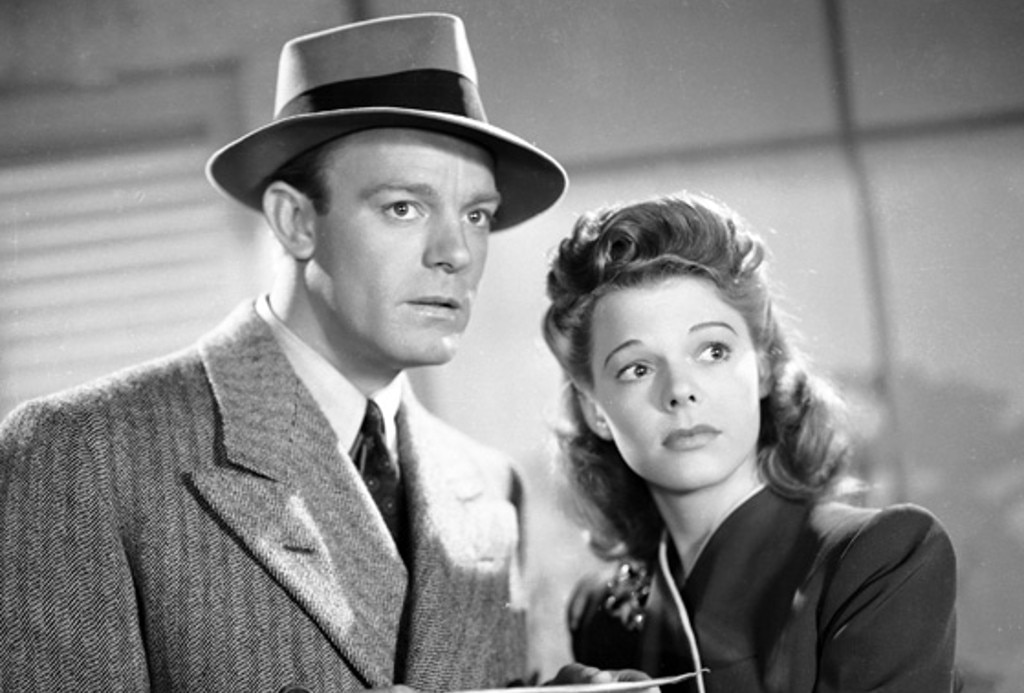
As Mrs. Danvers in Alfred Hitchcock's Rebecca (1940), Judith Anderson gave a stunning performance for which she was Oscar®-nominated and will always be remembered. Barely a year later, strangely enough, she accepted the title character in a low-budget RKO thriller called Lady Scarface (1941). It's about a female gangster on the loose in Chicago, committing robberies and murders, and the police detective (Dennis O'Keefe) hunting her down. O'Keefe is unaware that she is a woman, thus allowing her to move around freely without attracting attention.
Anderson was a leading Broadway star in the 1920s and 1930s and made her film debut in Blood Money (1933). Rebecca, seven years later, was her second picture, and she went on to act in several more classics such as Laura (1944), The Strange Love of Martha Ivers (1946) and The Furies (1950), usually in unsympathetic or sinister roles. Her first love was always the stage, however. She was a famous Lady Macbeth opposite Laurence Olivier in 1937 and Maurice Evans in 1941, and an even more famous Medea in 1947, for which she won the Tony Award. In 1960 she was named Dame Commander of the British Empire and thereafter known as Dame Judith Anderson.
She once said that she accepted the role of Lady Scarface in the hope that it would do for her what Little Caesar (1931) had done for Edward G. Robinson. While she is very watchable and displays ferocity and toughness quite effectively, the movie just isn't as good as that earlier classic - and Anderson isn't given much screen time for a title character. Ironically, she's the best thing about it. The critics tended to agree, with The New York Times writing, "An accomplished villainess, Miss Anderson is afforded precious little scope as a lady gangster." Variety called Anderson "at once excellent and pathetic. Her superior acting ability gives the role lots more authenticity and substance than it deserves, but to find this player [who is scheduled to play Lady Macbeth on the Broadway stage this fall] appearing in a bottom-of-the-alphabet actioner is a sad commentary on the status of both films and theatre."
Cinematographer Nicholas Musuraca had recently completed Stranger on the Third Floor (1940) and would soon shoot Cat People (1942), both visually striking films and typical of his first-class talent. He would soon become one of the most important film noir cinematographers. Director Frank Woodruff was an obscure director of ten films from 1940-1944. His first movie, Curtain Call (1940), was a possible influence on Mel Brooks's The Producers (1968). Lady Scarface is a partial remake of Wanted: Jane Turner (1936).
Producer: Cliff Reid
Director: Frank Woodruff
Screenplay: Arnaud d’Usseau, Richard Collins
Cinematography: Nicholas Musuraca
Film Editing: Harry Marker
Art Direction: Van Nest Polglase
Music: Dave Dreyer, Gene Rose, Paul Sawtell, Harry Tierney, Frank Tours, Roy Webb
Cast: Dennis O’Keefe (Lt. Bill Mason), Judith Anderson (Slade), Frances Neal (Ann Rogers), Mildred Coles (Mary Jordan Powell), Eric Blore (Mr. Hartford), Marc Lawrence (Lefty Landers).
BW-66m.
by Jeremy Arnold
Lady Scarface
by Jeremy Arnold | November 21, 2005
SIGN UP FOR OUR NEWSLETTERS

CONNECT WITH TCM