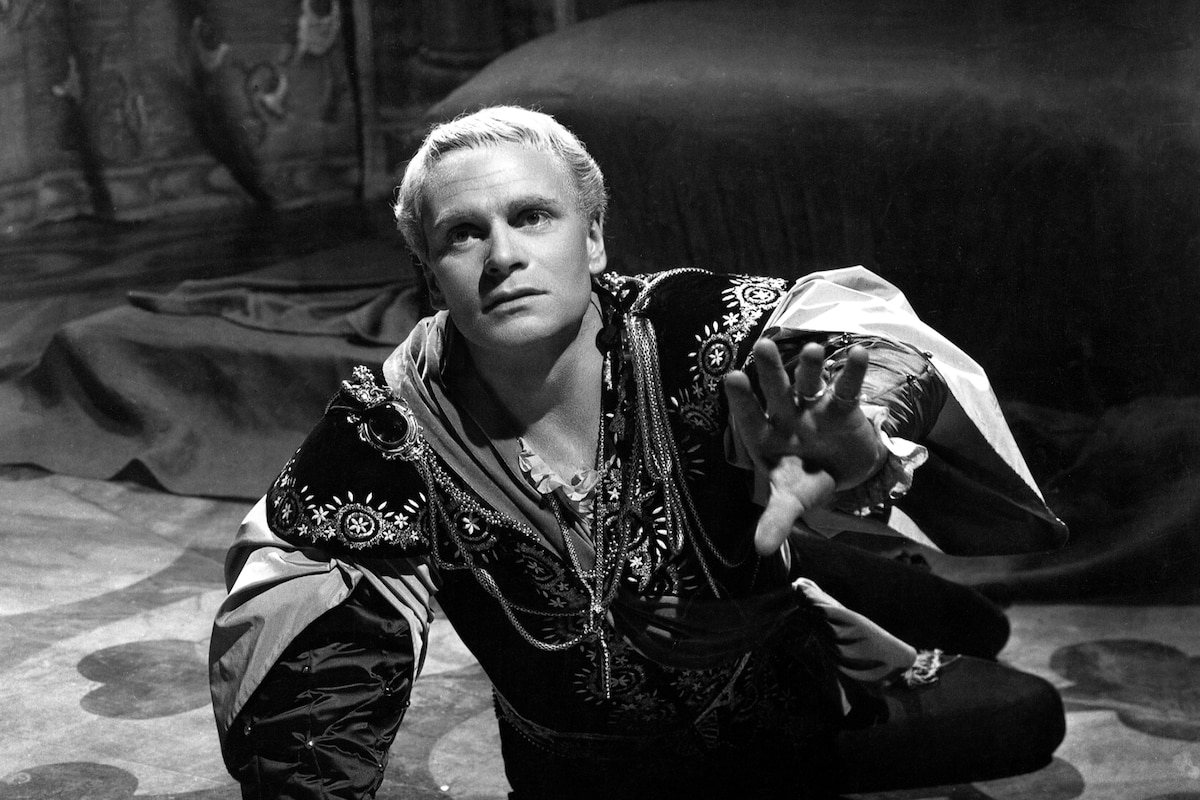
Today Hamlet, Prince of Denmark is usually regarded as Shakespeare's greatest play, both for its richness of language and its psychological and structural complexity. It is also his longest work, at over 3,900 lines; a performance of the full text takes approximately four hours. Clearly, the play presents unique challenges for adapting to film. Sir Laurence Olivier's 1948 version still stands out from the pack as a coherently conceived interpretation of Shakespeare and as a work of cinema.
Not surprisingly, Shakespeare adaptations in general date back to the
earliest days of cinema, and Hamlet is no exception. The
legendary Sarah Bernhardt, who flouted gender boundaries to play the
role of Hamlet on the stage, appeared in an 1899 experimental short depicting Hamlet's climactic duel. The Italian director Mario Caserini, best known for the spectacle The Last Days of Pompeii (1913), directed another version in 1910, and in 1913 the British film pioneer Cecil Hepworth produced a version staring Sir Johnston Forbes-Robertson in the title role. During the sound era, perhaps due to the demands that the spoken text places on both actors and audience, no one attempted a full-scale, English-language feature film of the play before Olivier, though a British television version was broadcast in 1947. Interestingly enough, the first substantial sound adaptation was an Urdu-language production from India, entitled Khoon Ka Khoon (1935), directed by and starring Sohrab Modi, who had previously written and staged his own Urdu translation to great acclaim.
Laurence Olivier's first stage appearance as Hamlet ran in January and February of 1937 at the Old Vic Theatre under the direction of the famed
theatrical director Tyrone Guthrie. Olivier recreated the role later that summer for a series of special performances at Kronborg Castle in Elsinore (Helsingor), Denmark. It was Olivier's first performance at the Old Vic, and as Terry Coleman points out in his authoritative biography, it reflected his ambition to establish himself as a truly great actor. Olivier distinguished himself for his natural approach to reading Shakespeare's lines rather than declaiming them as verse, which his older rival John Gielgud did to admittedly great effect.
Influenced by the writings of Professor Ernest Jones, Olivier and
Guthrie also took an explicitly Freudian interpretation of the play,
portraying Hamlet as driven by a quasi-incestuous love for his
mother--a notion Olivier clearly repeats in the film. Eileen Herlie,
the actress who plays Gertrude, was in fact more than ten years
younger than Oliver, and they appear very nearly the same age on
screen. One of the most interesting interpretive touches is how Gertrude knowingly drinks from the poisoned cup, her act thus representing a kind of self-sacrifice for her son.
However, Olivier was not content to make a mere filmed play, but
rather conceived the film in overtly cinematic terms. The austere
design of the castle set, the winding camerawork and the low-key,
almost Expressionist lighting all contribute to the image of the
castle as a mental labyrinth. Of particular note is Desmond
Dickinson's deep focus cinematography, evidently inspired by
Citizen Kane (1941). In terms of integration between camerawork
and staging of the actors, perhaps the most effective scene is that
depicting the reaction of Claudius to the play-within-the-play "The
Murder of Gonzago"; here the camera winds about the room, gradually
revealing the reactions of different members of the court and
constantly creating new foreground/background juxtapositions between various groups of actors. Olivier also uses the film medium to achieve dramatic effects that are not possible on the stage; for example, during the famed "To be or not to be" soliloquy Hamlet shifts back and forth between speaking the lines onscreen and thinking them in his head via voiceover commentary, to startling effect.
The most controversial aspect of the film has always been its
extensive cuts--about half the play's text. Not only did Olivier
and his scriptwriter Alan Dent excise characters such as Fortinbras,
Rosencrantz and Guildenstern, but they removed entire soliloquies,
reduced other speeches to a bare line or two, and even shuffled the
order of certain scenes; for example, the scene in which Claudius and
Laertes plot Hamlet's death was moved to follow the scene in the
graveyard. However, at nearly 160 minutes Olivier's Hamlet is
still longer than most other versions that followed it. In fact, the full text of the play was not used in a film until Kenneth Branagh's 1996
version, which ran at four hours. While that film was generally well
received, some critics felt that Branagh's version, shot in 70mm with
lavish sets and an all-star cast, finally collapsed under the weight
of its own spectacle.
In his review for Time, James Agee praised Olivier for
balancing the demands of "screen, stage and literature" and praised
his performance of Hamlet in particular. While admitting that some viewers would likely be upset by Olivier's "liberties with the text," Milton Schulman of the Evening Standard expressed high praise for
Olivier's interpretation of the role: "Laurence Olivier leaves no
doubt that he is one of our greatest living actors. His rich, moving
voice, his expressive face, make of the tortured Dane a figure of deep
and sincere tragedy." The film ultimately won four Academy Awards:
Best Picture, Best Actor (Olivier), Best Black and White Art Direction
(Roger Furse and Carmen Dillon), and Best Black and White Costume
Design (Roger Furse). It also received nominations for Best Supporting
Actress (Jean Simmons), Best Score (William Walton) and Best Director
(Olivier).
Director: Laurence Olivier
Script: Alan Dent [and Laurence Olivier], adapted from the play by
William Shakespeare
Photography: Desmond Dickinson
Editor: Helga Cranston
Music: William Walton
Production Design: Roger Furse
Art Direction: Carmen Dillon
Costumes: Elizabeth Hennings, Roger Furse
Cast: Laurence Olivier (Hamlet); Eileen Herlie (Queen
Gertrude); Basil Sydney (King Claudius); Jean Simmons (Ophelia);
Norman Wooland (Horatio); Felix Aylmer (Polonius); Terence Morgan
(Laertes); Peter Cushing (Osric); Stanley Holloway (Gravedigger); John
Laurie (Francisco); Esmond Knight (Bernardo); Anthony Quayle
(Marcellus); Niall MacGinnis (Captain); Harcourt Williams (Player);
Russell Thorndike (Priest); Patrick Troughton (Player King); Tony
Tarver (Player Queen); John Gielgud (Voice of the Ghost).
BW-155m.
by James Steffen
Hamlet (1948)
by James Steffen | November 23, 2005
SIGN UP FOR OUR NEWSLETTERS

CONNECT WITH TCM