It's a truism that history is written by victors and conquerors, not by the defeated and vanquished. But complications arise when historians can't easily divide their subjects into neat categories with friends, allies, and forces of good lined up on one side and rivals, enemies, and forces of evil lined up on the other.
That problem confronted the great Hollywood director Frank Capra when he supervised the government-sponsored documentary series Why We Fight, designed to assure Americans that winning World War II was worth all the sacrifices it entailed. Soldiers and civilians of the Soviet Union were contributing mightily to the Allied effort, so the dark activities engineered by dictator Joseph Stalin before the war had to be swept under the rug in what was essentially a pro-America propaganda film made for compulsory viewing by the United States military.
Capra launched Why We Fight in 1942 with Prelude to War, portraying the conflict as a duel to the death between democratic freedom and totalitarian slavery, and concluded it in 1945 with War Comes to America, encouraging Americans to remain vigilant against threats to liberty on their own soil and around the globe. With the war still raging as the documentaries were made, the filmmakers had to think and work quickly, adjusting facts and fine-tuning explanations to serve the pro-American cause most effectively.
Special challenges came in the fifth and longest of the seven films, The Battle of Russia, which took no fewer than six writers - not including Adolf Hitler, whose screed Mein Kampf is quoted - to plan and execute. It reached the screen in November 1943, when its strongly pro-Soviet message was less surprising than it would seem during the cold war that commenced a few years later. The film works energetically to praise the courage of the Russian people, salute the tenacity of the Soviet leaders, empathize with the miseries the nation is undergoing, and emphasize that the worst finally appears to be over. And all this without bringing up Karl Marx or Communism even once.
Like all of the Why We Fight documentaries, The Battle of Russia is a virtuoso exercise in found-footage cinema, editing a wide array of preexisting material into a forceful, if manipulative, compilation. A printed text lays out the groundwork at the beginning, stating that both the "thirst for power that animates our enemies" and the "indomitable will for freedom of our allies" come from the "historic traditions" of the cultures involved. To understand the clashes between these traditions, the text continues, "we must know and understand the past," and therefore "the film you are about to see [makes] free use...of motion pictures that illustrate this historical background," along with other material "obtained from newsreels, United Nations' films and...enemy material," plus maps and diagrams prepared by the War Department of the US government.
A great deal of the footage in The Battle of Russia comes from on-the-spot camerawork by combat photographers, supported by graphics made on commission by the Walt Disney studio. True to the film's opening text, long-past historical events aren't just described by the narrator - the popular movie actor Walter Huston and the fine writer and producer Anthony Veiller lend their voices to the Why We Fight films - but are further enlivened by vivid shots from such appropriate Soviet productions as Sergei Eisenstein's Alexander Nevsky (1938), showing helmeted Teutonic knights trying and failing to conquer Russia in the twelfth century, and Vladimir Petrov's Peter the First (1937), showing Swedish forces doing the same about 450 years later. The Battle of Russia makes an excellent case for Eisenstein's hugely influential theory of montage, building a broad intellectual argument - the overt cruelty, callousness, and ruthlessness of the German aggressors must ultimately lose to the underlying strength, bravery, and virtue of the Russian populace - from the shot-to-shot accumulation of images thrown across the screen at a machine-gun pace matching the rapid-fire intensity of the events themselves.
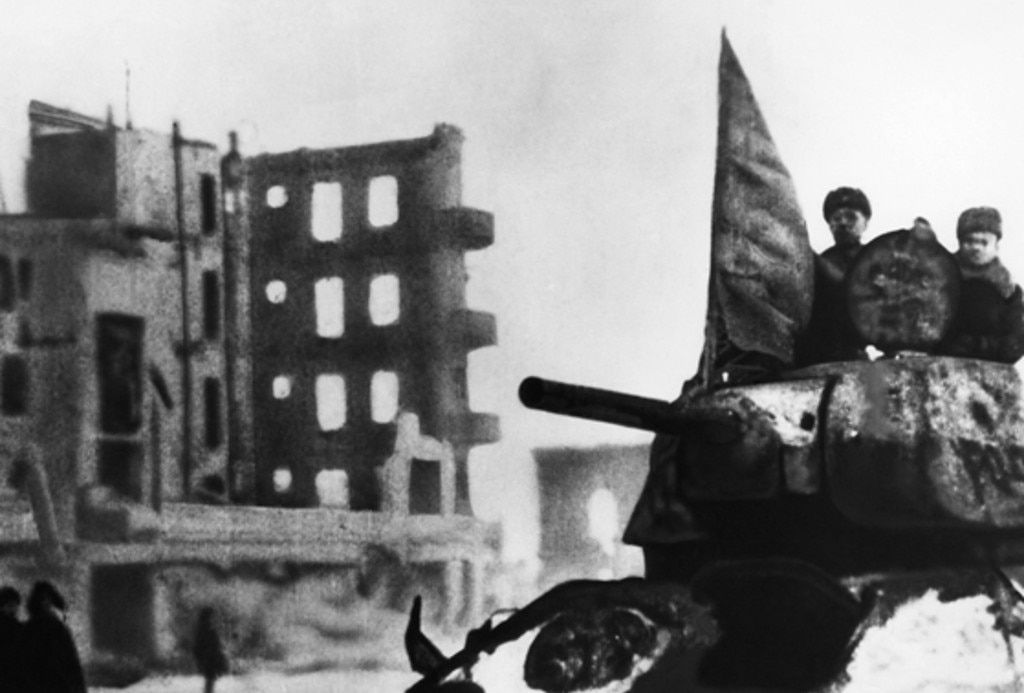
The Battle of Russia cites Leo Tolstoy's towering 1869 novel War and Peace, but it doesn't partake of Tolstoy's view that the outcome of an armed struggle is more likely to be a matter of happenstance and luck than the result of crafty organizing by generals and strategists. The film's maps show the spheres of Axis power as menacing black stains with well-defined borders, crossed by animated lines and arrows marking troop movements and battle plans with didactic precision. These graphics provide rudimentary information about major clashes and the tactics behind them - German invasions in the Baltics, the Siege of Leningrad, the Battle of Stalingrad, and more - without conveying much of the overwhelming chaos, profound confusion, and sheer madness that surely surrounded almost every move.
Seen today, The Battle of Russia is most notable for its nonstop cheerleading on behalf of the Soviets, always referred to as Russians even though their nation is correctly identified as the Union of Soviet Socialist Republics in an early sequence. The purges, invasions, annexations, induced famines, and other malignancies perpetrated by Joseph Stalin go unmentioned, as do the long history of Russian anti-Semitism and the Nazi-Soviet nonaggression agreement signed in 1939. According to documentary historian Erik Barnouw, the film was shown widely in the USSR on Stalin's orders.
It is incontestably true, however, that the torments inflicted on the Soviets were unimaginably vast, with some 20 million military and civilian casualties over the course of the war. And the film is right to acclaim their country for its varied and extensive territory - the sun never sets on the USSR, the voiceover reminds us - as well as its lavish natural resources, far-reaching cultural heritage, and sweeping ethnic diversity, all of which made it a tempting target for belligerent foes hoping to acquire those riches for themselves. The movie backs up its enthusiasm with quotations from American leaders of the period, such as General Douglas MacArthur, who said that "the scale and grandeur of the [Soviet] effort mark it as the greatest military achievement in all history," and Secretary of the Navy Frank Knox, who stated that Americans and their allies "owe and acknowledge an everlasting debt of gratitude to the armies and people of the Soviet Union."
The gratitude turned out to be less than everlasting. By 1947 the cold war was in full flower, filling many in the West with paranoid fear of horrors - merciless ideological domination, cataclysmic nuclear holocaust - that might pounce from behind the Iron Curtain at any moment. Russian and Soviet glories are justly celebrated in The Battle of Russia, from the heroism of the scorched-earth policy, whereby Soviet people destroyed their own precious resources rather than surrender them, to the priceless creations of Peter Ilyich Tchaikovsky and Dmitri Shostakovich, whose music swells often on the soundtrack. The film isn't first-rate history, but it's a fitting tribute to Russian and Soviet culture and a worthwhile antidote to the black-and-white worldviews of the cold-war era.
Directors: Anatole Litvak, Frank Capra
Producers: War Department, Army Service Forces Special Service Division, in cooperation with the Army Signal Corps
Screenplay: Julius J. Epstein, Philip G. Epstein, Robert Heller, Anatole Litvak, John Sanford, Anthony Veiller
Cinematographer: Robert Flaherty
Film Editing: William Hornbeck
Music: Dimitri Tiomkin, Army Air Forces Orchestra
With: Anthony Veiller, Walter Huston
BW-83m.
by David Sterritt
The Battle of Russia
by David Sterritt | August 17, 2015
SIGN UP FOR OUR NEWSLETTERS

CONNECT WITH TCM