"Skeletons in closets always speak loudest to police."
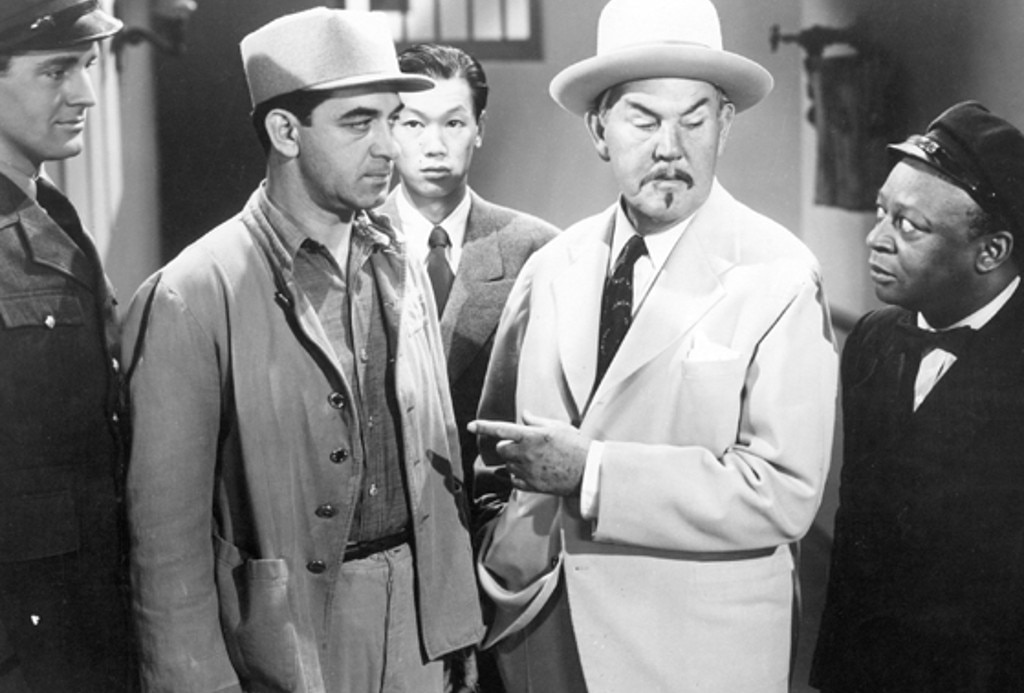
Sidney Toler in Dark Alibi
From 1931 until 1949, the unflappable Asian sleuth Charlie Chan solved crimes in a series of 44 films that started at Fox and then moved to Monogram. Although, like most series films, the pictures were produced on relatively low budgets, the Chan pictures moved quickly, usually wrapping up their amazingly complicated mysteries in just over an hour. The films have become controversial in recent years because of their perpetuation of racist stereotypes in their depiction of the subservient Chan, his bumbling sons and his cowardly black chauffeur. Yet the series also has its defenders, who point out that Chan's expertise far outshines that of the white police officers working alongside him (and sometimes getting in his way). More telling is the fact that, although Chan's offspring were always played by Asian-American actors, the leading man was always portrayed by a white actor in stereotypical makeup.
For the series' 35th entry, a young woman enlists Chan (Sidney Toler) to prove that her ex-convict father was framed for bank robbery and murder, even though the police have his fingerprints at the crime scene. The investigation takes Chan, number three son Lee (Benson Fong) and chauffeur Birmingham Brown (Mantan Moreland) to the man's prison (one of the working titles was Charlie Chan in Alcatraz) to investigate a complicated criminal band that reaches into the ex-convict's personal life.
Novelist Earl Derr Biggers created Chan in 1925 in an attempt to counter the then-popular stereotype of Asian men as super-villains, like Fu Manchu. Sadly, the character would usher in another stereotype, the sexless Asian man with a submissive attitude and only a cursory knowledge of the English language. The first screen interpretations featured Asian actors, though in those early films Chan was treated as a supporting player. In the third film to feature the character, Fox's Behind That Curtain (1929), he doesn't even show up until the film's final ten minutes. In 1931, however, the studio cast Warner Oland, a white actor who claimed he had Mongolian ancestors, in Charlie Chan Carries On, the first of the official Charlie Chan series. They would cast Oland in 15 films, some of them notable for showcasing rising stars like Rita Hayworth, Robert Young, Ray Milland, George Brent and Leon Ames. When Oland died in 1938, the role went to Toler, another Caucasian actor. The early Chan films were big hits for Fox, helping it survive the diminished film attendance of the Great Depression's early years. By the '40s, however, they weren't as prestigious, and the studio decided to cancel the series with 1942's Castle in the Desert. At that point, Toler did something unheard of for a featured player in Hollywood. He bought the film rights himself and then peddled them to Monogram. They produced Chan films for another five years, with Roland Winters taking over the role when Toler died in 1947.
With the 1935 Charlie Chan in Paris, the series introduced Chan's number one son, Lee, played by Keye Luke. Other sons would turn up played by Victor Sen Yung, Fong and Edwin Luke. He even had a daughter assist him in one film, played by the appropriately named Frances Chan. Monogram added another regular to the series in 1944's Charlie Chan in the Secret Service, casting Moreland as Chan's driver Birmingham Brown. Moreland's character would prove as controversial as Chan. In the '60s, his portrayal of Brown as a cowardly, uneducated servant was derided as a destructive stereotype. In more recent years, however, critics have reevaluated his work, suggesting that Moreland's skills at playing comedy made the role seem more subversive, as if the actor were taking an ironic attitude toward the character.
The Secret Clue (1945), Monogram took advantage of Moreland's vaudeville background. Both films cast him with Ben Carter, his straight man in a comedy act back when they toured the vaudeville circuits. In fact, their three scenes together in this film draw heavily on their act. Also returning to the series was Russell Hicks, who had previously appeared in Charlie Chan in Shanghai (1935), as the warden, while Tim Ryan (Foggy) would return as a different character in Shanghai Chest, The Golden Eye (both 1948) and the series' final film, The Sky Dragon (1949).
Low-budget films often gave promising young directors a chance to break into feature filmmaking, with Fred Zinnemann cutting his teeth on MGM's Kid Glove Killer (1942) and William Castle directing for such Columbia film series as The Whistler and The Crime Doctor. Dark Alibi was the second of two Chan films helmed by Phil Karlson (the other was 1945's The Shanghai Cobra), who would become a darling of the auteur critics with his work on such '50s films noirs as 99 River Street (1953), The Phenix City Story (1955) and The Brothers Rico (1957). He got a shot at A pictures with 1960's Hell to Eternity, followed by such hits as Kid Galahad (1962), starring Elvis Presley, Ben (1972) and Walking Tall (1973), the latter shot on the locations in which his classic The Phenix City Story was set.
Director: Phil Karlson
Producer: James S. Burkett
Screenplay: George Callahan
Based on characters created by Earl Derr Biggers
Cinematography: William A. Sickner
Score: Edward J. Kay
Cast: Sidney Toler (Charlie Chan), Mantan Moreland (Birmingham Brown), Ben Carter (Benjamin Brown), Benson Fong (Tommy Chan), Teala Loring (June Harley), George Holmes (Hugh Kenzie), Joyce Compton (Emily Evans), Russell Hicks (Warden Cameron), Tim Ryan (Foggy)
By Frank Miller
Dark Alibi
by Frank Miller | August 05, 2015
SIGN UP FOR OUR NEWSLETTERS

CONNECT WITH TCM