Pat O'Brien was looking for a new career direction when he produced and starred in this 1944 wartime espionage thriller for Columbia Pictures. Working with his newly formed Torneen Productions, co-run by good friend Phil Ryan, he put together this taut story that capitalized on the fear of homeland sabotage. The studio even touted the picture with the line "DRAMA...by a handful of men and women who fight the enemy within our gates."
O'Brien turned to the short story "The Saboteurs," which brothers John and Ward Hawkins had published in the Saturday Evening Post. He then assigned scripting chores to Roy Chanslor, whose novels would inspire the films Johnny Guitar (1954) and Cat Ballou (1965). The two had worked together at Warner Bros., where O'Brien had starred in his script for The Final Edition (1932), then re-teamed at RKO for The Navy Comes Through (1942).
Chanslor's script casts O'Brien as Sam Gallagher, a reporter turned FBI agent who goes undercover to root out a Nazi sabotage ring at the shipyard where his estranged brother (Chester Morris) works. Although the enemy agents are the usual bloodthirsty lot, it's his brother who initially poses the greatest threat. First, he has a hard time believing O'Brien would want a job as a grunt at the shipyard, then he sees through the family with which the FBI has set up O'Brien. Complicating matters are the women in their lives, Carole Landis as a female agent who, with two war orphans, poses as O'Brien's happy little nuclear family and Ruth Warrick as an old flame of O'Brien's now involved with his brother.
For director, O'Brien turned to another man he'd worked with previously, A. Edward Sutherland. The British-born director had started as an actor and even served as one of the original Keystone Kops. Little wonder he was best known for his comedies, directing Laurel and Hardy in The Flying Deuces (1939), Mae West in Every Day's a Holiday (1937) and W.C. Fields in International House (1933), Mississippi (1935) and Poppy (1936). He also was adept at action and had worked with O'Brien and Chanslor on The Navy Comes Through.
Producing was a big step for O'Brien, who had never worked in that area before. Following seven years at Warner Bros., -- where his stage training made him a perfect match for the studio's fast-paced style, particularly in film's co-starring his good friend James Cagney -- O'Brien had struck out on his own after starring in Knute Rockne All American (1940). He continued playing leading roles, but at low-rent studios like RKO and Columbia. Producing could give him greater control over his career and a chance to share in the profits his name still generated.
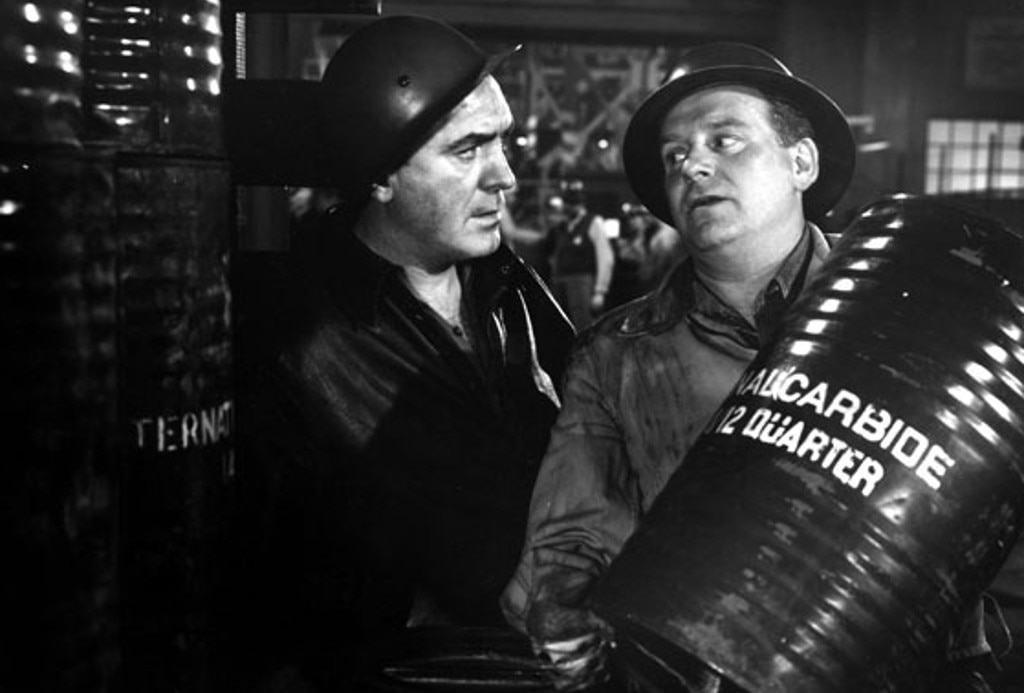
For his first venture, he worked with a strong cast, including Morris, Landis, Warrick and veteran character actors like Wallace Ford, Barton MacLane and Tom Tully. To give the film an air of authenticity, they shot some background footage at the Calship Shipyards on Los Angeles' Terminal Island, which produced 467 ships for the Navy during World War II. All of that was appreciated by Variety, whose critic called it a "lusty melodrama of counter-espionage around a large shipyard, with expert blending of action and suspense with spontaneous good humor resulting in solid entertainment." Bosley Crowther of The New York Times was less enthusiastic, suggesting that "the performances are not shaded with nuances" and concluding that the whole thing "is as subtle as a right to the jaw."
This would prove the sole producing effort for O'Brien. His friend and co-producer, Ryan, would stay in that line long enough to create two other O'Brien vehicles, the crime drama Perilous Holiday (1946), which co-starred Warrick in another script by Chanslor, and the biographical crime drama Fighting Father Dunne (1948).
Director: A. Edward Sutherland
Producer: Pat O'Brien, Phil L. Ryan
Screenplay: Roy Chanslor
Based on the story "The Saboteurs" by John Hawkins and Ward Hawkins
Cinematography: Franz Planer
Score: Paul Sawtell
Cast: Pat O'Brien (Sam Gallagher), Carole Landis (Jill McGann), Chester Morris (Jeff Gallagher), Ruth Warrick (Lea Damaron), Barton MacLane (Red Kelly), Tom Tully (Brownie Brownell), Wallace Ford (Miller), Ray Teal (Shipyard Worker)
By Frank Miller
Secret Command
by Frank Miller | August 05, 2015
SIGN UP FOR OUR NEWSLETTERS

CONNECT WITH TCM