Director John Huston had only three feature films under his belt (The Maltese Falcon, 1941; In This Our Life, 1942; Across the Pacific, 1942) when he filmed this color documentary as a captain in the U.S. Army Signal Corps. The footage was originally shot on 16mm Kodachrome stock over a period of about six months and enlarged to 35mm for theatrical release.
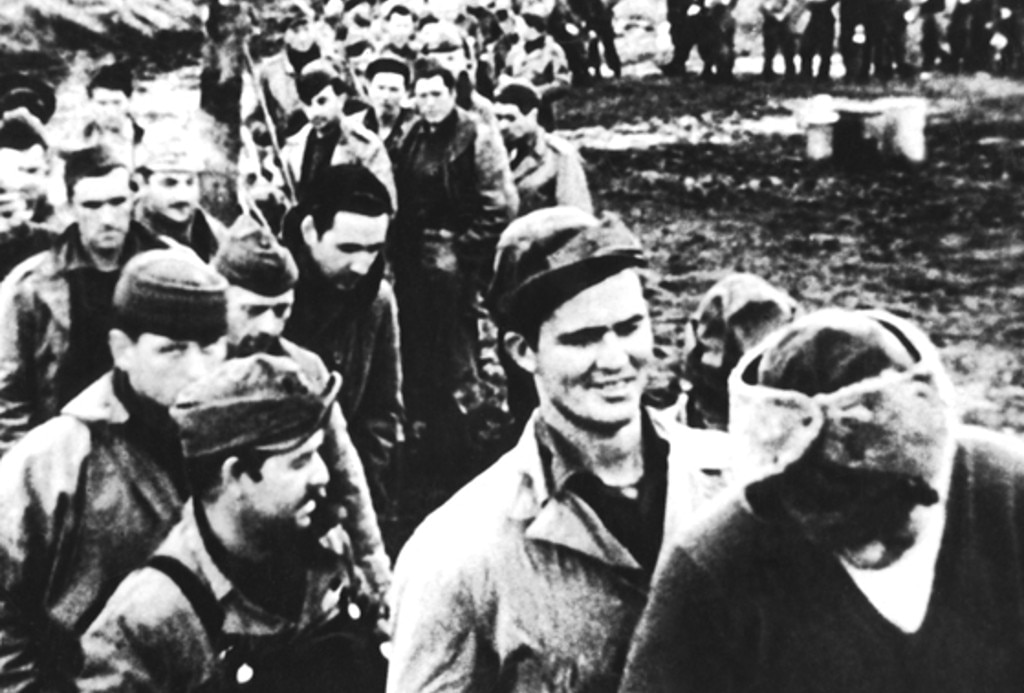
Report from the Aleutians is unlike most World War II combat documentaries in that it concentrates primarily on the day-to-day activities of servicemen and contains very little actual combat footage. The film focuses on sequences of the drudgery of base life (e.g., cleaning out latrines, eating in the mess halls) and the boredom soldiers feel. Huston had to wrangle with Army authorities to include the mundane scenes. It took a couple of months before he prevailed in his insistence that audiences back home needed to see the reality of a wartime soldier's life.
Nevertheless, much of what the troops engage in is vital work. Once a base was established on barren Adak Island in the Aleutians, the treeless, soaked tundra had to be cleared and a prefabricated steel runway laid down in 36 hours to prepare for bombing missions over Japanese positions in the area.
Nearly half of the film is devoted to one of these missions, an almost two-hour flight to a Japanese stronghold at Kiska at the far end of the Aleutians, giving the film its brief spate of action as the mission drops several loads of bombs on the enemy and tail gunners exchange fire.
The film opens with a map showing the location of this particular part of the Pacific campaign. As Huston's father and co-narrator Walter Huston explains, the Aleutian Islands are a chain that extends about 1,200 miles west-southwest of the Alaskan peninsula towards Siberia, forming the southern boundary of the Bering Sea. He details how the Japanese took advantage of the frequently moving curtain of storms over the region to land troops on the undefended island of Kiska.
According to an article in the New York Times on August 8, 1943, cameraman Rey Scott received a medal for making nine flights over Kiska. Huston twice came close to being killed--once when his plane crash-landed and once when a 20mm shell from an attacking enemy plane hit his plane, killing the waist gunner standing near him.
The film was nominated for a Best Documentary Feature Academy Award.
The working title was "Alaska--1942"; it was also identified by the Army as "Army Air Forces Training Film AF-114." The film begins with the written foreword: "Since the filming of this picture American troops have taken and are holding additional island objectives in their march out along the bridge to Asia." SPOILER ALERT: The Japanese lose the war.
Director: John Huston
Writer: John Huston
Screenplay: John Huston
Camera Operators: Jules Buck, Freeman C. Collins, Herman Crabtree, Buzz Ellsworth, Rey Scott
Editing: John Huston
Music: Dimitri Tiomkin
Cast: John Huston, Walter Huston (narrators), Maj. Milton Ashkin, Lt. Lyle Bean, Col. Jack Chennault, Lt. Hawley P. Nill, Lt. George I. Radell, Lt. Henry J. Strenkowski (USAAF Fighter Pilots), Col. C.M. McCorkle, Col. William Prince (USAAF Commanders)
By Rob Nixon
Report from the Aleutians
by Rob Nixon | July 22, 2015
SIGN UP FOR OUR NEWSLETTERS

CONNECT WITH TCM