By the time he played the villainous Prince Ghul in this 1938 epic set in India, Raymond Massey had already established a strong line of evil characters and a good working relationship with the Kordas, Hungarian-born brothers Alexander, who produced and directed, Zoltan, who mostly directed, and Vincent, one of the screen's great art directors. For their London Films, he had played Citizen Chauvelin, out to catch The Scarlet Pimpernel (1934) and Philip II of Spain in Fire Over England (1937). On a more benign note, they cast him as the scientists John Cabal and his grandson Oswald in the visionary science-fiction epic Things to Come (1936). That was more than balanced, however, by his work for producer David O. Selznick as Black Michael in The Count of Monte Cristo (1937).
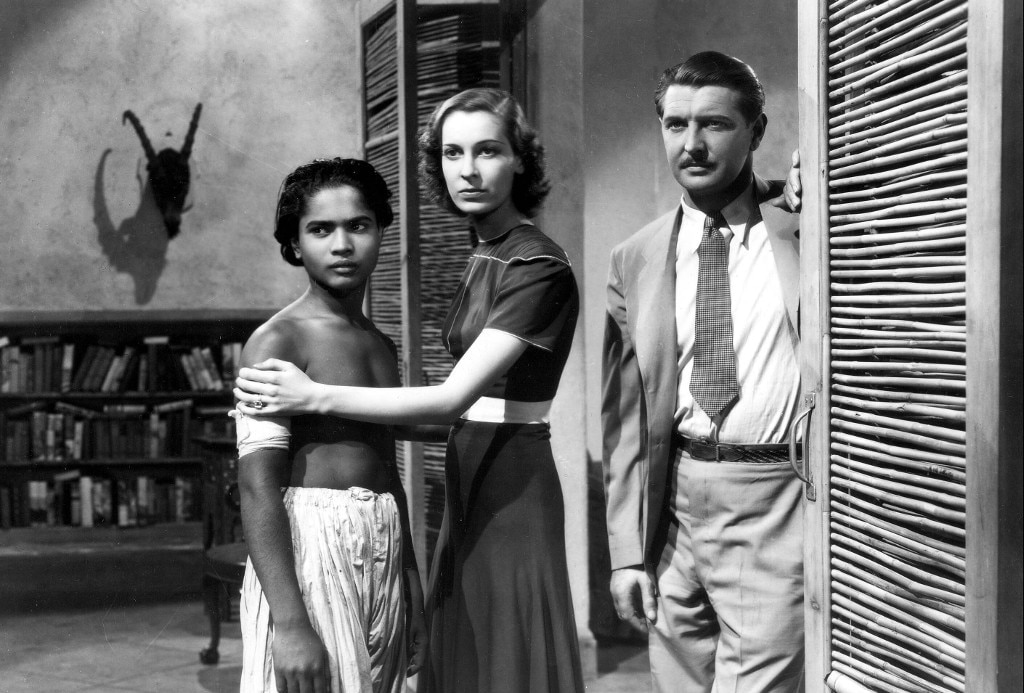
In The Drum, Massey is second-billed as a rebel leader so determined to get the British out of India he kills his brother, the Maharajah of the fictional border land of Tokut, and tries to have his young nephew, Prince Azim (Sabu), assassinated. He also feigns friendship with the British in hopes of luring them into a trap. All of this is opposed by Sabu, who has bonded with the British colonial forces, particularly Captain Carruthers (Roger Livesey), his wife (Valerie Hobson) and a feisty young drummer boy (Desmond Tester), who teaches him how to play the instrument.
Although Massey's role is reminiscent of Scar in The Lion King (1994), in many ways the role would seem more sympathetic to contemporary sensibilities, which would side with the Indian rebels determined to drive out their British colonizers. The Drum, however, was made in a very different era. It is the second of a trilogy of 1930s pictures from London Films dealing with the British Empire. Although not conceived by the Kordas as such, later critics would dub this film, Sanders of the River (1935) and The Four Feathers (1939) "The Empire Trilogy." All three are very much the product of British colonial myths, which were also central to the novels of writer A.E.W. Mason, including The Drum and The Four Feathers. In The Drum, the good Indians work with the occupying British forces while the evil ones are fighting for independence. In addition, Sabu was one of the few Indian actors in the film, with other roles played by Western actors like Massey wearing brown face. By the 1930s, many of those colonial attitudes were already considered outdated, though it would be another decade before Great Britain would relinquish its colonial hold on India.
London Films had introduced Sabu, the son of an Indian elephant driver, a year earlier in Elephant Boy (1937). After the film's international success, the Kordas signed him to a long-term contract and began looking for another vehicle for him. Originally, they wanted to put him in a film to be directed by Michael Powell, but plans were going nowhere when Mason submitted a detailed synopsis for what would become The Drum. Mason published the novel in 1937, while London Films' chief scenarist, Lajos Biro, turned it into a screenplay.
The Drum was the first film to shoot scenes beyond the Khyber Pass in Afghanistan. Other locations included Chitral, Jammu and Kashmir in India, where temperatures usually rose to 130 degrees during the day. The company then moved to London Films studios in Buckinghamshire for interiors. Osmond Borradaile shot the Indian footage, with Georges Perinal taking over in the British Isles, both working in Technicolor. That was a pretty amazing accomplishment for a film shot in Southeast Asia at the time. The picture also featured massive crowd and battle scenes, prompting London Films to advertise it with the line "A Cast of 3,000." Director Zoltan Korda was not happy, however, when his brother tightened the purse strings. After the high cost of Elephant Boy, which was shot extensively on location, Alexander insisted more of the film be made in the British Isles. As a result, most of the mountain scenes were shot in Wales, with local extras, elephants borrowed from a circus and all the horses they could rent from the nearby stables.
The picture was originally released in the U.S. as Drums, though British, Australian and Danish audiences saw it with Mason's original title. It won strong reviews and box office in Western countries, but triggered protests in Bombay and Madras, where it was branded colonialist propaganda. Zoltan Korda shared some of those objections. In fact, he had lobbied his brother to present the Indian rebels more sympathetically. It would be more than a decade before he could film a more sympathetic portrayal of Third World peoples, when he got London Films to produce the first film version of Alan Paton's indictment of Apartheid, Cry, the Beloved Country (1951).
Director: Zoltan Korda
Producer: Alexander Korda
Screenplay: Lajos Biro, Arthur Wimperis, Patrick Kirwan, Hugh Gray
Based on the novel by A.E.W. Mason
Cinematography: Osmond Borradaile, Georges Perinal
Score: John Greenwood
Cast: Sabu (Prince Azim), Raymond Massey (Prince Ghul), Roger Livesey (Capt. Carruthers), Valerie Hobson (Mrs. Carruthers), David Tree (Lieut. Escott), Desmond Tester (Bill Holder), Francis L. Sullivan (Governor), Leo Genn (Abdul Fakir), Guy Rolfe (Bit)
By Frank Miller
The Drum
by Frank Miller | July 17, 2015
SIGN UP FOR OUR NEWSLETTERS

CONNECT WITH TCM