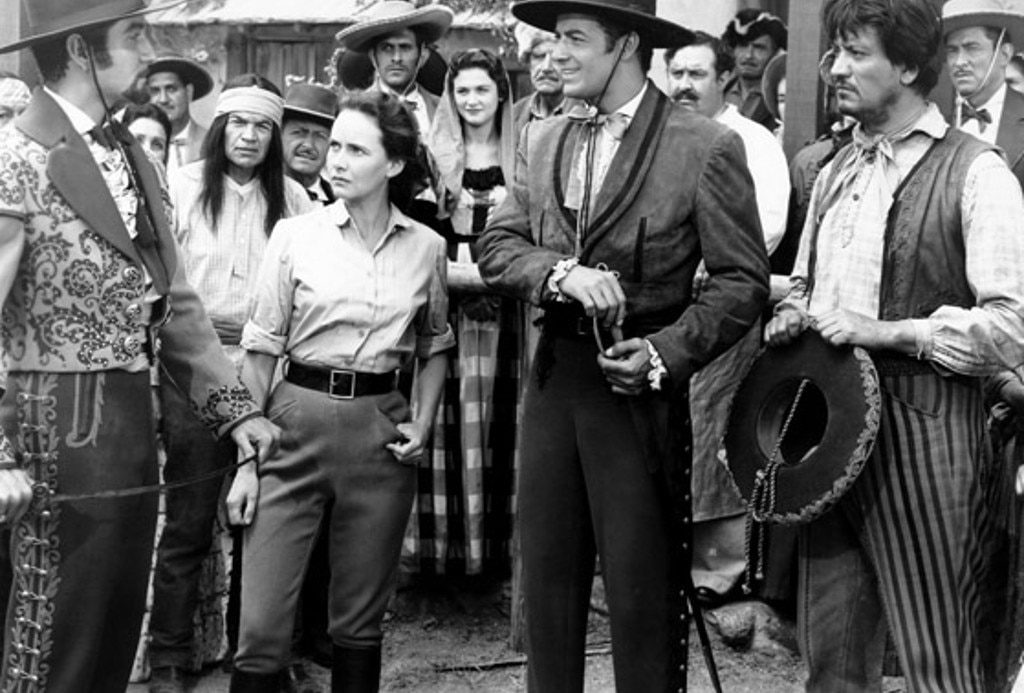
In California Conquest (1952), a western set in the 1830s, when California was still part of Mexico, the emphasis is on "conquest." As the opening narration informs us with remarkable efficiency, there's a popular movement to become an American territory but the French and the Russians are both vying for a piece of the new land and the Czar has established a foothold in Northern California. It is against this backdrop that Don Arturo Bordega, a son of Spanish nobility played with cocksure attitude and swashbuckling style by Cornel Wilde, commits himself to the American cause to turn old California into the "land of freedom," with the very capable and courageous American Julie Lawrence (Teresa Wright) at his side. "There's something in the wind," says Julie's father, a gunmaker in "la Reina de Los Angeles" (as the future metropolis is called under Mexican rule) who supports annexation by the U.S. When he's gunned down by bandits, Julie joins the fight.
The film was ostensibly based on "The Curse of Capistrano," the same story that Douglas Fairbanks turned into The Mark of Zorro (1920), but by the time the script reached the cameras the inspiration was limited to time and place. The film twisted history into pure fiction to transform the adventure into a fight against a Russian conspiracy to take over the state with the help of greedy landowners (led by John Dehner) and a bandit army led by the notorious outlaw José Martínez (Alfonso Bedoya). In the atmosphere of the Cold War and the looming threat of the blacklist, Hollywood was bending over backwards to prove its patriotism. The Variety reviewer noted the timely connection in his review, observing that the plot "purports to show that Russia had her eye on the rich land [of California] even back in those days...."
Columbia Pictures was the most frugal of the major studios and producer Sam Katzman specialized in cranking out inexpensive genre pictures, be they adventures, war pictures, crime movies, serials, or westerns. For California Conquest, Katzman had genuine A-list stars in the lead and a Technicolor palette, and he turned to veteran filmmaker Lew Landers to give the picture its excitement. It was Landers' fourteenth film for Katzman and he delivered swordfights, a runaway stagecoach, horseback chases and gun battles (with Mexican bandits taking the place of rampaging Indians), and even a little bullwhip action.
Reliable man of action Cornel Wilde was equally at home in urban crime dramas and muscular action pictures and swashbucklers. He'd already been Robin Hood, the son of D'Artagnan, and an arrogant trapeze superstar in Cecil B. DeMille's The Greatest Show on Earth (1952), when he took the lead as the gentleman adventurer with a flair for swordsmanship. According to The Hollywood Reporter, the studio originally considered Patricia Medina for the lead. Teresa Wright, who had earned Oscar nominations for her performances in The Little Foxes (1941) and The Pride of the Yankees (1942) and won for her supporting performance in Mrs. Miniver (1942), spends as much time in jeans and work shirts as she does in glamorous attire. It's only her second western but if there's a constant in her career, it is the strength of her characters and her commitment to her roles, and Julie is one tough customer: a committed businesswoman, a crack shot, and a hardy frontier veteran equally at home on the trail or undercover in a bandit camp.
The scene stealer of the film, however, is the Mexican character actor Alfonso Bedoya, who made his first impression on American screens in The Treasure of the Sierra Madre (1948) with the legendary line: "Badges? We ain't got no badges. We don't need no badges. I don't have to show you any stinking badges." After a career in Mexican films, he became a busy supporting player in Hollywood, playing everything from bandit villains to loyal sidekicks, and he had a flair for adding unexpected character touches to routine parts.
By Sean Axmaker
Sources:
AFI Catalogue of Feature Films
IMDb
California Conquest
by Sean Axmaker | July 17, 2015
SIGN UP FOR OUR NEWSLETTERS

CONNECT WITH TCM